
World Cancer Day 2026: Theme, Significance, India’s Cancer Burden, and Government Initiatives
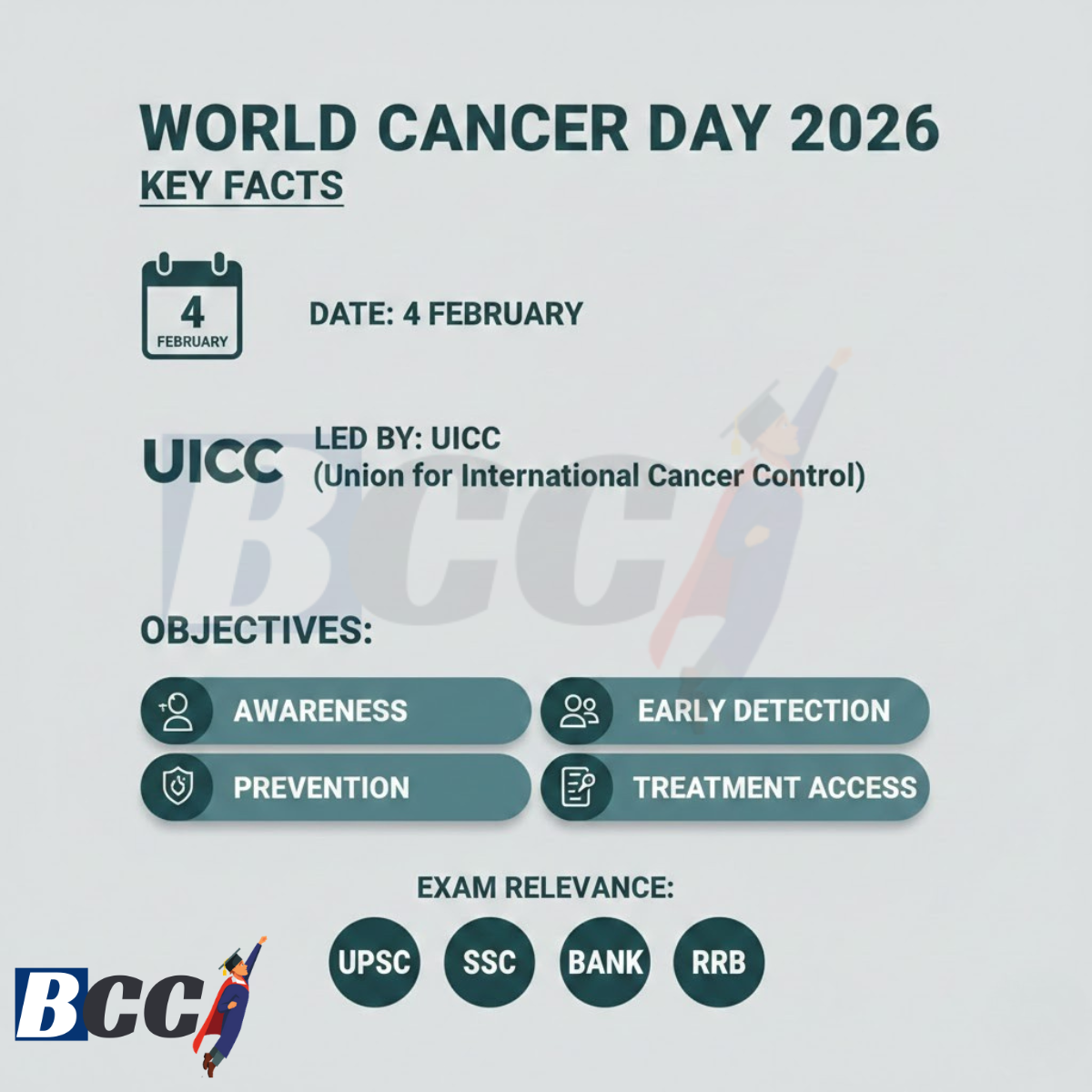
World Cancer Day is observed every year on 4 February to spread awareness about cancer prevention, early detection, and treatment. It is one of the most important global public health observances because cancer is now among the leading causes of death worldwide, including in India.
For competitive exams like UPSC, SSC, Banking, and RRB, World Cancer Day is important because it connects directly with:
- Public health
- Government schemes
- SDG targets
- Social sector issues
- India’s healthcare infrastructure
- Current affairs-based questions
This article explains the key facts, exam-relevant points, and India’s response to cancer in a structured way.
Why World Cancer Day Is Important (Exam Angle)
World Cancer Day is not just a health awareness event. It is also linked with:
- Global health governance
- National health policy
- Preventive healthcare
- Health financing
- Digital health and screening programmes
- Universal Health Coverage (UHC)
Competitive Exam Relevance
- UPSC GS-2: Health, governance, welfare schemes
- UPSC GS-3: Social issues, science & technology, policy challenges
- UPSC Essay: Public health, inequality, health system reforms
- SSC/RRB/Bank: Dates, themes, basic health facts, schemes
World Cancer Day 2026: Date and Key Facts
Observed On
4 February 2026
Global Body Associated
World Cancer Day is led by the Union for International Cancer Control (UICC).
Purpose
- Spread awareness
- Encourage early detection
- Promote healthy lifestyle
- Reduce stigma around cancer
- Support policy and community action
World Cancer Day 2026 Theme (What to Write in Exams)
World Cancer Day themes are designed for multi-year awareness campaigns. The theme generally focuses on:
- People-centred care
- Equality in cancer treatment
- Early detection and prevention
- Support systems for patients
How to Write a Theme in Exam Answers
Even if a specific slogan is not asked, you should focus on:
- Cancer prevention
- Early diagnosis
- Access to affordable treatment
- Public awareness
- Strengthening health systems
Exam Tip: If theme is asked, write it as:
“World Cancer Day focuses on improving awareness, early detection, and ensuring equitable cancer care for all.”
Cancer as a Global Health Challenge
Cancer is a non-communicable disease (NCD). It is caused by the uncontrolled growth of abnormal cells.
Why Cancer Is a Major Global Issue
- Increasing life expectancy
- Lifestyle changes
- Tobacco and alcohol consumption
- Poor diet and physical inactivity
- Environmental pollution
- Late diagnosis
India’s Cancer Burden: What Aspirants Must Know
India is facing a rising burden of cancer due to:
- Urbanisation and lifestyle changes
- Tobacco consumption
- Delayed diagnosis
- Limited screening in rural areas
- High out-of-pocket expenditure
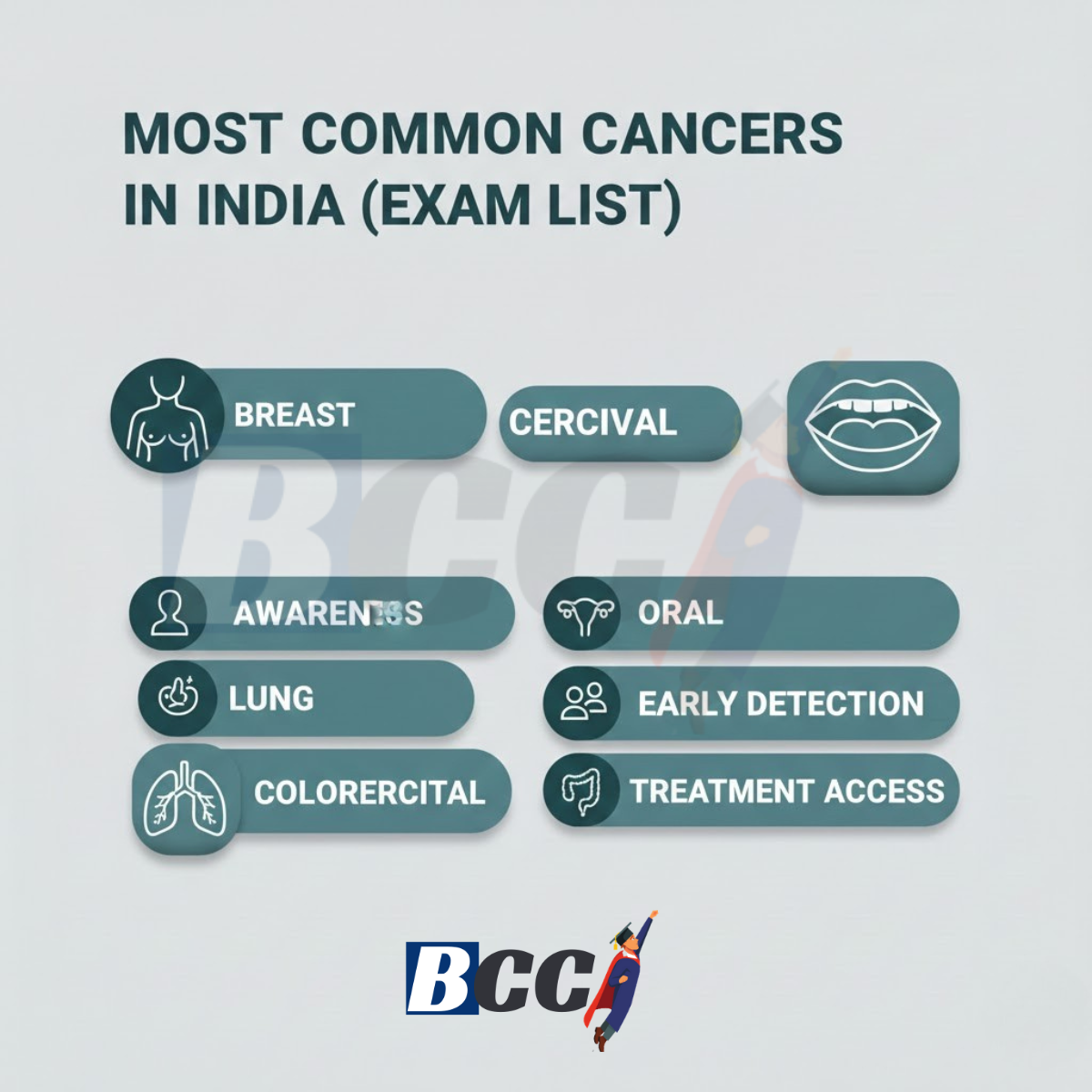
Major Cancer Types Common in India
- Breast cancer
- Cervical cancer
- Oral cancer
- Lung cancer
- Colorectal cancer
Key Concern for India
India’s cancer challenge is not only about treatment. It is mainly about early detection, affordability, and access.
Prevention: The Strongest Weapon Against Cancer
A large percentage of cancers can be prevented through lifestyle changes and early screening.
Preventable Risk Factors
- Tobacco (smoking + chewing)
- Alcohol
- Obesity
- Poor diet (high sugar, trans fats)
- Low physical activity
- HPV infection (cervical cancer)
- Air pollution and occupational exposure
Key Exam Point
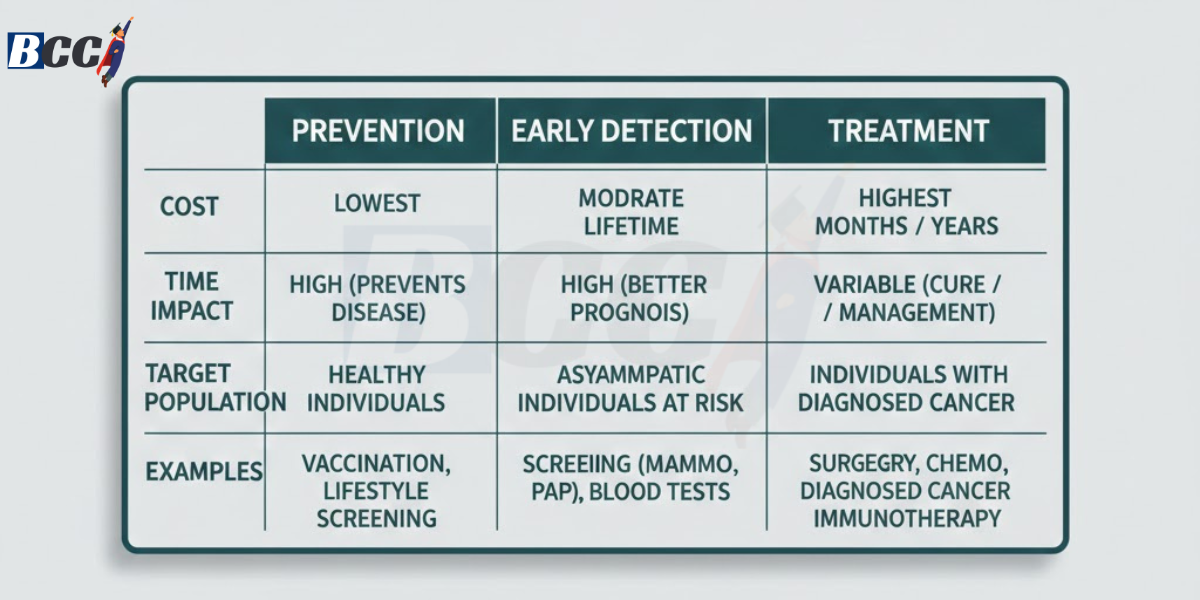
Cancer prevention is a cost-effective strategy compared to late-stage treatment.
Early Detection and Screening: Why It Matters
Cancer is often curable if detected early. However, in India:
- Many cases are detected in late stages
- Screening is not widespread
- Awareness is low in rural areas
Important Screenings
- Breast cancer: clinical screening, mammography
- Cervical cancer: Pap smear, HPV testing
- Oral cancer: regular oral examination
- Colon cancer: stool test, colonoscopy (less common in India)
Treatment Challenges in India (UPSC-Ready Points)
Even though medical technology has improved, India faces multiple structural challenges.
1. Unequal Access to Cancer Care
- Most advanced cancer hospitals are in cities
- Rural patients travel long distances
- Late-stage detection increases mortality
2. High Out-of-Pocket Expenditure
Cancer treatment is expensive due to:
- chemotherapy
- radiotherapy
- surgeries
- diagnostics
3. Shortage of Specialists
India faces a shortage of:
- oncologists
- radiologists
- trained nurses
- cancer counsellors
4. Stigma and Social Barriers
Many families hide cancer diagnosis due to:
- fear
- stigma
- misinformation
India’s Government Initiatives for Cancer Control (Most Important Section)
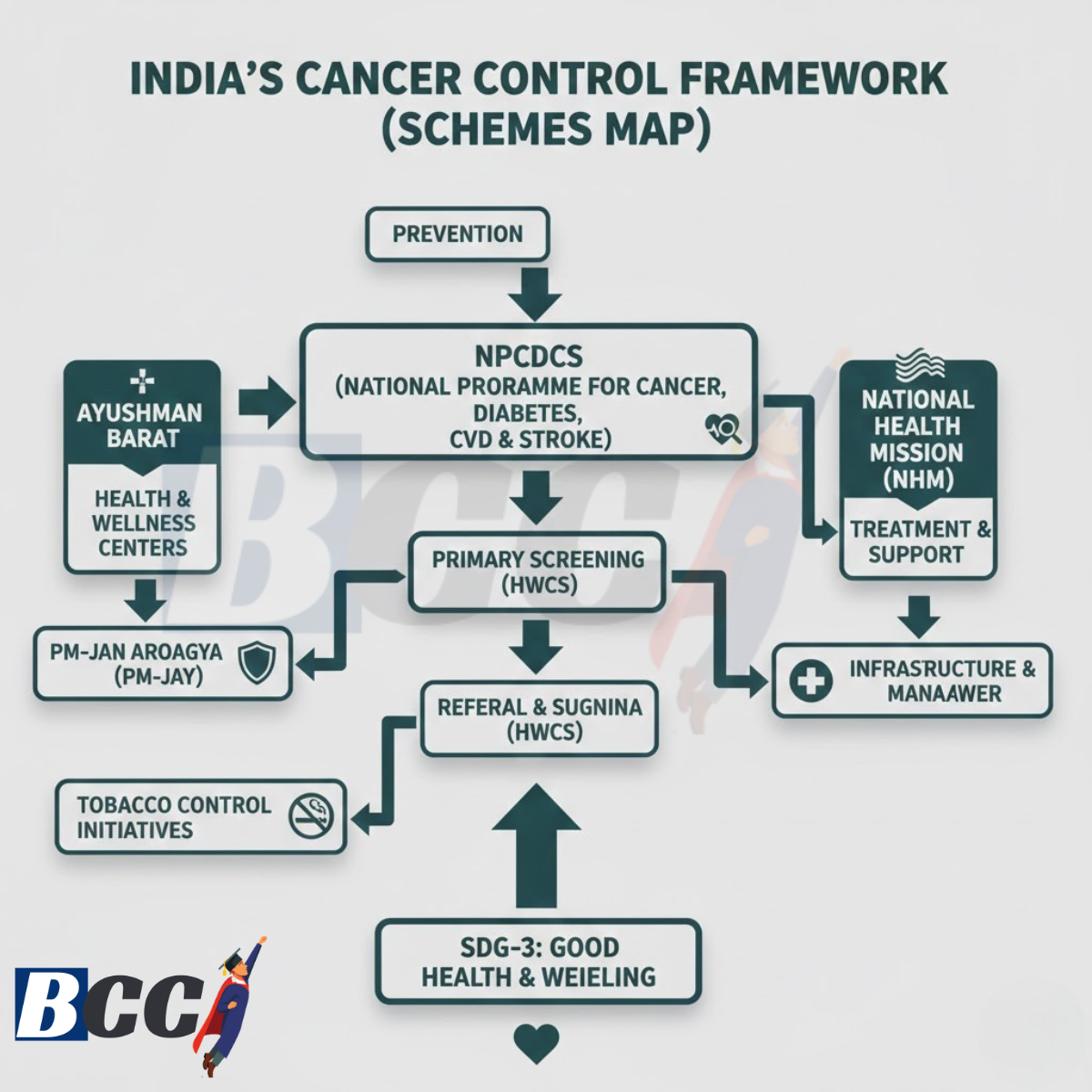
Cancer is covered under India’s broader NCD strategy.
1. National Programme for Prevention and Control of Cancer, Diabetes, Cardiovascular Diseases and Stroke (NPCDCS)
This is the key national programme for:
- NCD screening
- awareness campaigns
- early detection
- referral support
2. Ayushman Bharat – Health and Wellness Centres (HWCs)
HWCs focus on:
- preventive care
- screening for common NCDs
- health awareness
Cancer screening is part of comprehensive primary healthcare.
3. Ayushman Bharat – PM-JAY
PM-JAY supports poor families through:
- health insurance coverage
- hospitalisation support
- reduced out-of-pocket expenditure
4. National Health Mission (NHM)
NHM supports:
- health infrastructure strengthening
- district-level healthcare delivery
- awareness and outreach
5. Tobacco Control Measures
India’s tobacco control includes:
- Cigarettes and Other Tobacco Products Act (COTPA)
- warnings on tobacco products
- awareness campaigns
World Cancer Day 2026: Link with SDGs (Highly Exam-Relevant)
World Cancer Day connects directly with Sustainable Development Goals (SDGs).
Key SDG Link
- SDG 3: Good Health and Well-Being
- Target includes reducing premature mortality from NCDs
- Also linked with UHC (Universal Health Coverage)
UPSC Answer Value Addition
You can write:
“Cancer control supports SDG-3 targets, strengthens preventive healthcare, and reduces inequality in health access.”
What Makes World Cancer Day Important for UPSC Answers?
For UPSC mains, this topic helps in:
- Writing better GS-2 answers on health
- Adding value points in essays
- Connecting welfare schemes with outcomes
- Discussing health inequalities and reforms
Useful Keywords for UPSC Answers
- Preventive healthcare
- Screening and early detection
- Health infrastructure
- Universal Health Coverage (UHC)
- Out-of-pocket expenditure
- Primary healthcare strengthening
- Public-private partnerships (PPP)
Expected Exam Questions (UPSC + SSC + Bank + RRB)
Objective Type (SSC/Bank/RRB)
- World Cancer Day is observed on which date?
- Which body leads World Cancer Day globally?
- Name one government programme for cancer prevention.
UPSC Mains Style
- Discuss India’s cancer burden and the role of preventive healthcare.
- Explain the importance of early detection in reducing cancer mortality.
- Evaluate government initiatives for cancer screening at primary healthcare level.
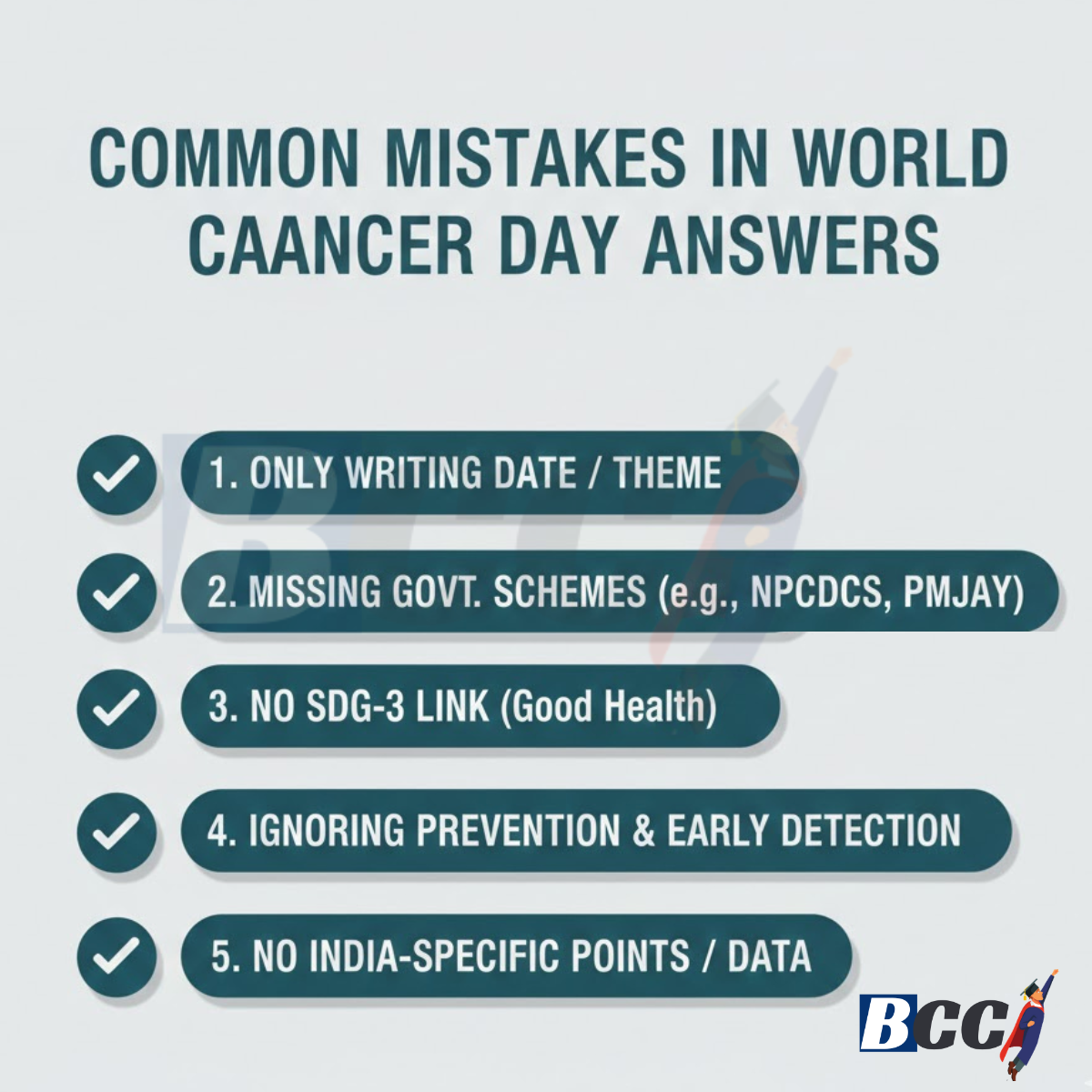
Common Mistakes Aspirants Make While Preparing This Topic
- Writing only the date and theme
- Ignoring India’s schemes
- Not linking with SDGs
- Missing prevention and screening angle
- Not using keywords like UHC, HWCs, NPCDCS
Conclusion: World Cancer Day 2026 as an Exam-Relevant Topic
World Cancer Day 2026 is a highly important topic for competitive exams because it combines:
- Health awareness
- Public policy
- Government schemes
- SDG targets
- Social issues like stigma and inequality
For exams, aspirants should remember:
- Date: 4 February
- UICC role
- India’s major cancer types
- Prevention + early detection
- Key government initiatives (NPCDCS, HWCs, PM-JAY)
- SDG 3 linkage
A well-structured answer on this topic can fetch high marks in both objective and descriptive exams.
FAQs
Q1. When is World Cancer Day observed?
World Cancer Day is observed every year on 4 February.
Q2. Which organisation leads World Cancer Day globally?
World Cancer Day is led by the Union for International Cancer Control (UICC).
Q3. Which cancers are most common in India?
Breast, cervical, oral, lung, and colorectal cancers are among the most common in India.
Q4. Which government programme covers cancer screening in India?
Cancer screening is supported under NPCDCS and also through Ayushman Bharat Health and Wellness Centres.
Q5. Why is early detection important in cancer control?
Early detection increases the chances of successful treatment and reduces mortality and treatment cost.