

Why Prelims Success Fails in UPSC Mains: What Most Aspirants Get Wrong
Every year, thousands of UPSC aspirants clear Prelims comfortably, yet fail to replicate the same success in Mains. This gap between Prelims performance and Mains results is not accidental. It reflects a structural flaw in preparation strategy, not a lack of intelligence or hard work.
This article explains why strong Prelims preparation often collapses in Mains, what aspirants misunderstand about the nature of UPSC stages, and how this gap can be systematically corrected.
Prelims and Mains Test Different Competencies
The most fundamental mistake aspirants make is assuming that knowledge is transferable in the same form across stages.
Prelims Tests:
- Recognition-based knowledge
- Objective elimination skills
- Breadth over depth
- Speed and accuracy
Mains Tests:
- Analytical ability
- Depth, structure, and coherence
- Interlinking of dimensions
- Expression under word limits
An aspirant may know the answer in Prelims but still fail to present it effectively in Mains.
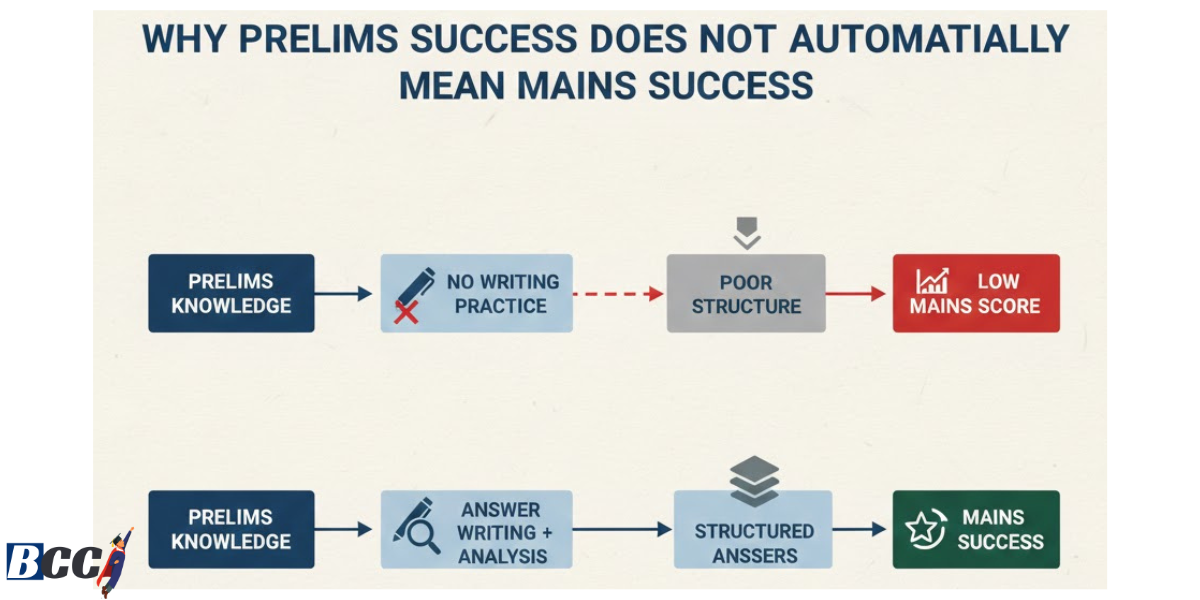
Mistake 1: Treating Knowledge as the Final Output
Prelims rewards what you know.
Mains rewards how you use what you know.
Many aspirants stop at:
- Facts
- Definitions
- Static notes
Mains demands:
- Explanation
- Analysis
- Examples
- Conclusion
Without practising answer articulation, Prelims knowledge remains inert.
Mistake 2: No Answer Writing Before Prelims
A common belief is:
“I will focus on answer writing after Prelims.”
This approach creates a sudden transition shock.
Problems that arise:
- Inability to structure answers
- Poor time management
- Overlong or underdeveloped answers
- Weak introductions and conclusions
Aspirants who integrate basic answer writing early adapt faster and perform better.
Mistake 3: Lack of Interlinking Across GS Papers
Prelims preparation is often subject-wise:
- Polity
- Economy
- Environment
Mains requires thematic integration, such as:
- Polity + Governance
- Economy + Social issues
- Environment + Technology
Without practising this integration, answers appear fragmented and shallow.
Mistake 4: Ignoring Directive-Based Writing
In Prelims, the question is fixed and objective.
In Mains, directives like:
- Analyse
- Examine
- Critically evaluate
- Discuss
change the entire nature of the answer.
Many aspirants:
- Write descriptive answers to analytical questions
- Miss the demand of the question
- Lose marks despite correct content
Understanding directives is a skill, not intuition.
Mistake 5: Overdependence on Notes and Model Answers
Prelims preparation encourages note-heavy learning.
In Mains, excessive dependence on:
- Coaching notes
- Model answers
- Standard phrases
results in:
- Generic answers
- Poor originality
- Examiner fatigue
Mains rewards personal structuring and clarity, not replication.
Mistake 6: Inadequate Use of Examples and Case Studies
Prelims rarely test examples.
Mains expects:
- Current examples
- Supreme Court judgments
- Government initiatives
- Reports and data
Aspirants who do not consciously collect and apply examples struggle to add depth to answers.
Mistake 7: Time Mismanagement in Mains
Prelims builds speed for MCQs, not writing.
In Mains, aspirants face:
- Incomplete papers
- Rushed answers at the end
- Poor answer balance
Without timed practice, even knowledgeable aspirants underperform.
What Converts Prelims Strength into Mains Success
A successful transition requires strategic reorientation, not restarting preparation.
Key Shifts Needed:
- From facts to arguments
- From subjects to themes
- From notes to answers
- From reading to writing
This shift must begin before Prelims, not after.
Role of Structured Mains-Oriented Guidance
Many aspirants fail not due to lack of effort, but due to lack of direction.
Institutes like The Prayas India emphasise:
- Early Mains integration
- Directive-based answer writing
- GS paper interlinking
- Continuous feedback
Such structured mentoring helps aspirants convert Prelims success into Mains-ready competence.
FAQs on Why Prelims Success Fails in UPSC Mains
Q1. Can Prelims-focused preparation alone clear Mains?
No. Mains requires separate skills like writing, structuring, and analysis.
Q2. When should the Mains answer writing start?
Ideally, during Prelims preparation in a limited but consistent manner.
Q3. Is knowledge more important or presentation in Mains?
Both are essential, but poor presentation can nullify good knowledge.
Q4. How many answers should be practised weekly before the Prelims?
Even 3–5 quality answers per week create a strong base.
Q5. Does coaching help in the Prelims–Mains transition?
Yes, if it focuses on feedback and structure rather than content overload.