

Why Most RRB Aspirants Fail CBT-1 Despite Good Practice
Every Railway exam cycle, lakhs of aspirants appear for RRB CBT-1 with months of preparation behind them. Many have solved hundreds of questions, revised multiple times, and taken several mock tests. Yet, a large number of these aspirants fail to clear CBT-1.
This leads to confusion and frustration. Common reactions include:
- “I practised a lot, still didn’t clear.”
- “My mock scores were decent.”
- “The paper was not very tough.”
The reality is uncomfortable but important to accept: good practice alone does not guarantee success in RRB CBT-1. This article explains why many aspirants fail despite sincere efforts, what mistakes silently reduce scores, and how preparation needs to be corrected.
Understanding the Nature of RRB CBT-1
RRB CBT-1 is a screening stage, but it is highly competitive.
Key characteristics:
- Moderate difficulty questions
- Limited time
- Close cut-offs
- Negative marking
CBT-1 does not reward hard work blindly. It rewards smart preparation, accuracy, and decision-making.
The Biggest Illusion: “I Practised Enough”
Most aspirants equate practice with progress. They believe:
- Solving more questions = improvement
- More mocks = better performance
However, practice without direction often leads to:
- Repeating the same mistakes
- False confidence
- Plateau in scores
The quantity of practice matters only when quality and analysis are present.
Major Reasons Why Aspirants Fail CBT-1 Despite Practice
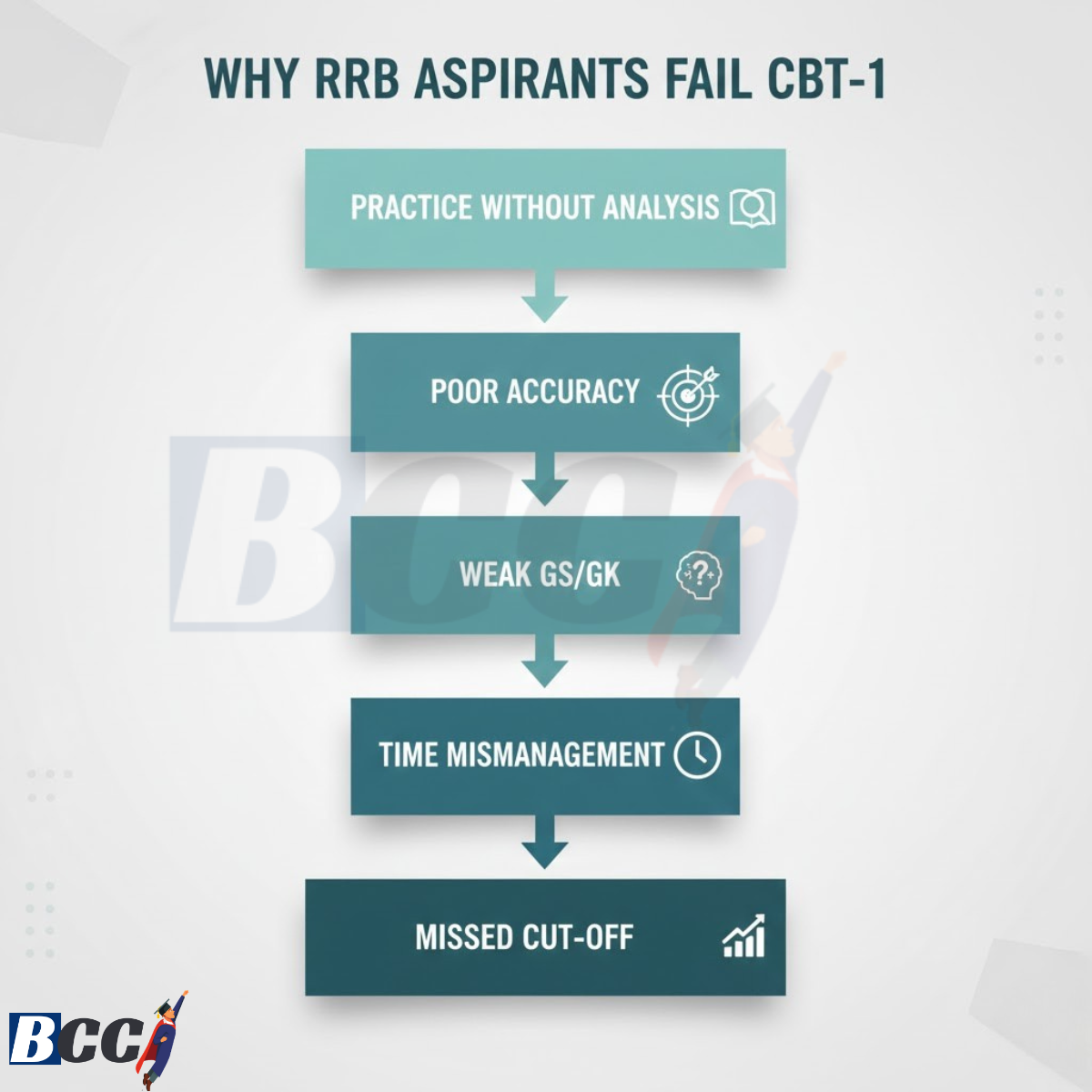
1. Practising Without Analysing Mistakes
This is the most common and damaging issue.
Many aspirants:
- Solve questions
- Check answers
- Move on
They do not ask:
- Why did I get this wrong?
- Is it a concept issue or a careless error?
- Am I repeating this mistake?
Without analysis, practice becomes mechanical.
2. Poor Accuracy Due to Guesswork
CBT-1 has negative marking. Even a small number of guesses can:
- Cancel correct answers
- Pull scores below the cut-off
Aspirants chasing attempts often ignore accuracy. In Railway exams, accuracy is as important as attempts.
3. Ignoring General Science and General Awareness
Many RRB aspirants focus heavily on Maths and Reasoning while postponing:
- General Science
- Static GK
- Current Affairs
This leads to:
- Unbalanced section-wise scores
- Low overall marks
Railway exams place significant weight on General Science, especially for Group D and ALP.
4. Overconfidence Based on Mock Scores
Mock tests are indicators, not guarantees.
Common issues:
- Mock difficulty differs from the real exam
- Aspirants remember answers, not concepts
- Scores fluctuate due to guessing
Mocks help only when followed by proper revision and correction.
5. Lack of Time Management Strategy
Many aspirants practise questions but never practise:
- Section-wise time allocation
- Question selection
- Skipping strategy
As a result, in the real exam:
- Time is wasted on tough questions
- Easy marks are missed
Why CBT-1 Punishes Casual Preparation
CBT-1 is not about brilliance. It is about:
- Consistency
- Discipline
- Awareness of exam pattern
Aspirants who prepare casually often:
- Depend on luck
- Rely on last-minute revision
- Panic under pressure
Railway exams are designed to filter out such approaches.
Practice vs Effective Practice: The Real Difference
| Aspect | Ordinary Practice | Effective Practice |
|---|---|---|
| Focus | Number of questions | Accuracy and learning |
| Errors | Ignored | Analysed and revised |
| Subjects | Selective | Balanced |
| Mocks | Score-based | Improvement-based |
| Outcome | Stagnation | Steady improvement |
Only effective practice leads to selection.
The Role of Revision in CBT-1 Success
Many aspirants practise daily but revise rarely.
Without revision:
- Concepts fade
- Formulas are forgotten
- Speed decreases
Regular revision ensures:
- Faster recall
- Better confidence
- Fewer silly mistakes
Aspirants who integrate revision with practice perform far more consistently.
How Mock Tests Should Actually Be Used
Mocks should be used to:
- Identify weak areas
- Understand time pressure
- Improve question selection
Not just to:
- Check rank
- Compare with others
A simple rule:
One mock = one full analysis + targeted revision
This approach converts effort into improvement.
Subject-Wise Common Failures
Maths
- Calculation errors
- Formula confusion
- Time mismanagement
Reasoning
- Rushing puzzles
- Misreading conditions
General Science
- Incomplete syllabus
- Relying on guesswork
General Awareness
- No revision cycle
- Ignoring static topics
Balanced preparation across all subjects is essential.
Why Average Aspirants Miss Cut-Offs by Small Margins
Most failures happen due to:
- 5–10 marks gap
- Avoidable mistakes
- Poor section balance
These are not intelligence issues. They are strategic issues.
Guided preparation environments often emphasise structured revision, mock analysis, and balance across subjects to prevent such narrow failures.
A Corrected Strategy for RRB CBT-1
- Practise with accuracy first
- Analyse every mock test
- Maintain an error notebook
- Revise weak topics weekly
- Balance all sections
- Avoid blind guessing
This strategy produces stable results, not temporary spikes.
Conclusion
Failing RRB CBT-1 despite good practice is frustrating, but it is also correctable. Most aspirants do not fail due to lack of effort, but due to lack of direction.
Railway exams reward aspirants who practise smartly, revise regularly, and analyse honestly. Once aspirants shift from mechanical practice to purposeful preparation, clearing CBT-1 becomes far more achievable.
Frequently Asked Questions (FAQs)
1. Is practising many questions enough for RRB CBT-1?
No. Practice must be combined with analysis and revision.
2. How important is accuracy in Railway exams?
Very important due to negative marking and close cut-offs.
3. Which subject is most ignored by RRB aspirants?
General Science and General Awareness.
4. How many mocks should I take?
Quality matters more than quantity. Analyse every mock properly.
5. Can revision really improve scores?
Yes. Regular revision improves recall, speed, and confidence.
Meta Description
Many RRB aspirants fail CBT-1 despite good practice. Learn the real reasons and how to correct your Railway exam strategy effectively.
SEO Tags (Comma-Separated)
rrb cbt 1 preparation, railway exam mistakes, rrb ntpc strategy, rrb group d preparation tips, railway exam mock analysis, how to clear rrb cbt 1, rrb aspirants guidance