

Why MH-CET Law Merit Rank Matters More Than Marks
After the MH-CET Law results are declared, one question dominates every aspirant’s mind:
“I scored decent marks, so why didn’t I get my preferred college?”
Many students focus only on marks, assuming higher marks automatically mean better college allotment. But MH-CET Law does not work that way. In reality, merit rank matters far more than raw marks, especially during counselling and seat allotment.
Understanding this difference is crucial for aspirants of both 3-Year and 5-Year MH-CET Law.
MH-CET Law Is a Rank-Based Admission Process
MH-CET Law is not a qualifying exam where crossing a fixed mark guarantees admission. It is a ranking exam.
What decides admission:
- Your position in the merit list
- Category-wise rank
- College preferences during counselling
- Seat availability in each round
Two students may have similar marks, but their merit ranks can be very different, which directly affects college allotment.
Why Marks Alone Do Not Decide College Allotment
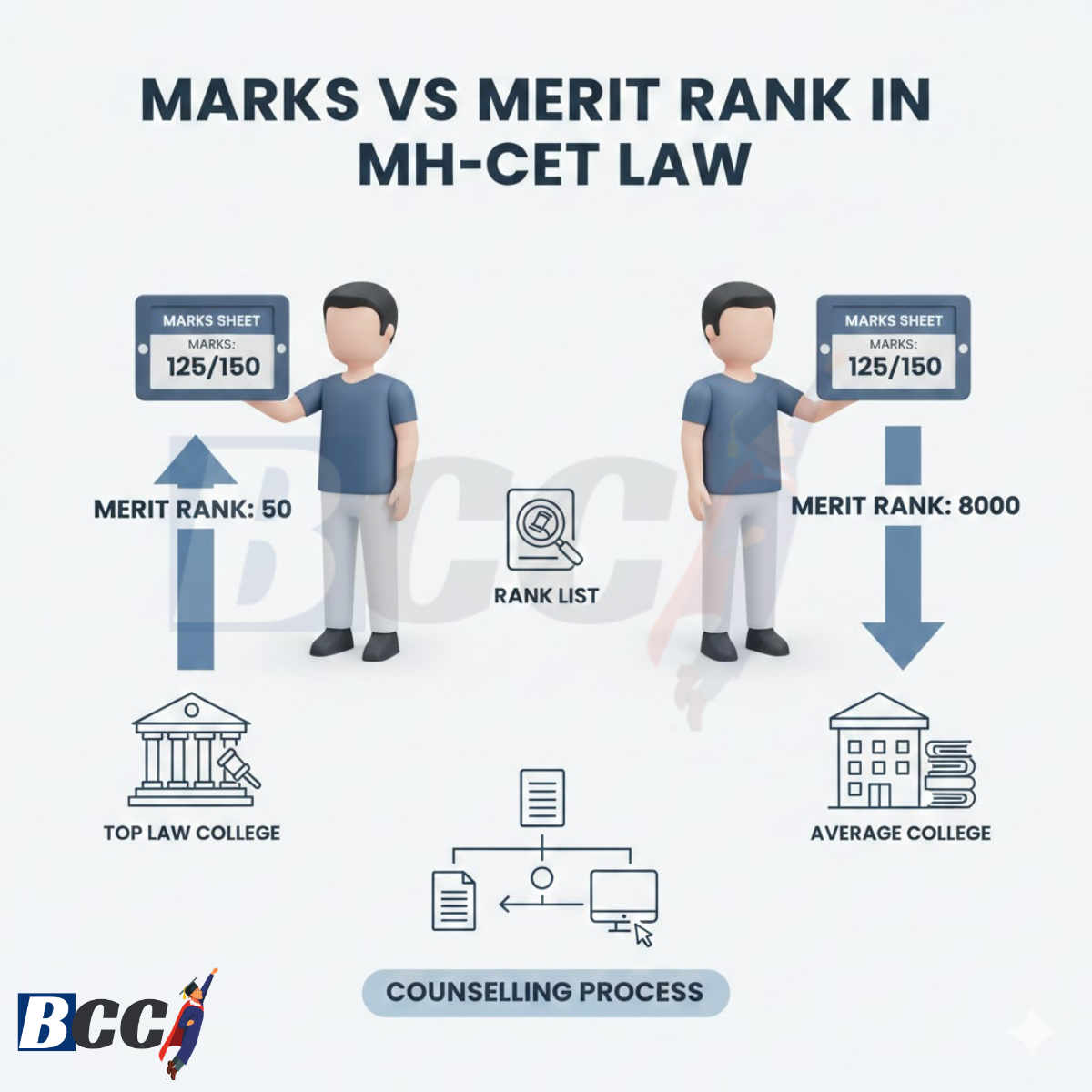
Marks show how many questions you answered correctly.
Rank shows how many candidates performed better or worse than you.
In MH-CET Law:
- Thousands of candidates score within a narrow mark range
- Small differences in marks create large differences in rank
- Colleges fill seats strictly based on rank order
This is why a student with slightly lower marks but a better rank may be offered a better college than someone with higher marks but a lower rank.
Score Density: The Real Reason Rank Becomes Crucial

When the paper is moderate to easy:
- Most aspirants attempt a high number of questions
- Accuracy levels are similar
- Scores cluster tightly
This creates score density, where hundreds of candidates are separated by 1–2 marks. In such a situation, rank becomes the only practical way to differentiate candidates.
Role of Normalisation in Merit Rank
MH-CET Law is conducted in multiple shifts, particularly for the 5-Year exam. Normalisation is applied to ensure fairness.
What aspirants must understand:
- Raw marks are adjusted after normalisation
- Final merit rank is based on the normalised score
- Two candidates with similar raw marks can get different ranks
This is why focusing only on marks without understanding normalisation leads to confusion.
Merit Rank and College Allotment Logic

During counselling:
- Colleges are filled in descending order of merit rank
- Higher-ranked candidates get first preference
- Lower-ranked candidates choose from the remaining seats
Once seats in top colleges are filled, marks become irrelevant. Only rank and preference order matter.
This is true for both:
- Government Law Colleges
- Aided and unaided institutes
3-Year vs 5-Year CET: Same Rank Logic
While the syllabus and competition differ slightly, the admission logic remains the same for both exams.
For both 3-Year and 5-Year MH-CET Law:
- Merit rank determines counselling order
- Marks are only a tool to create a rank
- Rank decides college quality
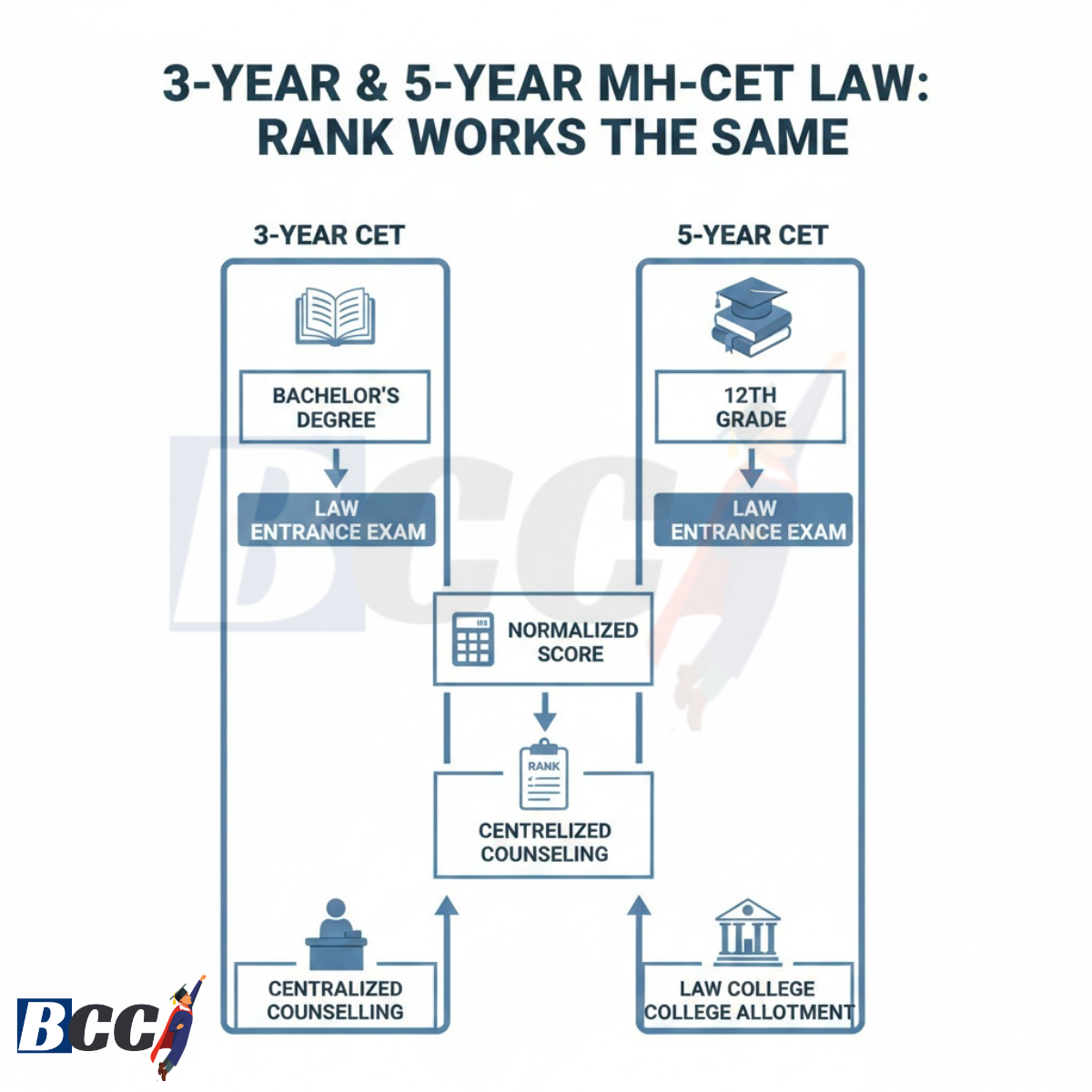
Understanding this helps aspirants align expectations realistically.
Why Aspirants Misjudge Their Chances
Common mistakes include:
- Comparing marks with friends instead of rank
- Relying on mock test marks
- Ignoring category-wise merit lists
- Assuming a “safe score” guarantees admission
These assumptions often lead to disappointment during allotment rounds.
How Aspirants Should Shift Their Mindset
Instead of asking:
-
“How many marks are enough?”
Aspirants should ask:
-
“What rank is needed for my target colleges?”
This shift helps in:
- Smarter preference filling
- Better post-result planning
- Reduced stress during counselling
What This Means for Preparation Strategy
Since rank matters more than marks:
- Avoid silly mistakes that affect rank sharply
- Focus on accuracy in easy questions
- Improve attempt efficiency
- Strengthen Legal Aptitude and GK
Even a 1-mark improvement can move an aspirant up by hundreds of ranks.
Conclusion: Rank Is the Real Currency in MH-CET Law
In MH-CET Law, marks are only a stepping stone.
Merit rank is the real currency that buys you a college seat.
Once aspirants understand this, preparation becomes more strategic and expectations more realistic. Whether it is the 3-Year or 5-Year CET, those who prepare with rank awareness—not just mark obsession—are the ones who secure better law colleges.