

Why MAH MBA CET Cut-Offs Rise Even When the Paper Feels Easy
Every year after the MAH MBA CET exam, a common reaction is heard among aspirants:
“Paper easy tha, cut-off kam hona chahiye.”
Yet, when results are declared, the opposite happens. Cut-offs rise, percentiles shift sharply, and many candidates who felt confident fail to secure top colleges.
This is not a coincidence. In fact, easy papers are one of the biggest reasons for higher cut-offs in MAH MBA CET.
This article explains why CET cut-offs rise when the paper feels easy, how percentile logic works, and what aspirants must understand to avoid strategic mistakes.
The Biggest Misconception: Easy Paper = Low Cut-Off
In the MAH MBA CET, the difficulty level does not directly decide cut-offs. Competition behaviour does.
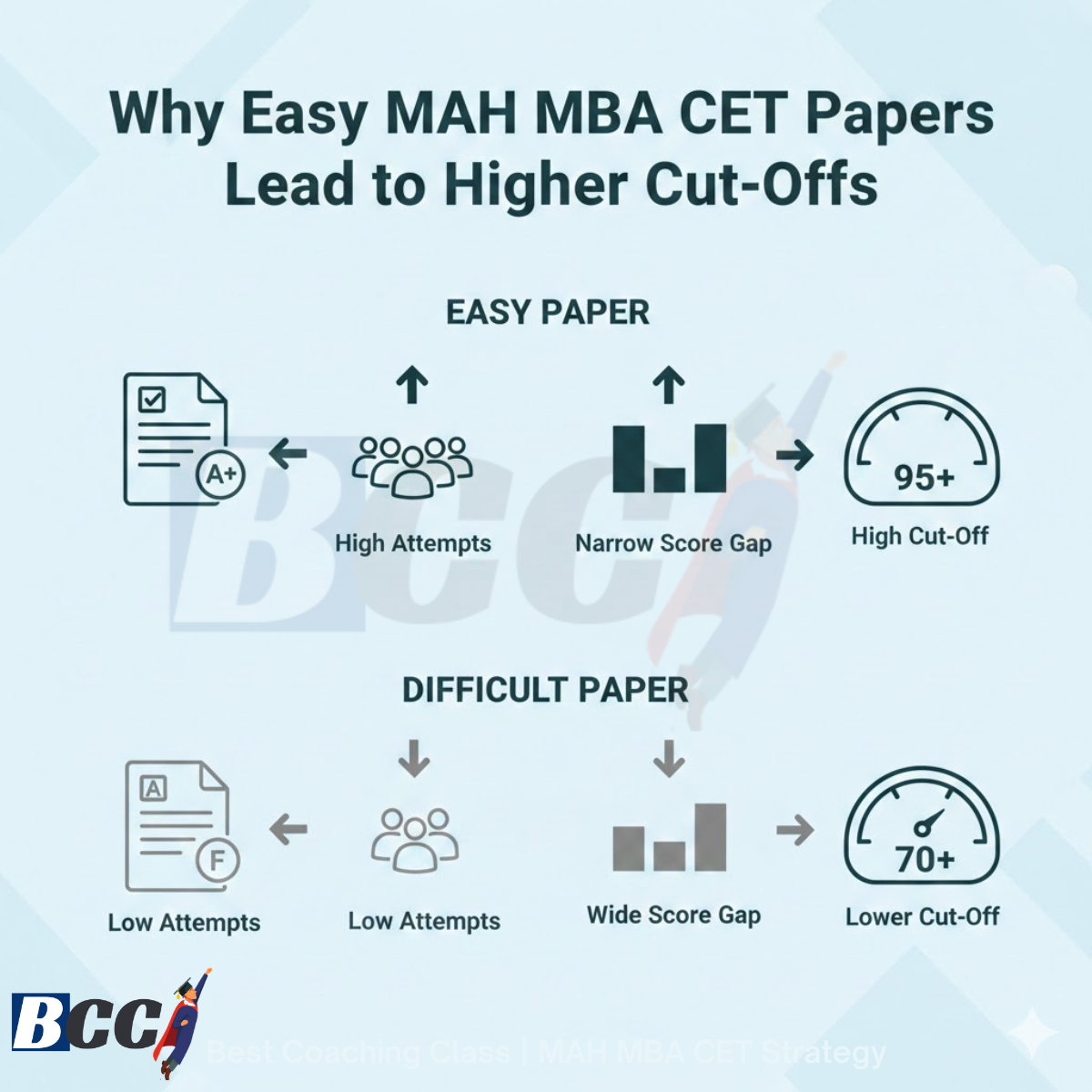
When a paper feels easy:
- More candidates attempt more questions
- Average scores increase
- Percentile gaps become narrower
As a result, cut-offs rise, not fall.
MAH MBA CET Is a Percentile-Based Exam
Understanding cut-offs requires understanding percentile logic, not raw difficulty.
In CET:
- You are not competing against the paper
- You are competing against other candidates
If most candidates score well, your percentile depends on how much better you perform than them, not how easy the paper was.
Reason 1: High Attempts Across the Board
In an easy CET paper:
- Easy and moderate questions dominate
- Guesswork reduces
- Confidence remains high
This leads to:
- Higher attempts by average candidates
- Fewer mistakes
- Compressed score range
When everyone scores within similar ranges, even a 2–3 mark change can drastically alter the percentile.
Reason 2: CET Rewards Speed More Than Difficulty
MAH MBA CET is designed as a speed-based exam, not a depth-based one.
In an easy paper:
- Speed becomes the real differentiator
- Fast solvers pull ahead quickly
- Slow but accurate candidates fall behind
This creates a situation where:
- Knowledge gap reduces
- Execution gap increases
Cut-offs rise because more people are “in the race.”
Reason 3: Logical Reasoning Dominates the Score
Logical Reasoning has:
- Maximum number of questions
- Repeating patterns
- Low conceptual difficulty
In easy papers:
- LR attempts shoot up
- Accuracy improves
- Scores inflate rapidly
Since LR contributes heavily to the total score, cut-offs rise sharply even if other sections are moderate.
Reason 4: Fewer Traps, Fewer Eliminations
In difficult papers:
- Tricky questions eliminate weak candidates
- Accuracy drops
- Score spread widens
In easy papers:
- Fewer traps
- More predictable questions
- Less elimination
This means more candidates remain clustered at higher scores, pushing cut-offs upward.
Why “Paper Easy Tha” Is Actually Dangerous Thinking
Many aspirants relax mentally when the paper feels easy:
- They spend extra time on questions
- They stop tracking time strictly
- They assume good performance
But CET does not forgive:
- Poor time allocation
- Low attempts
- Overconfidence
When the paper is easy, execution discipline matters more than ever.
Easy Paper vs Difficult Paper: What Changes?
| Aspect | Difficult CET Paper | Easy CET Paper |
|---|---|---|
| Attempts | Low to moderate | High |
| Accuracy | Lower | Higher |
| Score spread | Wide | Narrow |
| Competition | Selective | Dense |
| Cut-off trend | Stable or low | High |
What Actually Decides Cut-Offs in MAH MBA CET
Cut-offs are influenced by:
- Total number of candidates
- Average attempts
- Accuracy levels
- Speed of top performers
Difficulty is only a secondary factor.
This is why:
- Easy papers create panic after the results
- Well-prepared but slow candidates miss cut-offs
- Strategy matters more than content
How Toppers Think During an Easy CET Paper
Top CET scorers:
- Increase speed further
- Do not get emotionally relaxed
- Focus on maximising attempts
- Stick to selection discipline
They understand one truth clearly:
Easy paper = ruthless competition.
Strategic Lesson for CET Aspirants
Instead of asking:
“Paper easy tha ya tough?”
A better question is:
“Did I maximise my attempts with control?”
Success in CET depends on:
- Speed under comfort
- Discipline under confidence
- Strategy under ease
Role of CET-Focused Guidance
Many aspirants prepare well but misjudge exam dynamics.
Institutes like The Prayas India train students to:
- Handle easy papers strategically
- Increase attempts without losing accuracy
- Understand percentile behaviour
- Avoid overconfidence traps
This CET-specific orientation helps aspirants survive high cut-off years.
FAQs
Q1. Does an easy MAH MBA CET paper always mean high cut-offs?
Usually, yes, because high attempts and accuracy compress percentile differences.
Q2. Why do good students miss cut-offs in easy papers?
Because CET rewards speed and attempts more than comfort-level accuracy.
Q3. Are CET cut-offs decided before or after normalisation?
Cut-offs are percentile-based, determined after score normalisation.
Q4. Should the strategy change if the paper feels easy?
Yes. Speed and selection discipline must increase, not relax.
Q5. Can coaching help understand CET cut-off trends?
Yes. CET-focused guidance—like at The Prayas India—helps aspirants align preparation with exam behaviour.
Conclusion
In MAH MBA CET, easy papers are not a blessing—they are a test of execution.
When the paper feels easy, competition intensifies, margins shrink, and cut-offs rise. Aspirants who mistake comfort for success often pay the price.
Remember:
In CET, you don’t beat the paper. You beat the crowd.