

Why CAT-Level Preparation Can Hurt Your MAH MBA CET Score
(Understanding the CET Mindset That CAT Aspirants Often Miss)
Every year, a large number of MBA aspirants move from CAT preparation to MAH MBA CET, assuming that strong CAT-level preparation will automatically translate into a high CET percentile. On paper, this assumption looks logical—CAT is considered tougher, more analytical, and concept-heavy.
In reality, however, CAT-style preparation often works against aspirants in MAH MBA CET.
This article explains why CAT-level preparation can reduce CET performance, the key differences between the two exams, and how aspirants must recalibrate their strategy specifically for MAH MBA CET.
The Fundamental Difference: CET Is Not a “CAT-Lite” Exam
The biggest mistake aspirants make is treating MAH MBA CET as a simplified version of CAT. While both are MBA entrance exams, their exam philosophy, design, and scoring logic are completely different.
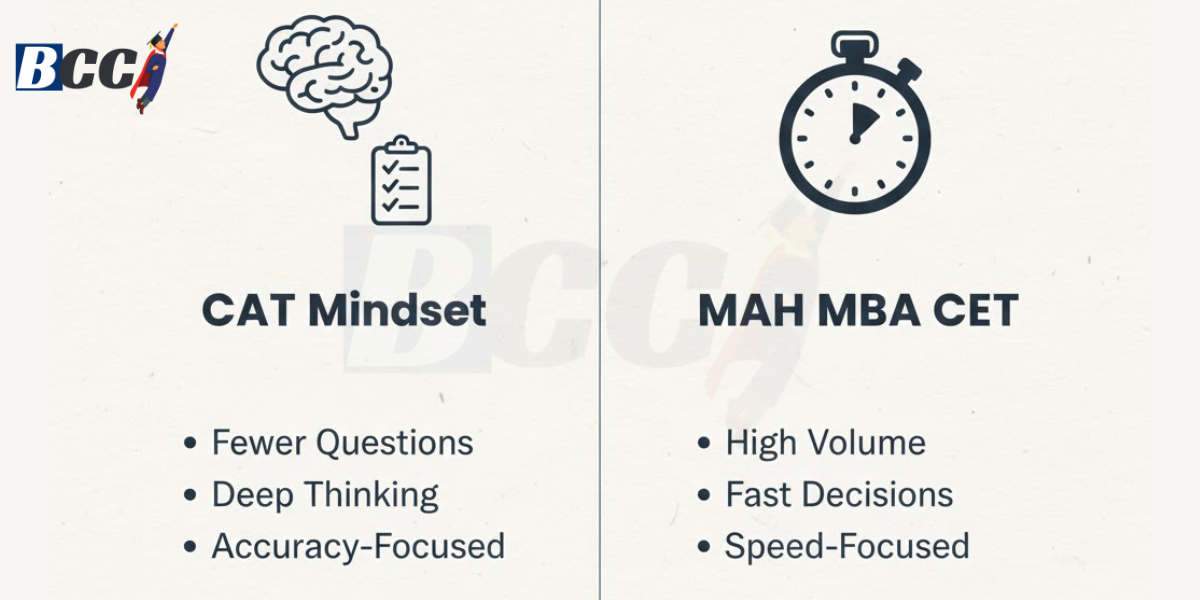
CAT Focuses On:
- Depth of thinking
- Conceptual traps
- Fewer questions, more time per question
- Accuracy over attempts
MAH MBA CET Focuses On:
- Speed and volume
- Pattern familiarity
- Rapid decision-making
- Smart selection over deep solving
CAT rewards how well you think.
CET rewards how fast and smart you move.
When CAT-trained aspirants carry the same mindset into CET, problems begin.
Mistake 1: Overthinking Simple CET Questions
CAT preparation trains aspirants to:
- Look for hidden traps
- Double-check logic
- Avoid quick assumptions
In MAH MBA CET, this habit becomes a liability.
Many CET questions are:
- Straightforward
- Pattern-based
- Designed to be solved quickly
CAT aspirants often:
- Spend extra time verifying
- Over-analyse easy questions
- Lose momentum
In a speed-driven exam like CET, overthinking costs more marks than conceptual weakness.
Mistake 2: Spending Too Much Time Per Question
In CAT, spending 2–3 minutes on a single question is normal. In MAH MBA CET, this approach is dangerous.
CET rewards:
- High attempts
- Continuous movement
- Letting go of time-consuming questions quickly
CAT-trained students often:
- Get emotionally attached to questions
- Refuse to skip
- Aim for perfect accuracy
In CET, 90% accuracy with low attempts is far worse than 75% accuracy with high attempts.
Mistake 3: Ignoring Question Pattern Familiarity
CAT questions change structure frequently. CET questions, on the other hand, repeat patterns aggressively.
CAT aspirants focus heavily on:
- Concept mastery
- Advanced problem-solving
But CET requires:
- Pattern recognition
- Familiarity with recurring models
- Fast recall rather than deep logic
Without CET-specific practice, CAT aspirants often face:
- Shock at question volume
- Fatigue due to continuous solving
- Poor time allocation across sections
Mistake 4: Underestimating Logical Reasoning Volume
Logical Reasoning in MAH MBA CET is not about difficulty—it is about sheer quantity.
CAT-style LR preparation focuses on:
- 4–5 sets
- Deep analysis
- Long reading time
CET LR demands:
- Rapid recognition
- Fast elimination
- Mental stamina
CAT aspirants often get stuck trying to “solve properly”, while CET toppers move ahead by solving adequately and quickly.
Mistake 5: Misplaced Confidence Due to CAT Preparation
Many aspirants assume:
“I am preparing for CAT, CET will be manageable.”
This mindset leads to:
- Late CET-specific preparation
- Fewer CET mocks
- Poor adaptation to exam rhythm
MAH MBA CET is highly competitive, especially due to:
- Home-state dominance
- Tight percentile clustering
- Extremely small score differences
A small strategy mismatch can lead to massive percentile loss.
CET Percentile Logic vs CAT Percentile Logic
Another major misunderstanding lies in how percentiles are formed.
In CAT:
- Percentile is driven by sectional performance + scaling
- Slightly lower attempts can still work
In MAH MBA CET:
- Percentile is driven by raw score and speed
- A difference of 3–4 questions can shift the percentile drastically
CAT-level accuracy obsession does not align with CET’s percentile mechanics.
What MAH MBA CET Actually Demands
To succeed in CET, aspirants must unlearn some CAT habits and adopt CET-specific principles:
1. Speed Over Perfection
Quick decisions matter more than flawless logic.
2. Pattern Recognition
Repeated exposure to CET models is essential.
3. High Attempt Strategy
Selective skipping and fast execution drive scores.
4. Mental Endurance
CET is long and intense. Stamina matters.
5. Mock-Based Learning
CET mocks are not for ranking—they are for strategy correction.
How CAT Aspirants Should Reframe Their CET Preparation
Shift 1: From “Solve Completely” to “Solve Quickly”
Train yourself to:
- Identify solvable questions in seconds
- Drop time-consuming ones without regret
Shift 2: From Concept Depth to Pattern Familiarity
Focus on:
- CET PYQs
- Repeating question types
- Speed drills
Shift 3: From Accuracy Metrics to Attempt Strategy
Track:
- Attempts per section
- Time spent per question
- Decision-making efficiency
Role of Structured Guidance in CET Preparation
Many CAT aspirants fail in CET not due to lack of intelligence, but due to lack of CET-specific mentoring.
Focused institutes like The Prayas India help aspirants:
- Transition from the CAT mindset to the CET mindset
- Develop speed-based strategies
- Analyse CET mocks beyond raw scores
- Build exam-day execution plans
The emphasis is not on learning more, but on executing better under CET conditions.
Where CAT Preparation Still Helps (If Used Correctly)
CAT preparation is not useless—it just needs adaptation.
CAT helps in:
- Concept clarity
- Logical thinking
- Reading discipline
When combined with:
- CET-specific mocks
- Speed training
- Smart selection techniques
CAT preparation becomes an advantage rather than a drawback.
FAQs on Why CAT-Level Preparation Can Hurt Your MAH MBA CET Score
Q1. Is the MAH MBA CET easier than the CAT?
MAH MBA CET is not easier—its difficulty lies in speed, volume, and execution rather than conceptual depth.
Q2. Can CAT preparation alone guarantee a high CET percentile?
No. Without CET-specific practice and strategy, CAT preparation can actually reduce CET performance.
Q3. How many CET mocks should CAT aspirants take?
At least 20–25 CET-specific mocks with detailed analysis focusing on speed and selection.
Q4. Should CAT aspirants reduce the accuracy standards for CET?
Yes. CET requires balanced accuracy with high attempts, not near-perfect accuracy.
Q5. Does CET require separate coaching?
Not always, but CET-focused guidance—like that offered at The Prayas India—helps aspirants realign strategy and avoid common CAT-to-CET transition mistakes.
Conclusion
MAH MBA CET is not a test of how deeply you think—it is a test of how quickly and smartly you act.
CAT-level preparation builds strong foundations, but without adaptation, it becomes a strategic disadvantage in CET. Aspirants who recognise this early and recalibrate their approach gain a significant edge over those who rely purely on CAT habits.
To succeed in MAH MBA CET, the key is simple:
Stop preparing harder. Start preparing smarter.