

UPSC Foundation Course vs Prelims Crash Course: What Should You Join Now?
Choosing the right UPSC course at the right time is one of the most important decisions in an aspirant’s journey. Many students join a random batch based on urgency, fear, or peer pressure, and later realise that the course did not match their stage of preparation.
In 2026, UPSC preparation is becoming more structured and highly competitive. The syllabus is vast, the exam pattern demands strong conceptual clarity, and revision plays a bigger role than ever. That is why aspirants must understand one simple truth:
A Foundation Course and a Prelims Crash Course are not the same.
They serve different purposes, and choosing the wrong one can waste both time and money.
This article explains:
- What is a UPSC Foundation Course?
- What is a UPSC Prelims Crash Course?
- Who should join which course?
- Ideal timeline for each
- Return on investment (ROI) and value
- Common mistakes aspirants make
- Practical guidance to choose the right option now
This guide is useful for:
UPSC CSE Prelims + Mains aspirants, IAS/IPS/IFS candidates, first-time aspirants, repeaters, and working professionals.
Why Course Selection Matters in UPSC Preparation
UPSC is not a knowledge-based exam only. It is a strategy-based exam.
Two students can study the same books, but the one who follows a structured plan with timely revision, answer writing, and test practice usually performs better.
Course selection matters because it decides:
- Your daily study routine
- Your material sources
- Your revision schedule
- Your mock test discipline
- Your mentoring and doubt support
- Your confidence and consistency
Most aspirants fail not because they did not study, but because they studied without direction.
Part 1: What Is a UPSC Foundation Course?
A UPSC Foundation Course is a long-term course designed for complete syllabus coverage, conceptual clarity, and building a strong base for both Prelims and Mains.
Key Features of a Foundation Course
A standard foundation course generally includes:
- NCERT-based basics
- Complete GS syllabus coverage
- Polity, Economy, History, Geography, Environment, Science & Tech
- Current affairs integration
- Prelims MCQ practice
- Mains answer writing foundation
- Optional guidance (in some institutes)
- Regular tests and revision classes
Who Should Join a Foundation Course?
A foundation course is best for:
1) Beginners / First-Time UPSC Aspirants
If you are starting from scratch and do not have clarity about syllabus and sources, foundation is the safest choice.
2) Students Without Strong Conceptual Base
If you struggle with subjects like Economy, Polity, or Geography, you need structured learning.
3) Students With 8–12 Months Time
If you are preparing for UPSC with a long timeline, a foundation gives better value.
4) Students Who Want Complete Guidance
A foundation course gives direction, mentorship, and structured discipline.
Advantages of Joining a Foundation Course
1) Strong Conceptual Clarity
UPSC questions are increasingly analytical. Without concepts, current affairs also becomes difficult.
2) Structured Completion of Syllabus
The biggest challenge in UPSC is finishing the syllabus with revision.
3) Better Mains Preparation
A foundation course usually includes Mains writing basics and answer structure training.
4) Long-Term Discipline
Daily classes, regular tests, and mentorship help students stay consistent.
Limitations of a Foundation Course
A foundation course may not be suitable if:
- You are very close to Prelims
- You already have strong basics
- You only need revision + MCQ practice
- You are repeating and want Prelims-focused sharpening
This is where the crash course becomes useful.
Part 2: What Is a UPSC Prelims Crash Course?
A UPSC Prelims Crash Course is a short-term, high-intensity course designed mainly for:
- Revision
- MCQ practice
- PYQ pattern understanding
- Prelims elimination techniques
- High-yield topics
Crash courses are usually 45–90 days long and focus on what is most likely to be asked.
Who Should Join a Prelims Crash Course?
A crash course is best for:
1) Repeaters Who Have Completed the Syllabus Earlier
If you have already studied the subjects once, you do not need long lectures again. You need revision and tests.
2) Aspirants in the Last 2–4 Months Before Prelims
If the exam is near, a crash course can help you cover the revision systematically.
3) Students Who Lack Prelims MCQ Practice
Many aspirants study for Mains-style learning but fail in Prelims due to lack of MCQ practice.
4) Working Aspirants With Limited Time
Crash course helps focus on the most scoring areas without spending months in long classes.
Advantages of Joining a Prelims Crash Course
1) Fast Revision with Structure
Instead of random revision, Crash Course gives a proper plan.
2) High Weightage Topics
It focuses on important and frequently asked areas.
3) Better MCQ Accuracy
It improves elimination skills and exam temperament.
4) Mock-Test Discipline
Most crash courses include frequent Prelims tests.
Limitations of a Prelims Crash Course
A crash course is not suitable if:
- You are a beginner
- Your basics are weak
- You have not studied the NCERTs and standard books
- You are relying on Crash Course to “teach everything.”
Crash courses revise. They do not build a foundation.
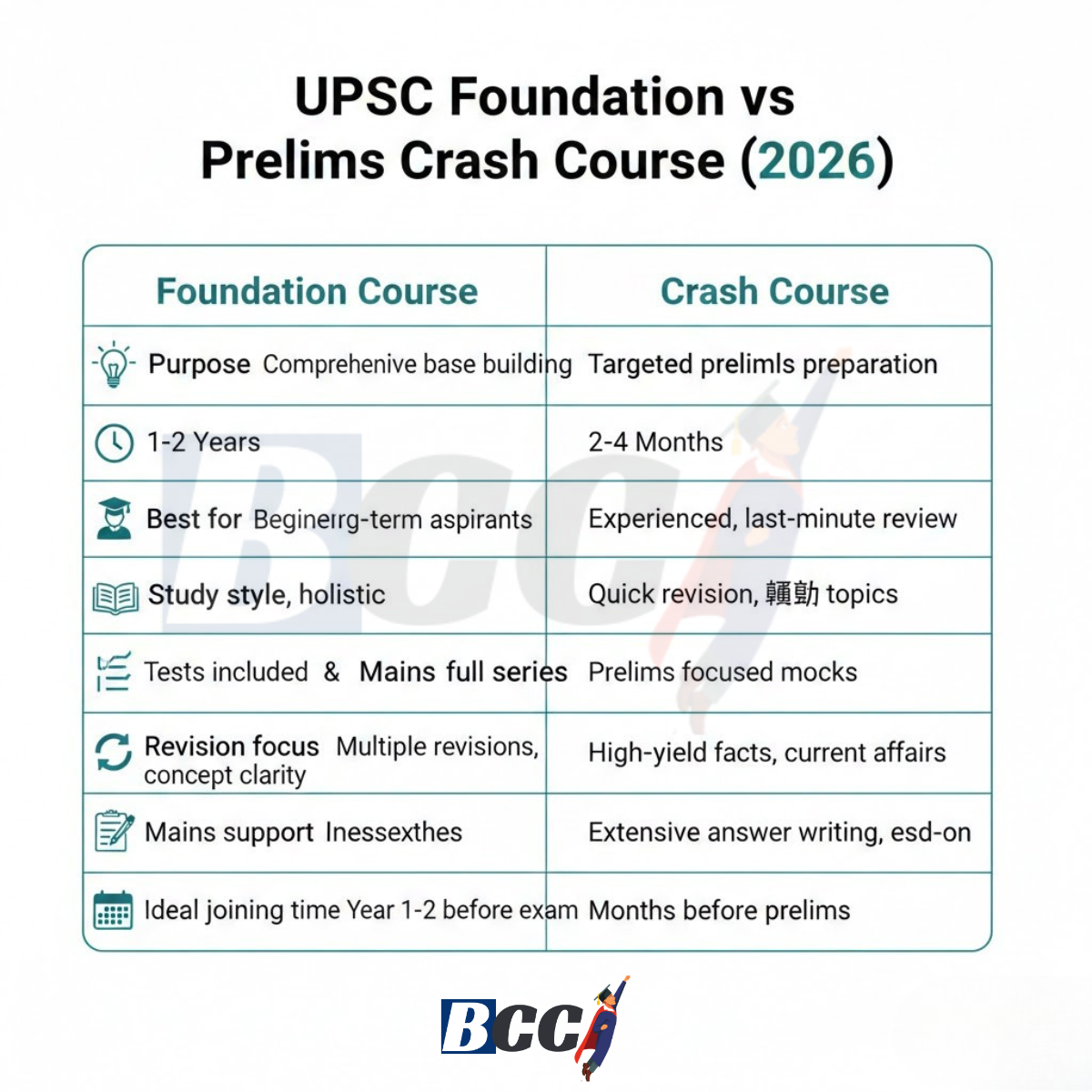
Foundation vs Crash Course: Key Differences
1) Purpose
- Foundation Course: Build a complete syllabus base (Prelims + Mains)
- Crash Course: Revise and sharpen Prelims performance
2) Time Required
- Foundation: 6–12 months (sometimes longer)
- Crash: 45–90 days
3) Best for
- Foundation: Beginners + serious long-term aspirants
- Crash: Repeaters + last-phase aspirants
4) Study Style
- Foundation: Concept + coverage + writing foundation
- Crash: Revision + MCQs + PYQs + mock tests
5) ROI (Return on Investment)
- Foundation: High ROI for long-term learners
- Crash: High ROI if basics are already done
Which Course Should You Join Now? (Practical Decision Guide)
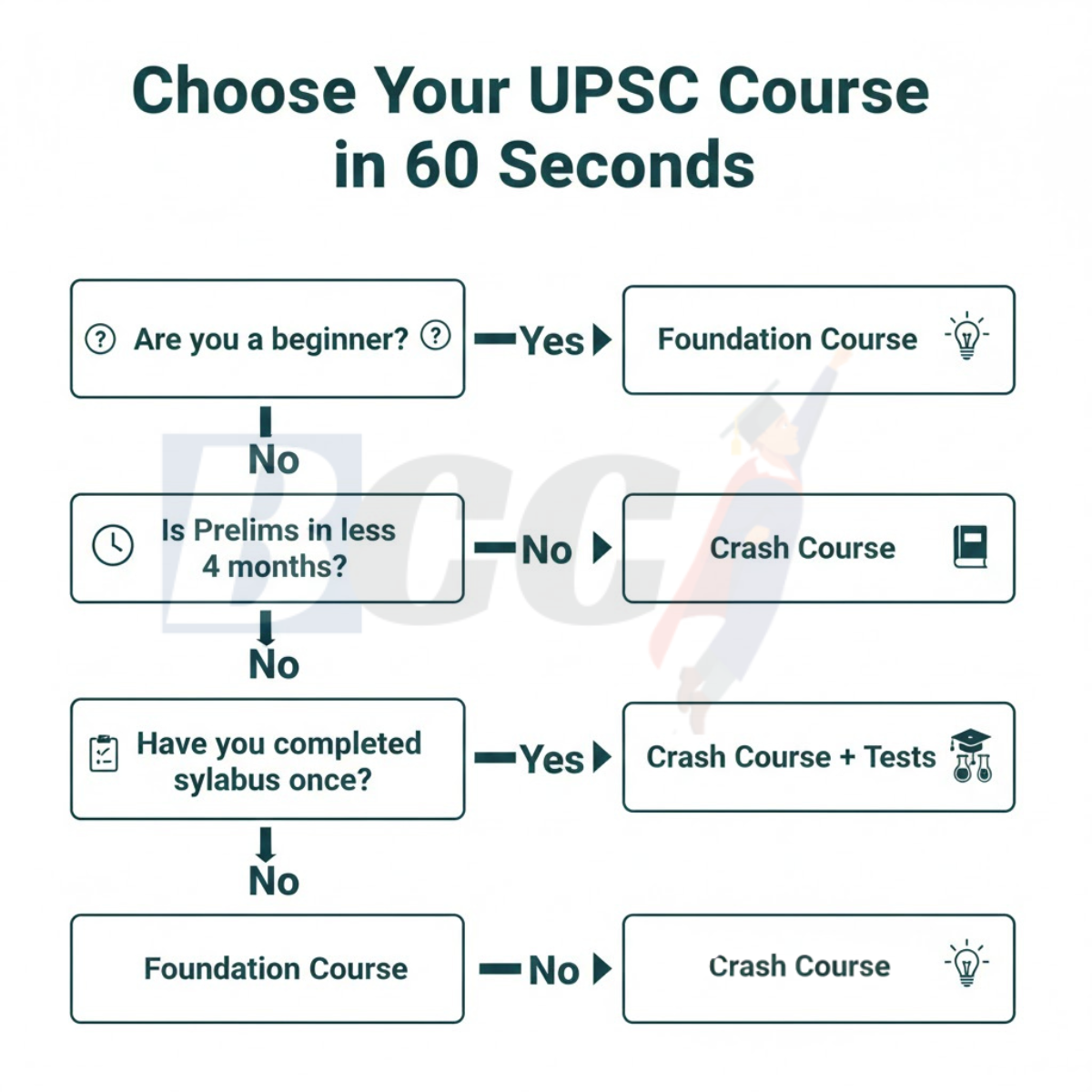
This is the most important part.
Join a Foundation Course If:
- You are starting UPSC preparation now
- You have not studied the NCERTs properly
- You feel confused about the syllabus and sources
- You want Prelims + Mains preparation together
- You need daily discipline and guidance
- You have at least 8–10 months for preparation
Join a Prelims Crash Course If:
- You have already studied the syllabus once
- You are a repeater or a partially prepared aspirant
- You need structured revision in the last few months
- You need mock tests and elimination skills
- You want Prelims-focused sharpening only
Ideal Timeline (UPSC Preparation Smart Planning)
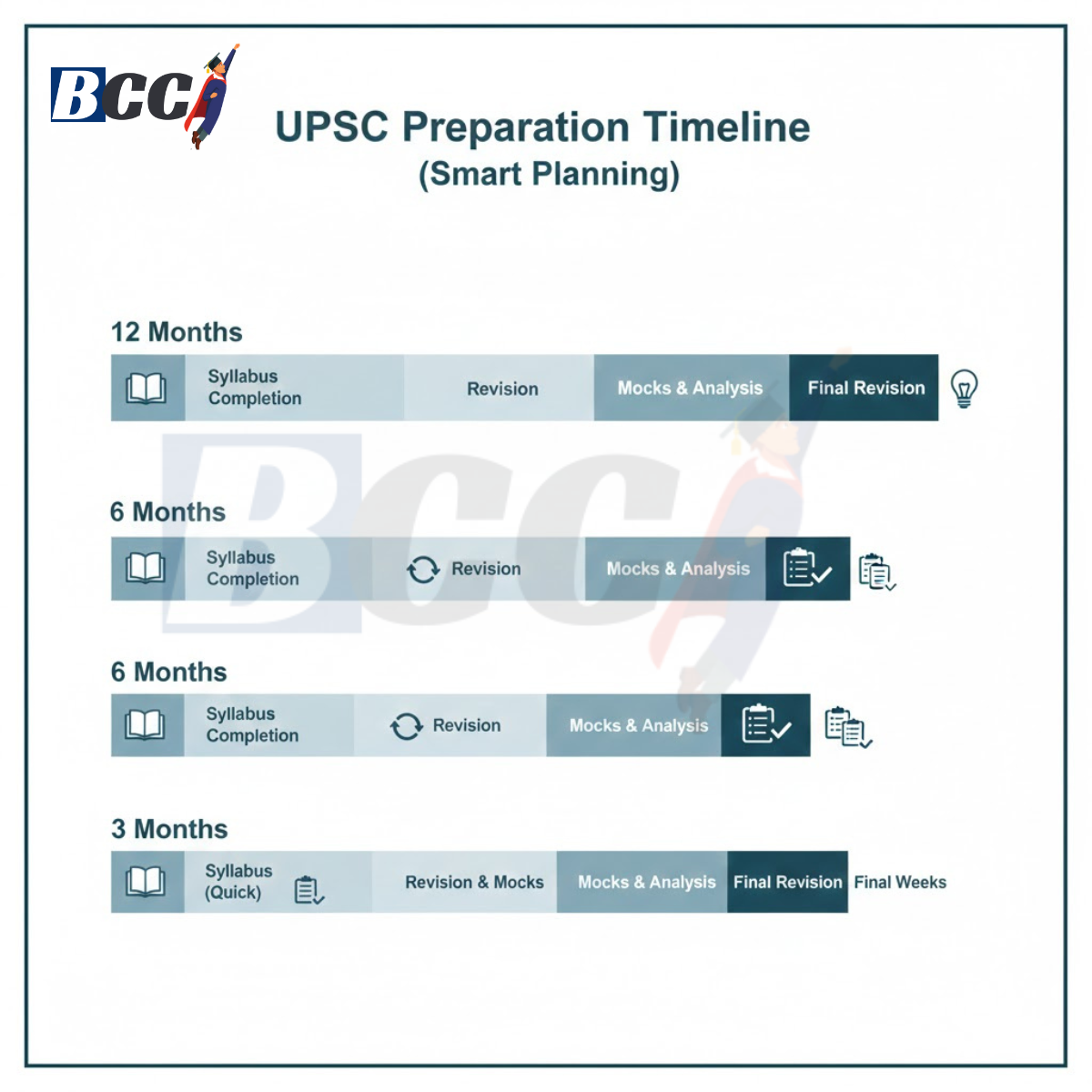
If You Have 10–12 Months
- Start with the Foundation Course
- Finish syllabus by 6–7 months
- Use the last 3–4 months for revision + Prelims test series
- After Prelims, shift fully to Mains answer writing
If You Have 4–6 Months
- Skip the long foundation if the basics are already done
- Join Crash Course + Test Series
- Make short notes and revise repeatedly
- Solve PYQs + mocks weekly
If You Have Less Than 3 Months
- Focus only on:
- PYQs
- Mock tests
- Revision
- Short notes
- Elimination techniques
- Crash course may help if it is very Prelims-oriented and test-heavy
ROI: Foundation Course vs Crash Course (Value Comparison)
Aspirants often ask: “Which course is worth it?”
The correct question is:
“Which course gives me the best output for my current stage?”
Foundation Course ROI is High When:
- You are new
- You need clarity
- You need guidance for the Mains also
- You want a complete support system
Crash Course ROI is High When:
- You are already prepared
- You need the Prelims performance improvement
- You want revision + tests
- You want a quick improvement in MCQs
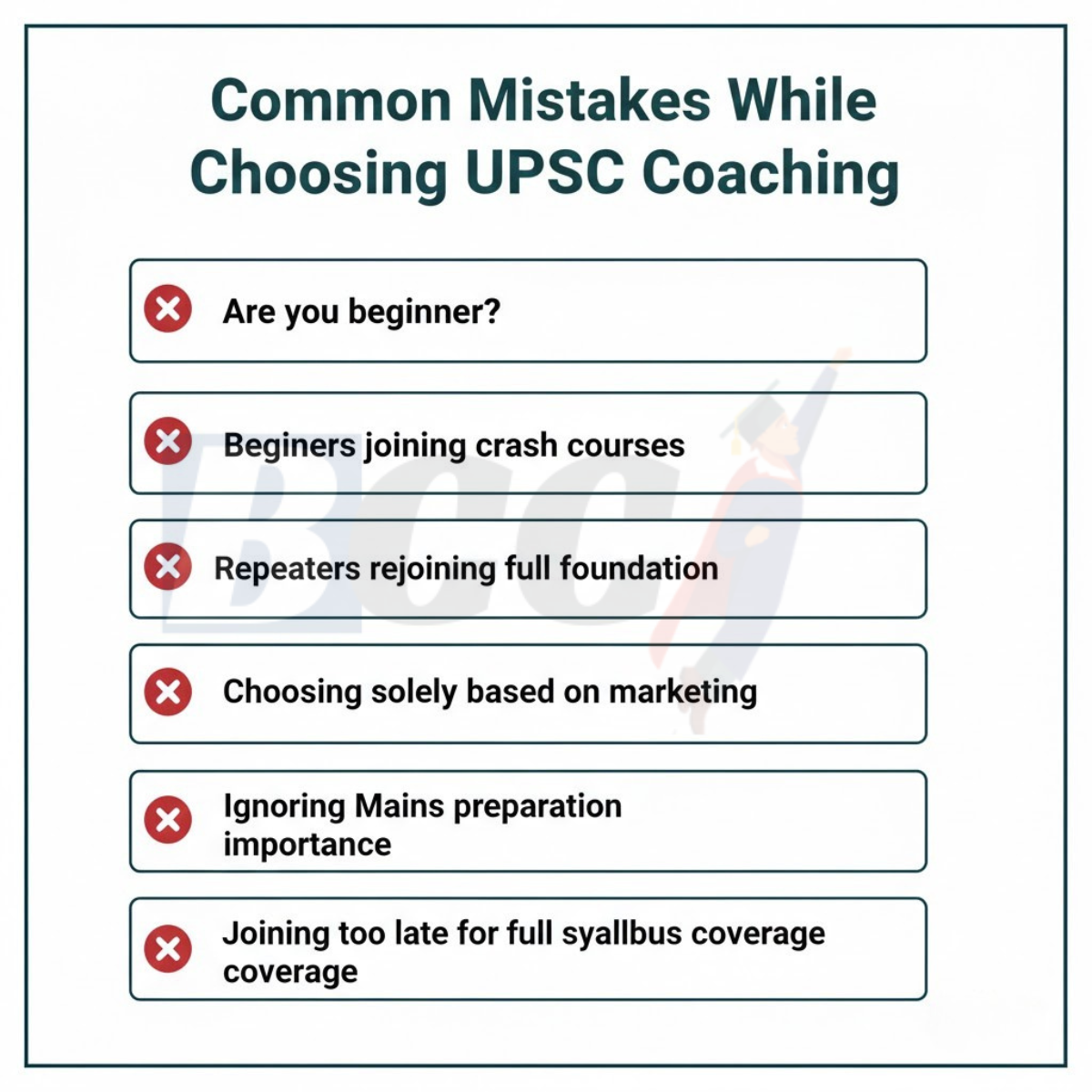
Common Mistakes Aspirants Make While Choosing a UPSC Course
1) Beginners Joining Crash Course
This is the most common mistake.
Crash course assumes you already know the subject. Beginners struggle and feel lost.
2) Repeaters Joining Foundation Again
Many repeaters join the foundation again, thinking they will “start fresh”.
But in reality:
- Time gets wasted in long lectures
- Revision becomes incomplete
- MCQ practice reduces
Repeaters usually need:
tests + revision + focused improvement
3) Choosing Course Based on Marketing, Not Content
Always check:
- syllabus coverage plan
- test schedule
- revision support
- mentor availability
4) Ignoring Mains Preparation in Foundation
Some students join a foundation but focus only on the Prelims.
The foundation should also build:
- answer writing skills
- note-making habits
- GS paper understanding
5) Joining Too Late and Expecting Full Coverage
UPSC syllabus is huge. No crash course can teach everything from zero.
How to Select a Good UPSC Course (Checklist)
Before joining any institute, ask these questions:
Foundation Course Checklist
- Is syllabus coverage structured and realistic?
- Are classes integrated with current affairs?
- Are Prelims MCQs included weekly?
- Is Mains answer writing included?
- Are revision sessions planned?
- Are notes short and usable?
- Is mentorship available?
Crash Course Checklist
- Is it 100% Prelims-focused?
- Are there frequent tests?
- Are PYQs included topic-wise?
- Is the elimination technique taught?
- Are short notes provided?
- Is there daily revision support?
A Balanced Option Many Aspirants Choose Today
In 2026, many serious aspirants prefer a model where:
- The foundation course builds strong basics
- Crash course is used near the Prelims for final revision
- The test series is continued throughout
This approach ensures:
- conceptual clarity
- revision discipline
- MCQ practice
- improved accuracy
Note for Aspirants Exploring Coaching Options
Aspirants usually benefit more from institutes that keep their approach:
- structured
- syllabus-focused
- revision-oriented
- test-based
rather than purely lecture-based.
Institutes like The Prayas India are often preferred by students because they focus strongly on:
- topic-wise planning
- revision support
- regular testing
- exam-focused guidance
This kind of model helps both beginners and repeaters choose the right batch based on their preparation stage.
(However, students should always attend demo classes and check the course plan before joining.)
Actionable Guidance: What You Should Do in the Next 7 Days
If you are confused, follow this simple plan:
Day 1–2: Evaluate Your Current Level
- Have you completed the NCERTs?
- Have you studied standard books?
- Can you solve PYQs confidently?
Day 3–4: Identify Your Timeline
- How many months are left for Prelims?
- Are you working or full-time?
Day 5–6: Decide Course Type
- Beginner → Foundation
- Repeater / near exam → Crash
Day 7: Start Immediately
Do not wait for “perfect time”. UPSC rewards consistency.
Conclusion
UPSC preparation is not about joining the most popular course. It is about joining the course that matches your current stage and timeline.
- A Foundation Course is ideal for beginners and long-term aspirants who want full syllabus coverage and Mains foundation.
- A Prelims Crash Course is best for repeaters and last-phase aspirants who need revision, MCQ practice, and mock discipline.
If you choose correctly, you save months of confusion and increase your chances of clearing Prelims with confidence.
Strategic course selection is the first smart step in UPSC preparation.
FAQs
Q1. Can a beginner clear UPSC by joining only a crash course?
It is very difficult. Crash courses are designed for revision and assume you already know the basics. Beginners should start with a foundation course.
Q2. Should repeaters join the foundation again?
Usually no. Repeaters should focus more on revision, mock tests, PYQs, and improving weak areas. A crash course is often more suitable.
Q3. What is the ideal time to join a foundation course?
Ideally, 10–12 months before your target Prelims. This gives enough time for syllabus completion, revision, and test practice.
Q4. What should I prioritise in the last 2–3 months before Prelims?
PYQs, mock tests, revision cycles, short notes, and elimination techniques should be the main focus.
Q5. Can I join both the foundation and the crash course?
Yes. Many aspirants do a foundation for basics and later join a crash course near the Prelims for final revision and Prelims sharpening., clean layout, accent color #3b576c, no decorative clutter.