
SSC CGL 2026 Tier-1 Mock Test Strategy – How Many Mocks, When to Start, and How to Analyse Properly
Introduction
SSC Tier-1 is one of those exams where hard work alone is not enough. You can complete the syllabus, solve thousands of questions, and still struggle in the actual exam if you have not trained your brain for the real Tier-1 environment. The reason is simple: Tier-1 is not just about knowing the answer, it is about finding the answer quickly and correctly under pressure.
This is exactly why mock tests matter more than random practice. Random practice improves your knowledge, but mock tests improve your exam performance. A mock test forces you to manage time, handle stress, make quick decisions, and maintain accuracy even when your mind is tired. These are the exact skills SSC tests.
February is the right time to start mock strategy for SSC CGL 2026 because it gives you a long, safe window to improve. If you start early, you can build speed gradually, fix weak topics without panic, and complete multiple mock cycles with revision. Starting mocks late usually creates a situation where students only attempt mocks but do not analyse them properly. And without analysis, mocks do not improve score.
Finally, it is important to understand that SSC Tier-1 is a speed + accuracy exam. With 100 questions in 60 minutes, you get less than 40 seconds per question. So your rank depends on how smartly you select questions, how quickly you solve them, and how many silly errors you avoid.

Understanding the SSC Tier-1 Mock Test Purpose
Many aspirants think mocks are only for checking marks. In reality, marks are the least important part of a mock. The real purpose of mock tests is training. A good mock prepares you for the exact pattern, the same time pressure, and the same mental fatigue you will face on the final day.
The first major purpose of mocks is speed building. You may know the concept of percentage or analogy, but you still need to solve it in 20–30 seconds. That speed only comes through repeated timed practice, and mocks are the best tool for it.
The second purpose is accuracy improvement. SSC Tier-1 rewards accuracy more than aggressive attempts. Because of negative marking, attempting more questions without accuracy can reduce your score. Mocks help you identify the exact types of mistakes you make repeatedly.
The third purpose is question selection. In Tier-1, you cannot afford to solve every question. Some questions are time-consuming and not worth it. Mock tests train you to identify such questions instantly and skip them without ego.
The fourth purpose is time distribution. Many students waste 25 minutes in Quant, leaving other sections rushed. A mock test teaches you how much time each section deserves and how to shift time smartly if one section is difficult.
Finally, mocks help you nearly identify weak areas. Sometimes you think your English is strong, but mocks show grammar errors. Sometimes you feel Reasoning is easy, but mocks show you take too much time in puzzles. This clarity is what makes mocks the most important tool in Tier-1 preparation.
When to Start Mock Tests (Beginner vs Intermediate vs Advanced)
The right time to start mock tests depends on your current level. A beginner, an intermediate student, and an advanced student should not follow the same strategy. This is where many aspirants go wrong.
If you are a beginner, meaning your score in a first mock is around 0–40, you should start your mock strategy now but in a safer format. Beginners should start with sectional tests and mini-mocks. Jumping directly into daily full mocks can create frustration and fear. The goal at this stage is to become comfortable with timer pressure and to learn the pattern of SSC questions.
If you are intermediate, meaning your score is around 40–70, you should start full mocks immediately. This is the perfect stage to improve because your basics are already there. Your score will increase mainly through better time management, improved accuracy, and better selection.
If you are advanced, meaning your score is already 70+, then mocks become a score-maximisation tool. At this level, the syllabus is not the main problem. The main focus becomes reducing silly mistakes, improving speed, and developing a fixed attempt strategy.
A simple way to decide is this: if you have completed at least 60–70% of your syllabus once, then you should begin mock strategy now. But if your basics are very weak, start with sectional tests for 2–3 weeks before moving to full mocks.
A common wrong timing mistake is starting mocks only in the last month. Another common mistake is giving full mocks too early when basics are missing. Both situations lead to poor improvement and wasted effort.
How Many Mocks Are Enough for SSC CGL 2026?
The number of mocks needed depends on your target exam, your starting level, and most importantly, your analysis quality. The truth is that 20 well-analysed mocks can be more useful than 80 poorly analysed mocks.
For SSC CGL Tier-1, most serious aspirants should aim for around 40 to 60 full mocks. Along with that, sectional tests are equally important because they help you fix specific weaknesses faster. PYQ mocks should also be included because SSC repeats question patterns heavily.
For SSC CHSL, the required number is slightly lower because the level is a bit easier. For CHSL, 30 to 45 full mocks are usually enough, provided analysis is strong.
For SSC GD, the number can be lower again, but the focus should be on consistency and speed. For GD, 25 to 40 full mocks are a practical range.
Weekly Mock Plan (Recommended)
| Exam Target | Full Mocks per Week | Sectional Tests per Week | PYQ Mocks per Month |
|---|---|---|---|
| SSC CGL | 3 to 4 | 4 to 6 | 4 to 6 |
| SSC CHSL | 2 to 3 | 4 to 5 | 3 to 5 |
| SSC GD | 2 to 3 | 3 to 5 | 2 to 4 |
This table is practical for most aspirants and avoids burnout.
Best Mock Test Schedule (12-Week Plan)
A 12-week plan is ideal because it gives enough time for improvement without rushing. It also allows you to revise properly, which is the most ignored part of mock preparation.
In the first 4 weeks, your goal should be building comfort. This means giving fewer mocks but analysing deeply. The second 4 weeks should focus on increasing frequency and strengthening weak areas. The final 4 weeks should focus on speed, revision, and exam-level performance.
A smart 12-week schedule includes revision days, PYQ mock days, and error correction days. Without these, mocks become meaningless.
12-Week Mock Plan (Week-wise)
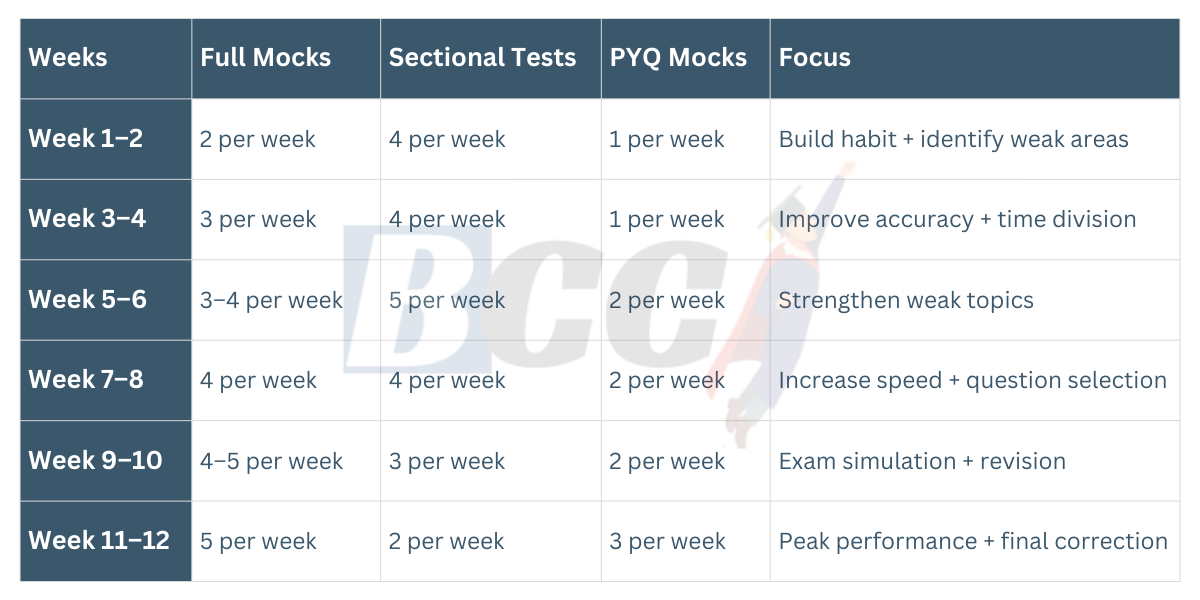
This is a balanced plan that ensures mocks do not replace revision, but work together with it.
Mock Test Attempt Strategy (Tier-1)
A mock test is not meant to be attempted like a normal practice set. In Tier-1, the best attempt strategy is always section-based and time-controlled.
A good strategy is to treat Tier-1 as 4 separate mini exams. You should decide in advance how much time each section will get. This prevents panic and ensures balance.
A safe and effective time division for most aspirants is:
- Reasoning: 12–14 minutes
- Quant: 18–20 minutes
- English: 10–12 minutes
- GA: 10–12 minutes
This is not a strict rule, but it is a strong starting point. With practice, you can adjust based on your strengths.
Your safe-attempt range should be determined based on accuracy. If your accuracy is below 85%, increasing attempts is dangerous. If your accuracy is around 90% or more, you can increase attempts confidently.
The 90% rule is very important for SSC Tier-1. It means you should train yourself to attempt only those questions where you are almost sure. Random guessing reduces score in the long run.
Skipping is a skill. In Tier-1, you should skip when:
- A question is calculation-heavy
- The concept is unfamiliar
- The question takes more than 40–50 seconds
- options are confusing and you are not sure
The Most Important Part: Mock Analysis Method
If you want real improvement, you must understand one truth: mock tests improve you only after analysis, not during attempt.
The best mock analysis method is a simple cycle:
Attempt → Review → Categorise mistakes → Fix → Retest
First, attempt the mock seriously in one sitting. Do not pause. Do not check answers in between. After the mock, take a short break. Then start review.
During review, do not only see correct and wrong. You must categorise your mistakes. This is the difference between an average aspirant and a topper.
Categorise mistakes into 4 types
- Concept mistake (you did not know the rule/concept)
- Calculation mistake (wrong calculation, wrong table, wrong simplification)
- Time mistake (you knew it but took too long)
- Silly mistake (wrong reading, wrong marking, confusion in options)
Once you categorise, the fixing becomes easy. Concept mistakes require revision. Calculation mistakes require speed drills. Time mistakes require shortcut practice. Silly mistakes require discipline.
How to maintain an error notebook
An error notebook should be simple and practical. You do not need to write full solutions. You only need to record:
- mock number and date
- question topic
- mistake type
- correct approach in 2–3 lines
- what you will do to avoid it next time
This notebook becomes your most valuable revision tool in the last month.
How to track improvement
Tracking is what makes mock strategy powerful. You should track:
- total score
- section-wise score
- attempts
- accuracy
- time distribution
- top 3 weak topics every week
Aspirants who track these for 12 weeks improve faster than those who just “give mocks”.
How to Analyse Each Section (Detailed)
Mock analysis should not be the same for all sections. Each section has a different nature, so analysis should also be different.
Quant: concept gaps vs calculation speed
In Quant, you must identify whether the issue is concept or speed. If you are repeatedly wrong in percentage, profit-loss, or algebra, it is a concept gap. But if you are correct yet slow, it is a speed issue.
Quant analysis should focus on:
- which topics take the maximum time
- where calculation errors happen
- whether you are using long methods
- which questions should be skipped faster
Reasoning: pattern gaps
Reasoning is a pattern-based section. If you get stuck, it usually means:
- you have not practised that pattern enough
- you are taking too long in puzzles
- you are over-solving instead of using options
Reasoning analysis should focus on:
- which question types are slow
- where you waste time
- which patterns repeat in mocks
English: grammar vs vocabulary errors
English mistakes must be separated into:
- grammar rule mistakes
- vocabulary meaning mistakes
- reading errors (misread sentence)
If grammar is weak, you need rule revision. If vocabulary is weak, you need daily word revision. If reading errors happen, you need slower reading and more discipline.
GA: revision vs guessing mistakes
GA is the most misunderstood section in SSC. Many aspirants treat it as “luck”. But in reality, GA performance depends on revision quality.
GA analysis should focus on:
- whether you knew the fact but forgot
- whether you guessed without logic
- whether you are revising static topics properly
- whether current affairs revision is consistent
PYQ Mocks vs New Pattern Mocks (What to Do First)
For SSC Tier-1, PYQs are more important than any new mock series. The reason is simple: SSC repeats the same type of questions and the same style of traps.
PYQ mocks teach you:
- the real difficulty level
- the real pattern of errors
- the actual type of options SSC gives
- the most repeated topics
A smart way to use PYQ papers is to treat them as full mocks in timer mode. After attempting, analyse them just like a mock. Do not treat PYQs as casual practice.
New pattern mocks are still useful, but for a different reason. They help you:
- handle unexpected question combinations
- improve speed
- test your adaptability
The best order is:
- Start with PYQ mocks
- Mix PYQ + new mocks together
- In the last month, increase PYQ mock frequency again
Common Mistakes Aspirants Make With Mocks
Most aspirants give mocks but do not improve because they repeat the same wrong habits. These mistakes look small, but they destroy your score improvement.
One major mistake is giving too many mocks without revision. Mocks are not a revision replacement. If you do not revise, you will keep repeating the same mistakes.
Another common mistake is not analysing properly. Many students check the score, feel happy or sad, and move to the next mock. This wastes the purpose of mocks.
Changing sources frequently is also a big mistake. Every mock series has its own style. If you change sources every week, your performance becomes unstable and your analysis becomes meaningless.
Many aspirants also ignore GA revision. They keep giving mocks and guessing GA questions. But GA is not a section you improve through mocks alone. It improves through daily revision.
Over-attempting is another dangerous habit. Many aspirants attempt 95 questions but with low accuracy. Because of negative marking, this often reduces the final score.
Timer pressure panic is also common. Students start rushing, making silly mistakes, and losing marks in easy questions. This improves only through regular mocks in exam-like conditions.
Finally, the biggest mistake is repeating the same mistakes without correction. If the same error appears in 5 mocks, it means your analysis system is not working.
Actionable Last 30 Days Mock Strategy
The last 30 days are the most important for SSC Tier-1 because this is where your final score shape becomes stable. In this phase, your goal is not to learn new topics. Your goal is to maximise performance using mocks and revision.
A practical last 30-day strategy is:
- 4 to 5 full mocks per week
- 2 PYQ mocks per week
- daily revision of GA + error notebook
- sectional tests only for weak areas
Revision should be the priority in the last month. A common mistake is doing only mocks and no revision. In the last 30 days, revision gives faster marks than new learning.
Final error correction should focus on:
- Your top 10 repeated mistakes
- Your slowest 5 topics
- Your most common silly errors
To avoid burnout, you must plan rest days. Even toppers do not give mocks daily without breaks. A good method is keeping 1 lighter day every week, where you only revise and do sectional practice.
Conclusion
For SSC CGL 2026 Tier-1, mock tests are not optional. They are the core of serious preparation. However, the real benefit of mocks comes only when you combine them with deep analysis, revision, and error correction.
Strategic mocks plus proper tracking create the highest score boost. The aspirants who consistently follow a 12-week plan, maintain an error notebook, and measure their accuracy improvement always outperform those who only solve random questions.
If you want a predictable improvement, the formula is simple:
Consistency in mocks + discipline in analysis + revision of mistakes.
FAQs
1) How many mocks should I give for SSC CGL Tier-1?
For SSC CGL, 40–60 full mocks are enough if you analyse properly and revise your mistakes regularly.
2) When should I start giving full mocks for SSC CGL 2026?
You should start full mocks when your syllabus is around 60–70% complete. Before that, sectional tests are better.
3) Are PYQ mocks more important than new mock tests?
Yes. PYQ mocks are more important because SSC repeats question patterns and option traps frequently.
4) How much time should I spend on mock analysis?
You should spend at least 1.5 to 2 times the mock duration. For a 60-minute mock, analysis should be 90–120 minutes.
5) What is the best accuracy target for SSC Tier-1 mocks?
A safe accuracy target is around 90%. If accuracy is low, increasing attempts can reduce your score due to negative marking.
Feature Image Prompt (Flat-3D Hybrid, #3b576c, No Text)
Prompt:
Professional flat-3D hybrid illustration of a serious Indian SSC aspirant sitting with a laptop showing a mock test analysis dashboard (no readable text), with a notebook open showing charts and check marks. Minimal clean background, soft shadows, exam preparation theme, Google Discover friendly. Use theme color #3b576c in subtle accents like laptop UI, stationery, and highlights. No typography, no logos, no watermark, no cartoon exaggeration.