

RRB Preparation Mistake: Ignoring General Science Till the End
(Why this single mistake ruins the chances of thousands of Railway aspirants every year)
Railway recruitment exams such as RRB NTPC, Group D, ALP, and Technician are often perceived as speed-based exams where Mathematics and Reasoning dominate the preparation strategy. As a result, General Science (GS) is frequently pushed to the end of the study plan—or worse, left for the “last one or two months”.
This approach looks harmless at the beginning, but in reality, ignoring General Science till the end is one of the biggest and costliest RRB preparation mistakes.
This article explains why aspirants neglect General Science, how it impacts final scores, and what a practical, Railway-specific GS strategy should look like.
Why Aspirants Ignore General Science Initially
Most RRB aspirants do not ignore General Science intentionally. The neglect usually happens due to the following reasons:
1. Fear of Theory-Heavy Content
General Science includes Physics, Chemistry, and Biology, which many aspirants associate with school-level theory, formulas, and memorisation. Compared to the “solvable” nature of Maths and Reasoning, GS feels time-consuming.
2. Misplaced Priority on Scoring Subjects
A common belief is:
- Maths + Reasoning = Rank deciders
- General Science = Optional or manageable later
This belief is flawed, especially in Railway exams where GS has fixed-weightage and high accuracy potential.
3. Overconfidence Due to “Static” Nature
Many candidates assume that since GS is static, it can be completed quickly at the end. However, retention, revision, and application-based questions make GS unsuitable for last-minute preparation.

Why Ignoring General Science Is Dangerous in RRB Exams
1. General Science Has Equal or Higher Weightage
In exams like RRB NTPC and Group D, General Science contributes 20–25 questions, which is often equal to or higher than General Awareness.
Neglecting GS means:
- Losing guaranteed marks
- Depending heavily on Maths/Reasoning for cut-off clearance
In competitive exams, one weak section can nullify two strong sections.
2. GS Is a High-Accuracy Section (If Prepared Early)
Unlike Reasoning or DI-based Maths questions, most General Science questions are direct:
- One correct concept
- One correct answer
A well-prepared aspirant can achieve 85–95% accuracy in GS, which significantly boosts the overall score.
Leaving GS till the end results in:
- Rote memorisation without clarity
- Confusion between similar concepts
- Poor accuracy under exam pressure
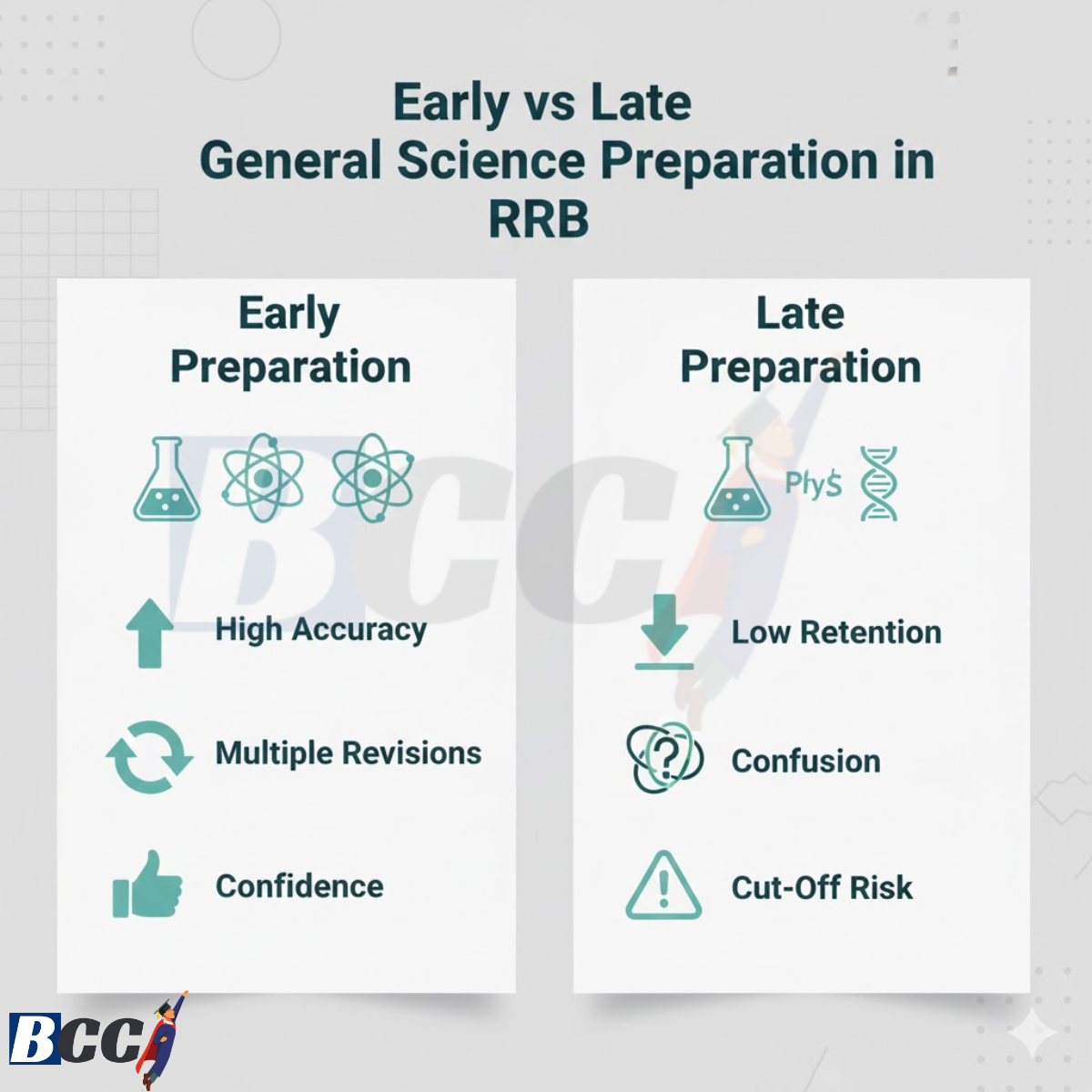
3. No Time for Multiple Revisions at the End
General Science is not about one-time reading. It requires:
- Concept building
- Repeated revision
- MCQ-based reinforcement
When aspirants start GS late:
- Only one revision is possible
- Forgetting begins before the exam
- Mock test GS scores remain inconsistent
4. GS Questions Are Increasingly Concept-Based
Recent RRB papers show a shift from pure factual questions to conceptual and application-based GS questions, such as:
- Everyday physics applications
- Basic biology reasoning
- Chemistry concepts linked to daily life
Without early preparation, such questions become guesswork.
The Real Cost of Ignoring General Science
Many aspirants experience the following pattern:
- Good Maths score
- Decent Reasoning performance
- Weak or average GS section
- Final score stuck just below the cut-off
In Railway exams, cut-offs are often decided by 2–4 marks. General Science alone can bridge this gap if handled correctly.
When Should You Start General Science for RRB?
The ideal time to start GS is from Day 1 of preparation, but in a controlled and realistic manner.
You do not need to study GS for hours daily. Instead:
- 30–45 minutes daily
- One small topic at a time
- Consistent revision cycle
This approach prevents overload and ensures long-term retention.
Practical Subject-Wise General Science Strategy for RRB
Physics (Railway-Oriented Focus)
Key areas:
- Motion, Work & Energy
- Heat and Temperature
- Electricity (basic)
- Light and Sound
- Units and Measurements
Strategy:
- Focus on concepts, not derivations
- Link formulas to daily-life examples
- Solve topic-wise MCQs weekly
Chemistry (Simplify and Score)
Key areas:
- Matter and its properties
- Acids, Bases, and Salts
- Metals and Non-metals
- Chemical reactions
- Basic everyday chemistry
Strategy:
- Short notes with reactions and examples
- Avoid unnecessary academic depth
- Revise through MCQs, not theory alone
Biology (Highest Return Section)
Key areas:
- Human body systems
- Nutrition and diseases
- Plant physiology (basic)
- Cell and tissues
Strategy:
- Diagram-based understanding
- Simple language notes
- Frequent revision due to the memory-based nature
How Top RRB Performers Handle General Science
Serious aspirants follow these principles:
- GS is treated as a scoring asset, not a burden
- Concepts are built early and revised regularly
- GS performance is tracked in every mock test
- Weak topics are revised weekly, not postponed
This disciplined approach ensures stable scores across all sections.
Institutes like The Prayas India emphasise early integration of General Science with Maths and Reasoning, ensuring aspirants do not face last-minute panic or uneven preparation.
Ideal Weekly GS Plan (Alongside Other Subjects)
- 3 days: Physics or Chemistry
- 2 days: Biology
- 1 day: Revision
- 1 day: GS sectional test analysis
This balanced approach keeps GS active throughout preparation without affecting other subjects.
FAQs on RRB Preparation Mistake
Q1. Is General Science significant for RRB NTPC and Group D?
Yes. General Science carries significant weightage and offers high accuracy potential, which is crucial for clearing cut-offs.
Q2. Can I prepare for General Science in the last two months?
It is risky. GS requires repeated revision. Last-minute preparation often leads to poor retention and low mock scores.
Q3. Which GS subject should I start with first?
Biology is usually the easiest and most scoring. Physics should be approached conceptually, followed by a basic Understanding of Chemistry.
Q4. How much time should I give to GS daily?
Around 30–45 minutes daily is sufficient if done consistently with revision.
Q5. Do coaching institutes help with Railway-specific GS preparation?
Yes. Structured guidance, Railway-oriented content, and regular testing—like that provided at The Prayas India—help aspirants prepare GS efficiently without overload.
Conclusion
Ignoring General Science till the end is not a minor oversight—it is a strategic error that costs marks, confidence, and sometimes the final selection.
Railway exams reward balanced preparation, not selective strength. When General Science is prepared early, revised regularly, and tested properly, it becomes one of the most reliable scoring sections.
If you want consistency, accuracy, and cut-off safety in RRB exams, General Science must be part of your preparation from the beginning—not the end.