

RRB General Awareness Strategy 2026: Static GK vs Current Affairs
Focus Areas: Railway GK, Science Basics, Current Events
Applicable Exams: RRB NTPC, Group D, ALP, Technician
Nature: CBT-based exams | High ROI section
Introduction: Why General Awareness Is a Game-Changer in RRB Exams
In RRB examinations, General Awareness (GA) is often the most scoring yet most neglected section. Unlike Maths or Reasoning, GA questions are direct, factual, and time-saving. A well-prepared candidate can attempt this section in 5–7 minutes with high accuracy.
However, the biggest confusion among aspirants is:
▶ What to study more — Static GK or Current Affairs?
This article provides a clear, exam-oriented RRB GA strategy, balancing Static GK, Railway-specific GK, Science basics, and Current Affairs, based on previous year trends and exam pattern.

Understanding the RRB GA Section
Key Characteristics:
- Questions are direct and factual
- No lengthy calculations or logic
- High accuracy possible
- Same syllabus across NTPC, Group D, ALP, Technician (difficulty varies)
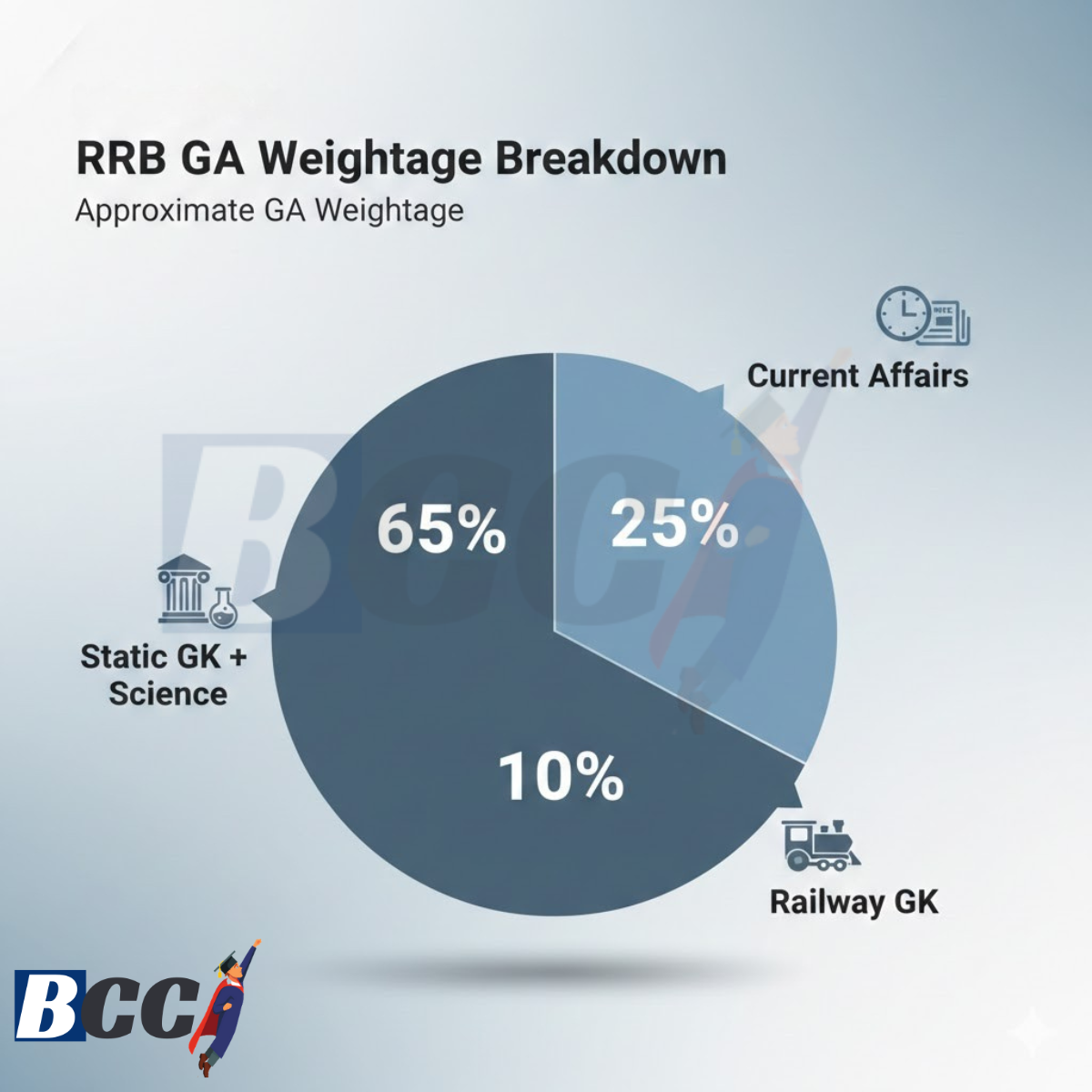
Typical GA Weightage:
- Static GK + Science: ~60–70%
- Current Affairs: ~30–40%
▶ This clearly shows that Static GK dominates RRB GA, unlike UPSC or even SSC.
Static GK: The Backbone of RRB General Awareness
What Comes Under Static GK?
- Indian History
- Geography (India-focused)
- Indian Polity (basic level)
- Economy (basic concepts only)
- Culture & Heritage
- Important Days & Facts
Static GK questions are repeatable in nature, making them extremely valuable.
Science Basics: Non-Negotiable for RRB
Science questions are very common, especially in:
- RRB Group D
- ALP
- Technician
Important Science Areas:
- Physics: Motion, Heat, Light, Electricity
- Chemistry: Acids-Bases, Metals, Everyday Chemistry
- Biology: Human Body, Plants, Diseases
▶ Level is Class 8–10 NCERT-based, factual and direct.
Railway GK: A Must-Prepare Area
Railway-related GK is RRB-specific and often ignored by aspirants.
High-Priority Railway GK Topics:
- Indian Railways zones & headquarters
- Railway ministers (current & recent)
- Railway boards & departments
- Important railway trains & projects
- Dedicated Freight Corridors
- Railway safety systems
▶ Even 2–3 correct Railway GK questions can make a big difference in cutoff-based exams.
Current Affairs: How Much Is Enough for RRB?
Unlike UPSC, RRB does not demand deep analysis.
RRB-Focused Current Affairs Scope:
- Last 6–8 months only
- National & International events
- Awards & Honours
- Sports
- Government schemes (basic objectives)
- Appointments
What to Avoid:
- Opinion-based news
- Editorials
- Deep policy analysis
▶ Focus on facts, names, dates, and places.
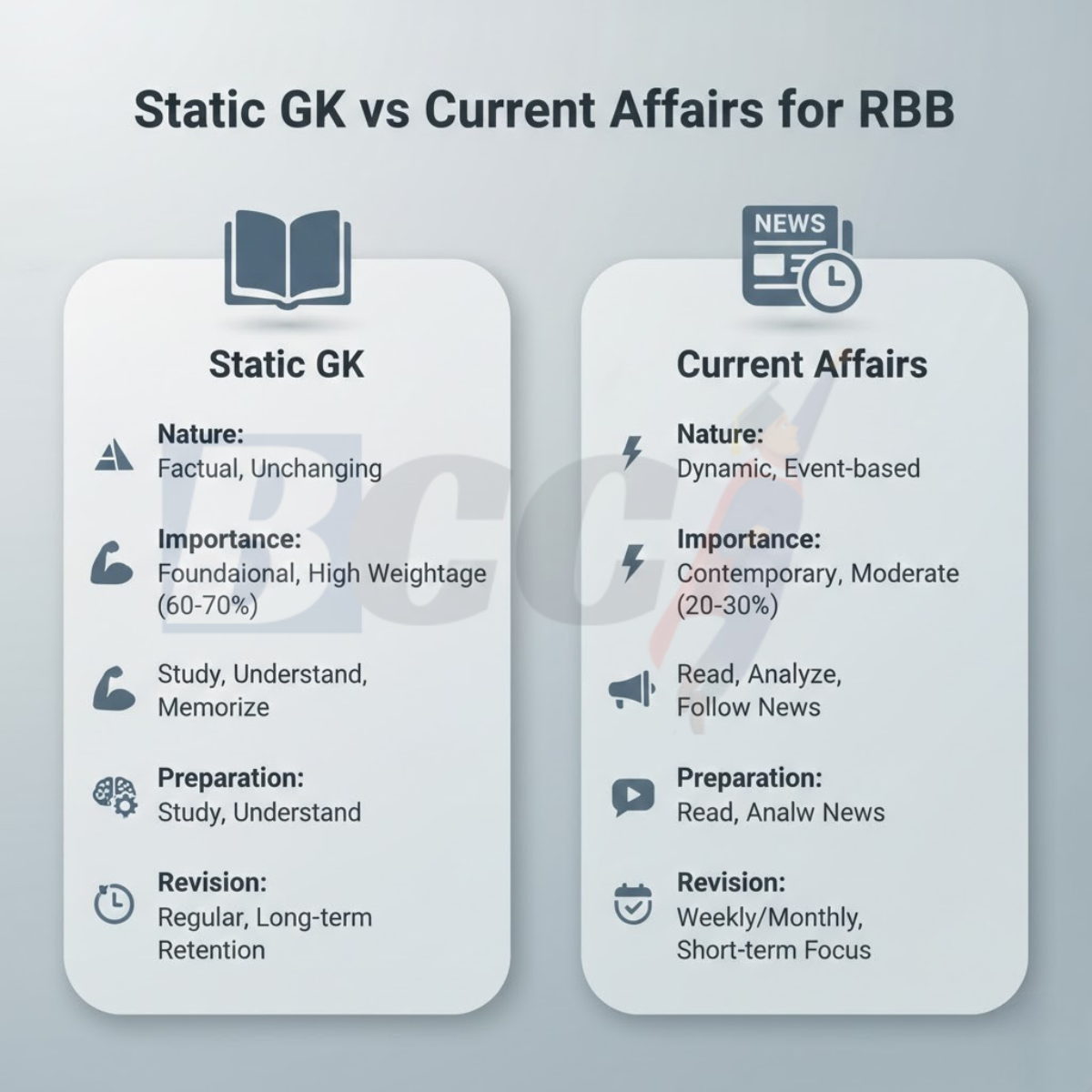
Static GK vs Current Affairs: Smart Comparison
| Area | Importance | Nature | Preparation Style |
|---|---|---|---|
| Static GK | Very High | Repeatable | One-time + revision |
| Science | Very High | Concept-based | NCERT + PYQs |
| Railway GK | High | RRB-specific | Memorisation |
| Current Affairs | Medium | Time-bound | Short notes |
▶ Static GK + Science should be your priority.
Smart RRB GA Preparation Strategy (Step-by-Step)
Step 1: Start with Static GK + Science
- Finish Static GK basics first
- Cover Science from the NCERT notes
- Use PYQs to understand patterns
Step 2: Add Railway GK
- Study zone-wise railway data
- Revise weekly
Step 3: Cover Current Affairs (Selective)
- Limit to last 6–8 months
- Use monthly capsules
- Make short factual notes
Step 4: Daily Revision
- GA needs daily touch
- Even 30–40 minutes is enough
Common Mistakes RRB Aspirants Make in GA
- Studying current affairs like UPSC
- Ignoring Railway GK
- Not revising Static GK
- Relying only on mock tests
- Reading instead of revising
Mock Test Strategy for GA
- Attempt GA section first in mocks
- Note repeated static questions
- Maintain a GA mistake notebook
- Revise wrong answers weekly
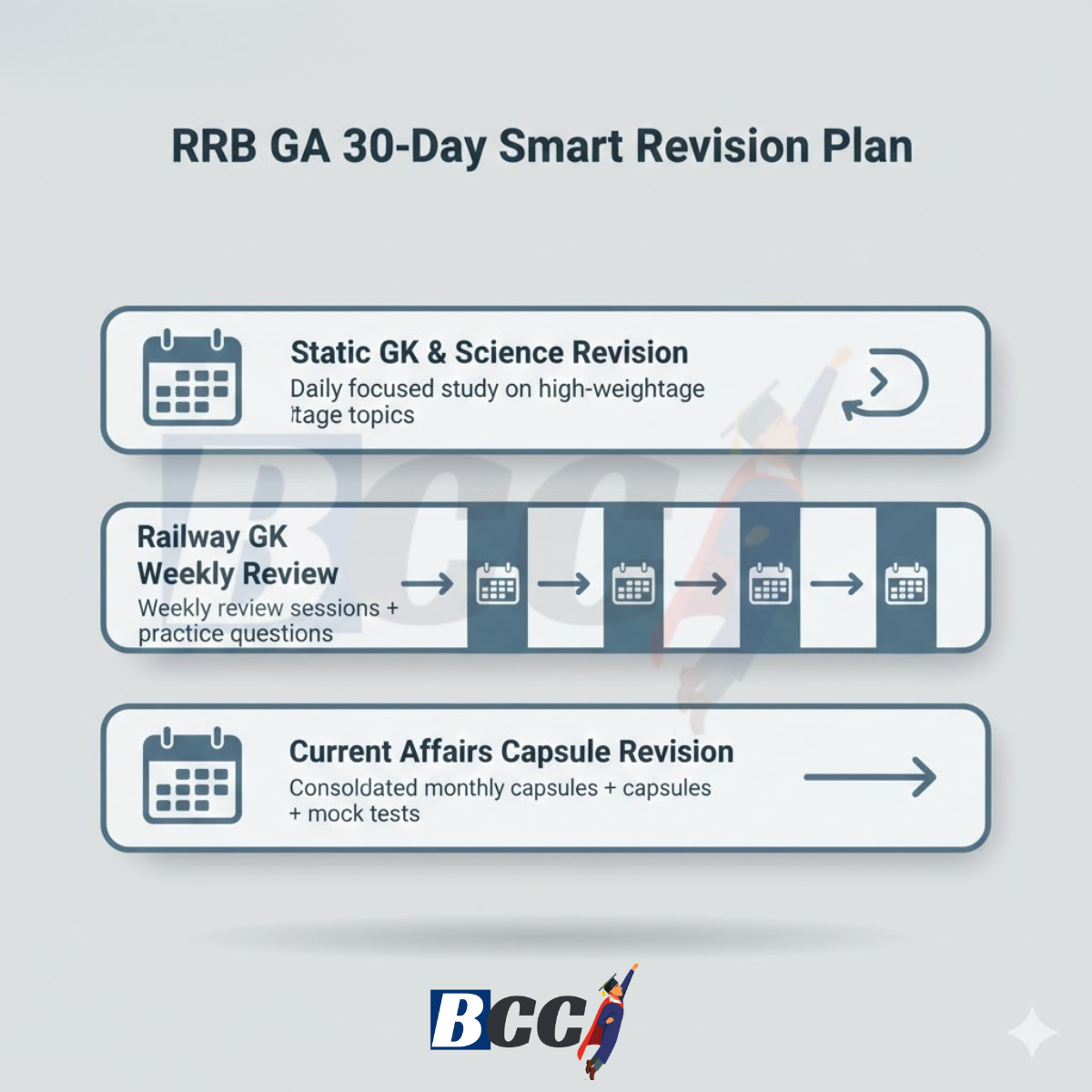
Last 30-Day GA Action Plan for RRB
Focus Only On:
- Static GK revision
- Science short notes
- Railway GK facts
- Current affairs revision (not new reading)
Avoid:
- New sources
- Random YouTube videos
- Overloading information
Conclusion
For RRB exams, General Awareness is not about studying more, but revising smartly. A balanced approach where Static GK, Science basics, and Railway GK form the core, supported by limited current affairs, gives the highest return on time invested.
If prepared correctly, GA can become your rank-deciding section.
FAQs: RRB General Awareness Preparation
Q1. Is Static GK more important than Current Affairs for RRB?
Yes. Static GK carries higher and more predictable weightage in RRB exams.
Q2. How many months of current affairs are enough for RRB?
Last 6–8 months are sufficient if revised properly.
Q3. Is Railway GK compulsory for RRB NTPC?
Not compulsory, but highly beneficial and often asked.
Q4. Are NCERT books enough for RRB Science?
Yes. NCERT Class 6–10 is more than sufficient.
Q5. How to revise GA effectively?
Use short notes, weekly revision, and PYQ-based MCQs.