
RBI Monetary Policy Basics: Repo Rate, CRR, SLR Explained for Competitive Exams (Bank, SSC, RRB)
The RBI monetary policy is one of the most important topics for competitive exams in India. Every year, questions based on repo rate, reverse repo, CRR, SLR, inflation, and the RBI tools are asked in:
- IBPS PO / Clerk
- SBI PO / Clerk
- The RBI Assistant / Grade B (basic level)
- SSC CGL / CHSL (GA section)
- RRB NTPC / Group D / ALP (GA section)
Many aspirants think monetary policy is a difficult topic. But in reality, exam questions are mostly concept-based and definition-based. If you understand the meaning and use of key terms like repo, CRR, and SLR, you can score full marks in this area.
This article explains monetary policy in a simple, exam-focused way, and also includes:
- Concept clarity
- Short notes
- Common mistakes
- FAQs
- MCQs for practice
- Infographic prompts for quick revision

1. What Is Monetary Policy?
Monetary policy is the process by which the Reserve Bank of India (RBI) controls:
- money supply
- interest rates
- credit flow
- inflation
- overall economic stability
In simple words:
Monetary policy is The RBI’s method to control inflation and manage economic growth by changing interest rates and banking rules.
Monetary Policy Has Two Main Objectives
1) Price Stability (Control Inflation)
The RBI tries to keep inflation under control so that prices do not rise too fast.
2) Growth Support
The RBI also ensures that the economy gets enough credit for growth, jobs, and business expansion.
2. Why RBI Monetary Policy Is Important for Exams
Competitive exams focus on the RBI monetary policy because:
- It affects the banking system
- It affects loan interest rates
- It affects inflation
- It affects investment and growth
- It is a frequently repeated topic in GA and Banking Awareness
In most exams, the questions are based on:
- Meaning of repo, reverse repo, CRR, SLR
- Effects of increasing/decreasing these rates
- Basic inflation concept
- The RBI’s role in controlling the money supply
3. Key Terms You Must Know (Most Important)
3.1 Repo Rate (Most Asked)
Definition
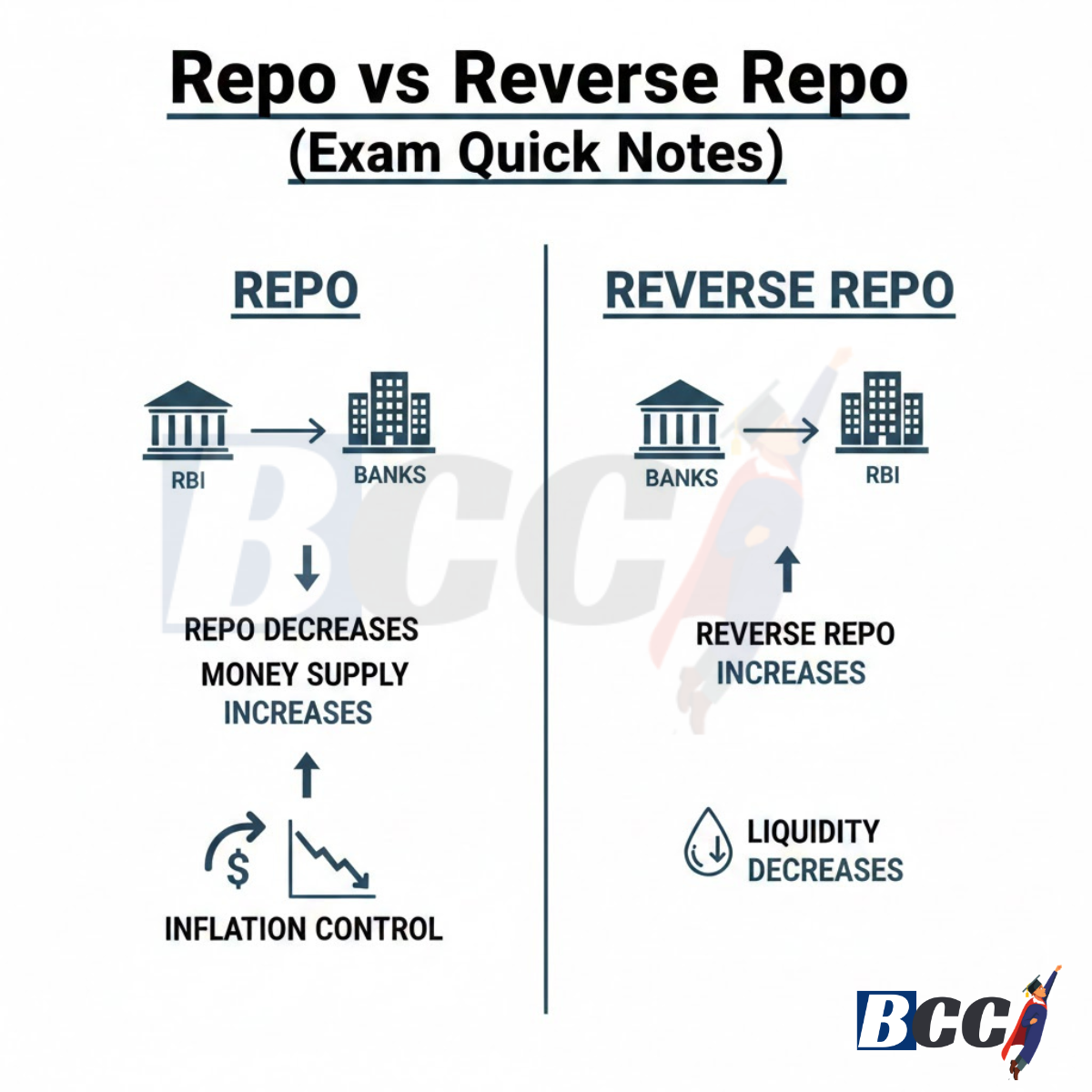
Repo rate is the interest rate at which commercial banks borrow money from The RBI for short-term needs by giving government securities as collateral.
In simple words:
Repo rate is the interest rate charged by The RBI when banks take loans from The RBI.
What Happens When The RBI Increases Repo Rate?
- Bank borrowing becomes expensive
- Banks increase loan interest rates
- Loans become costlier for public
- Spending decreases
- Inflation reduces
Conclusion:
✅ Repo rate increase → inflation control
What Happens When The RBI Decreases Repo Rate?
- Bank borrowing becomes cheaper
- Banks reduce loan interest rates
- Loans become cheaper for public
- Spending increases
- Growth increases
Conclusion:
✅ Repo rate decrease → economic growth support
3.2 Reverse Repo Rate
Definition
Reverse repo rate is the interest rate at which The RBI borrows money from banks.
In simple words:
Reverse repo is the rate The RBI pays banks to park money with The RBI.
When Reverse Repo Increases
- Banks deposit more money with the RBI
- Money supply in market reduces
- Inflation decreases
3.3 CRR (Cash Reserve Ratio)
Definition
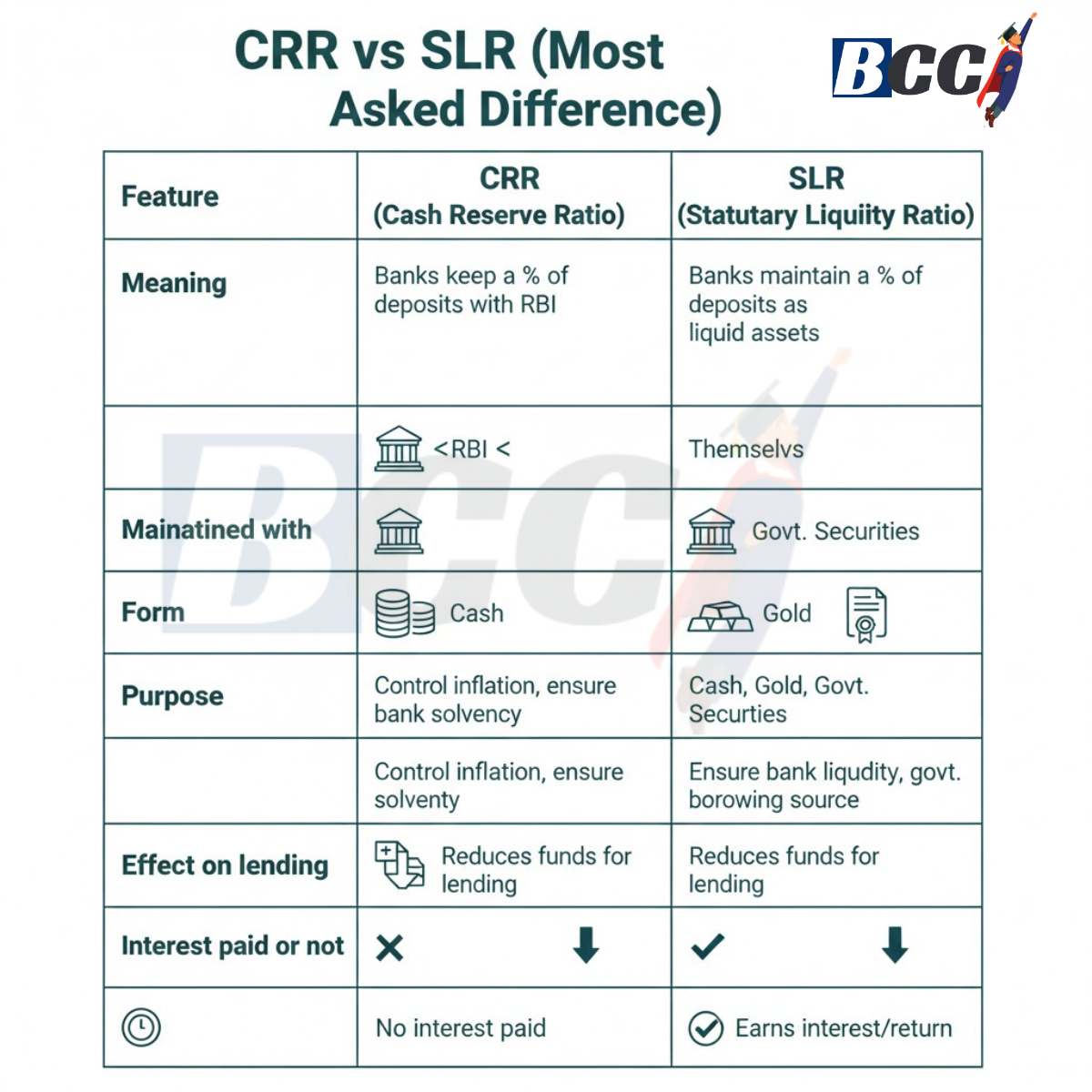
CRR is the percentage of a bank’s total deposits that must be kept as cash reserve with The RBI.
In simple words:
CRR is compulsory cash deposit by banks with The RBI.
Important Points About CRR
- Banks cannot use CRR money for loans
- The RBI does not pay interest on CRR
- CRR directly controls liquidity in the market
If the RBI Increases CRR
- Banks must keep more money with the RBI
- Banks have less money to lend
- Loan availability reduces
- Inflation decreases
If the RBI Decreases CRR
- Banks keep less money with the RBI
- Banks can lend more money
- Credit increases
- Growth increases
3.4 SLR (Statutory Liquidity Ratio)
Definition
SLR is the percentage of deposits that banks must keep in the form of:
- Cash
- Gold
- Government-approved securities
In simple words:
SLR is mandatory reserve maintained by banks (not necessarily with The RBI).
Key Difference: CRR vs SLR
- CRR is kept with The RBI (cash only)
- SLR is kept by banks (cash/gold/securities)
If The RBI Increases SLR
- Banks must keep more money in safe reserves
- Less money for lending
- Credit decreases
- Inflation reduces
If The RBI Decreases SLR
- Banks can lend more
- Credit increases
- Growth increases
4. One-Line Short Notes for Exams (High Value)
Use these for revision:
- Repo rate: The RBI lends to banks
- Reverse repo: The RBI borrows from banks
- CRR: Cash reserve with the RBI
- SLR: Reserve with banks in cash/gold/securities
- Inflation: General rise in prices
- Liquidity: Availability of money in the economy
- Tight monetary policy: Reduce inflation
- Easy monetary policy: Increase growth
5. Monetary Policy Committee (MPC) – Important for GA
The RBI’s monetary policy decisions are taken by the Monetary Policy Committee (MPC).
MPC Composition
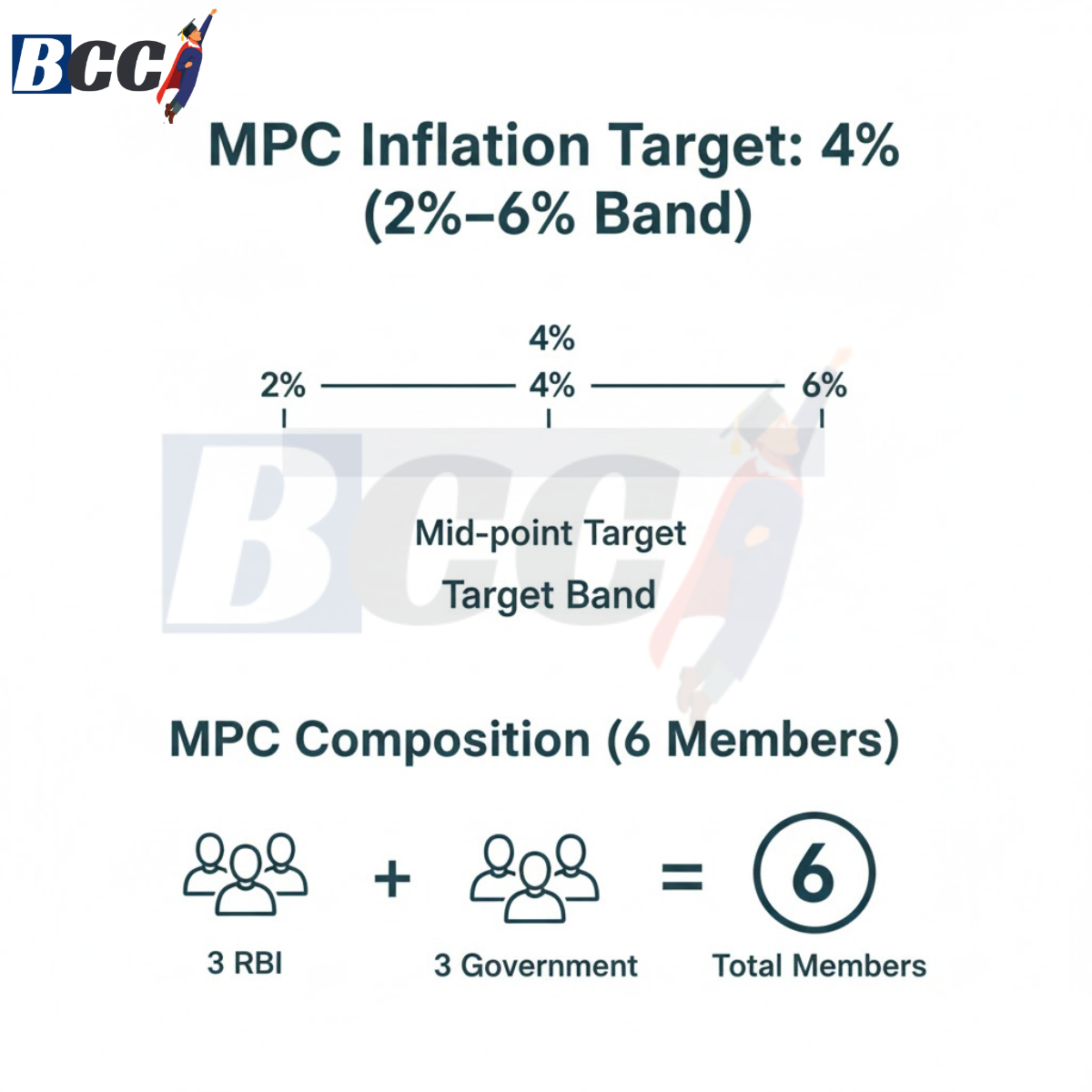
- Total members: 6
- The RBI members: 3
- Government nominated members: 3
MPC Main Work
- Decide repo rate
- Maintain inflation target
Inflation Target (Exam Fact)
India follows inflation targeting under CPI inflation.
- Target: 4%
- Upper limit: 6%
- Lower limit: 2%
This is a very common question in banking exams.
6. How The RBI Controls Inflation (Exam Concept)
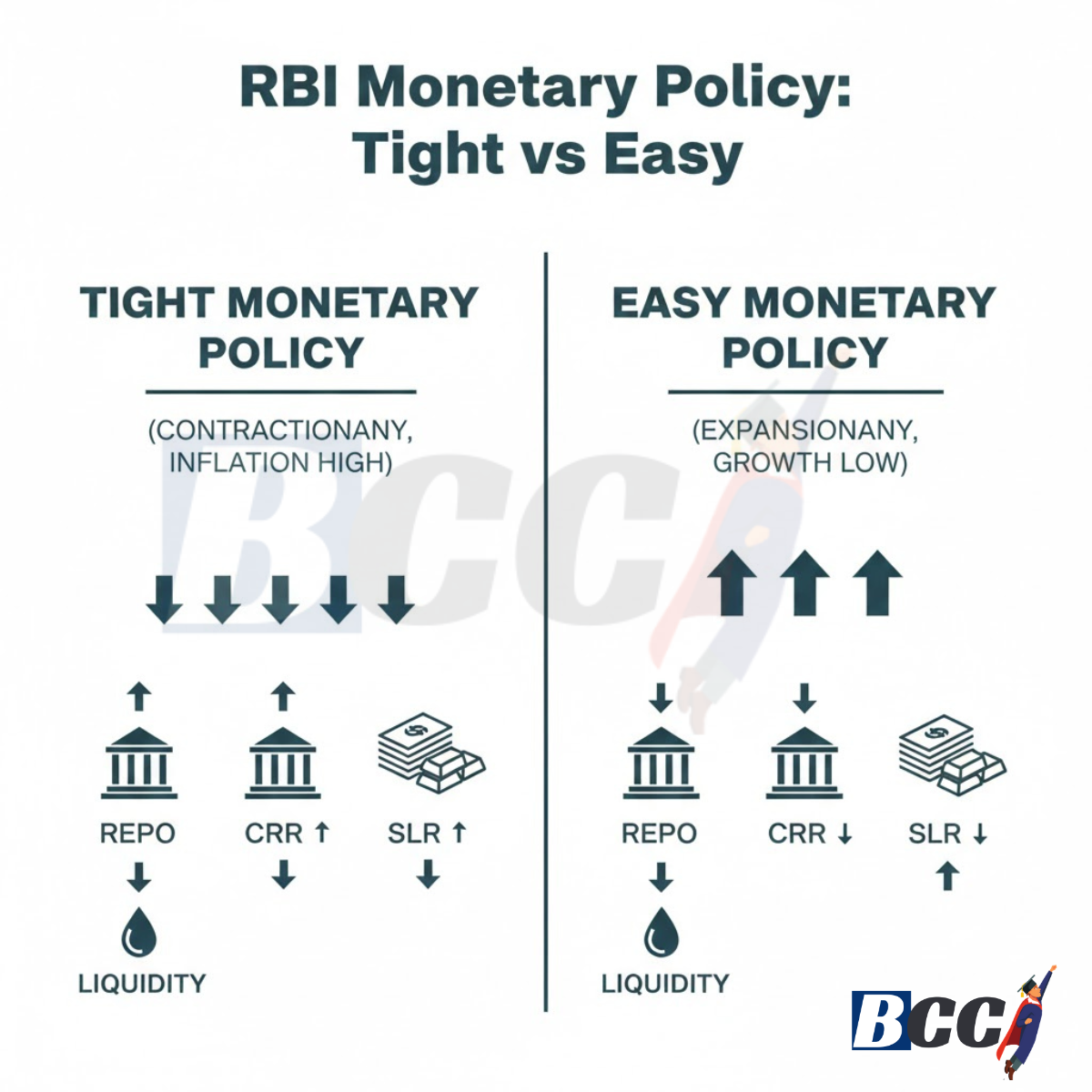
When inflation is high, the RBI generally:
- increases repo rate
- increases CRR/SLR (sometimes)
- reduces money supply
- makes loans expensive
When inflation is low and growth is weak, the RBI generally:
- reduces repo rate
- reduces CRR/SLR
- increases money supply
- makes loans cheaper
7. Monetary Policy Types (Easy to Remember)
7.1 Expansionary Monetary Policy (Easy Policy)
Used when:
- growth is slow
- unemployment is high
- demand is low
The RBI does:
- decrease repo rate
- decrease CRR/SLR
- increase liquidity
7.2 Contractionary Monetary Policy (Tight Policy)
Used when:
- inflation is high
- prices are rising fast
The RBI does:
- increase repo rate
- increase CRR/SLR
- reduce liquidity
8. How This Topic Appears in SSC, Bank, and RRB Exams
In Banking Exams
- direct definitions
- “if repo increases, what happens?”
- CRR/SLR conceptual differences
- MPC + inflation target
In SSC Exams
- one-liner facts
- static GK style
- basic effects of repo
In RRB Exams
- mixed: definitions + basic effects
- inflation-related questions
- The RBI functions
9. Common Mistakes Aspirants Make
Mistake 1: Confusing Repo and Reverse Repo
- Repo: The RBI gives money to banks
- Reverse repo: The RBI takes money from banks
Mistake 2: Confusing CRR and SLR
- CRR: kept with the RBI
- SLR: kept with banks
Mistake 3: Not Understanding “Increase vs Decrease”
Most questions are based on the effect of changing rates.
Mistake 4: Ignoring Short Notes
Monetary policy is a revision topic. Without short notes, you forget it quickly.
Mistake 5: Not Solving MCQs
This topic becomes scoring only when you practice MCQs.
10. Best Revision Strategy for Monetary Policy (Last 7 Days)
If your exam is near, revise like this:
Day 1: Repo + Reverse Repo + effects
Day 2: CRR + SLR + differences
Day 3: MPC + inflation target
Day 4: Practice 30 MCQs
Day 5: Revise short notes
Day 6: Practice PYQ-based GA questions
Day 7: Final revision (definitions + effects)
11. Note
Many aspirants preparing for Bank, SSC, and RRB exams prefer coaching institutes that teach such topics with:
- short notes
- concept clarity
- weekly mock tests
- GA one-liners
- doubt support
Institutes like The Prayas India are often chosen by students because they focus on exam-oriented teaching + revision + regular tests, which is especially helpful for Banking and RRB aspirants.
(Students should still attend demo sessions and compare the test series quality before joining.)
Conclusion
The RBI monetary policy is one of the easiest scoring topics if you study it the right way. You do not need advanced economics for SSC, Bank, or RRB exams.
You only need:
- clear definitions
- correct direction-based understanding (increase/decrease effects)
- CRR vs SLR difference
- MPC and inflation target facts
- regular MCQ practice
If you revise this topic properly, you can secure sure-shot marks in GA and Banking Awareness.
FAQs
Q1. What is repo rate in simple words?
Repo rate is the interest rate at which banks borrow money from the RBI for short-term needs.
Q2. What happens if the RBI increases repo rate?
Loans become expensive, spending reduces, and inflation is controlled.
Q3. What is the main difference between CRR and SLR?
CRR is kept with the RBI in cash form. SLR is kept by banks in cash, gold, or government securities.
Q4. Who decides repo rate in India?
Repo rate is decided by the Monetary Policy Committee (MPC) under the RBI.
Q5. Which is more important for bank exams: repo rate or CRR?
Both are important, but repo rate and MPC-based questions are asked most frequently.
MCQs (SSC / Bank / RRB Exam Style)
1. Repo rate is the rate at which:
A) The RBI lends to banks
B) Banks lend to the RBI
C) Banks lend to customers
D) The government lends to the RBI
✅ Answer: A
2. Reverse repo rate is the rate at which:
A) The RBI lends to banks
B) The RBI borrows from banks
C) Banks borrow from customers
D) The Government borrows from the RBI
✅ Answer: B
3. CRR is maintained by banks in the form of:
A) Gold only
B) Cash with The RBI
C) Government bonds with banks
D) Foreign currency
✅ Answer: B
4. If the RBI increases CRR, the money supply in the economy will:
A) Increase
B) Decrease
C) Remain same
D) Become zero
✅ Answer: B
5. SLR is maintained by banks in the form of:
A) Only cash with the RBI
B) Only gold with the RBI
C) Cash, gold, and approved securities
D) Only foreign currency
✅ Answer: C
6. Monetary Policy Committee (MPC) has how many members?
A) 4
B) 5
C) 6
D) 7
✅ Answer: C
7. India’s inflation target under MPC framework is:
A) 2%
B) 4%
C) 6%
D) 8%
✅ Answer: B
8. When repo rate decreases, it generally leads to:
A) Higher loan interest rates
B) Lower loan interest rates
C) No effect on loans
D) Increase in CRR automatically
✅ Answer: B
9. If the RBI increases SLR, banks will:
A) Lend more money
B) Lend less money
C) Stop taking deposits
D) Increase reverse repo rate
✅ Answer: B
10. Which of the following is used by the RBI to control inflation?
A) Repo rate
B) CRR
C) SLR
D) All of the above
✅ Answer: D