

MH-CET Law Attempt Strategy for Top Colleges | 3 & 5 Year CET
Many MH-CET Law aspirants prepare hard, study all sections, and still end up missing top colleges. When they look back, the gap often isn’t knowledge—it’s an attempt strategy.
In MH-CET Law, how many questions you attempt, which ones you skip, and where you take calculated risks decide whether you land in a top college or settle for an average one. This article explains why the attempt strategy matters more than people realise and how top-rank aspirants think differently during the exam.
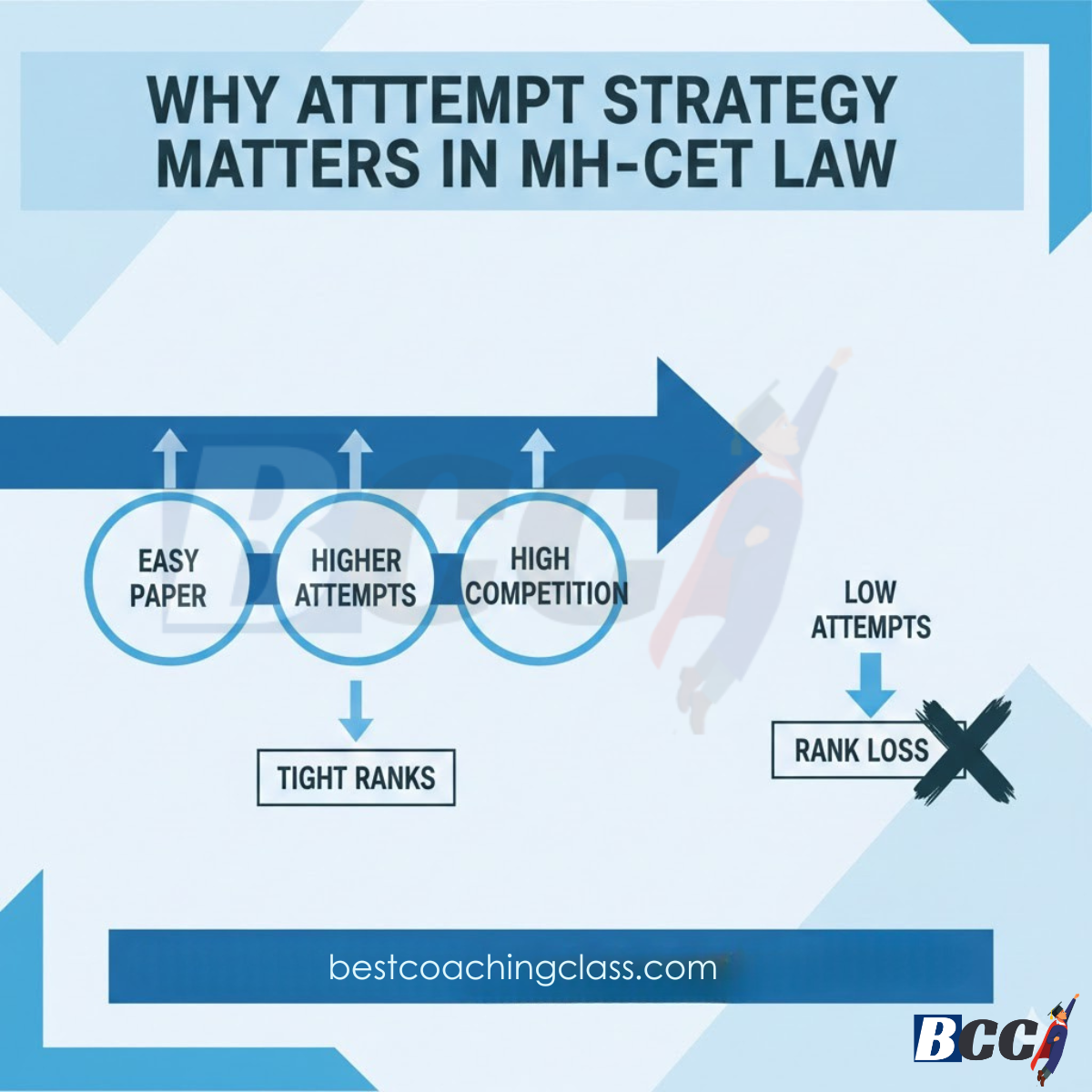
MH-CET Law Is Won on Strategy, Not Just Syllabus
MH-CET Law is a rank-based, high-density exam. Marks are tightly packed, and thousands of aspirants score within a small range. In such exams:
- Accuracy alone is not enough
- Playing too safe can be dangerous
- One wrong strategic decision can cost hundreds of ranks
Top colleges are not taken by those who know the most, but by those who handle the paper smartly under pressure.
Why Attempt Strategy Matters So Much
In easy to moderate MH-CET Law papers:
- Most questions are attemptable
- Many aspirants attempt a high number of questions
- Rank difference comes from marginal gains
If you attempt fewer questions than the competition—even with good accuracy—you fall behind. Top college cut-offs usually favour candidates who combine decent accuracy with higher attempts.
The Biggest Myth: “High Accuracy Is Enough”
A common belief among aspirants is:
“I’ll attempt fewer questions but maintain high accuracy.”
This approach works only in very tough exams. MH-CET Law is usually not one of them.
In reality:
- 80% accuracy with low attempts often scores less than
- 65–70% accuracy with higher attempts
Top college aspirants understand this trade-off. They aim for maximum safe attempts, not perfection.
How Top College Aspirants Think During the Exam
Top-rank aspirants follow a clear mental framework:
- They do not leave easy questions unattempted
- They avoid spending too much time on one question
- They attempt all sections with a minimum balance
- They accept small risks to stay competitive
Average college aspirants, on the other hand:
- Overthink close options
- Skip doable questions
- Get stuck in one section
- End with fewer attempts
The difference shows up clearly in the merit list.

Section-Wise Attempt Strategy That Works
Legal Aptitude
- Attempt maximum questions
- Avoid over-analysis of principle-based questions
- Do not leave Legal questions blank unless completely unsure
Legal is attempted by almost everyone. Leaving questions here puts you immediately behind.
GK & Current Affairs
This section separates the top colleges from the average ones.
- Many aspirants underprepare for GK
- Questions are factual and quick
- Even partial GK preparation gives an edge
Top aspirants attempt most GK questions confidently. Low GK attempts are a major rank killer.
Logical Reasoning
Logical Reasoning demands balance.
- Skip time-consuming puzzles if stuck
- Attempt all straightforward questions
- Do not leave the section underattempted due to fear
A poor LR attempt count quietly drags down rank.
English
English is the safest scoring section.
- Questions are generally easy
- Accuracy can be high
- Skipping English is an unnecessary risk
Top aspirants treat English as “free marks” and complete it fully.
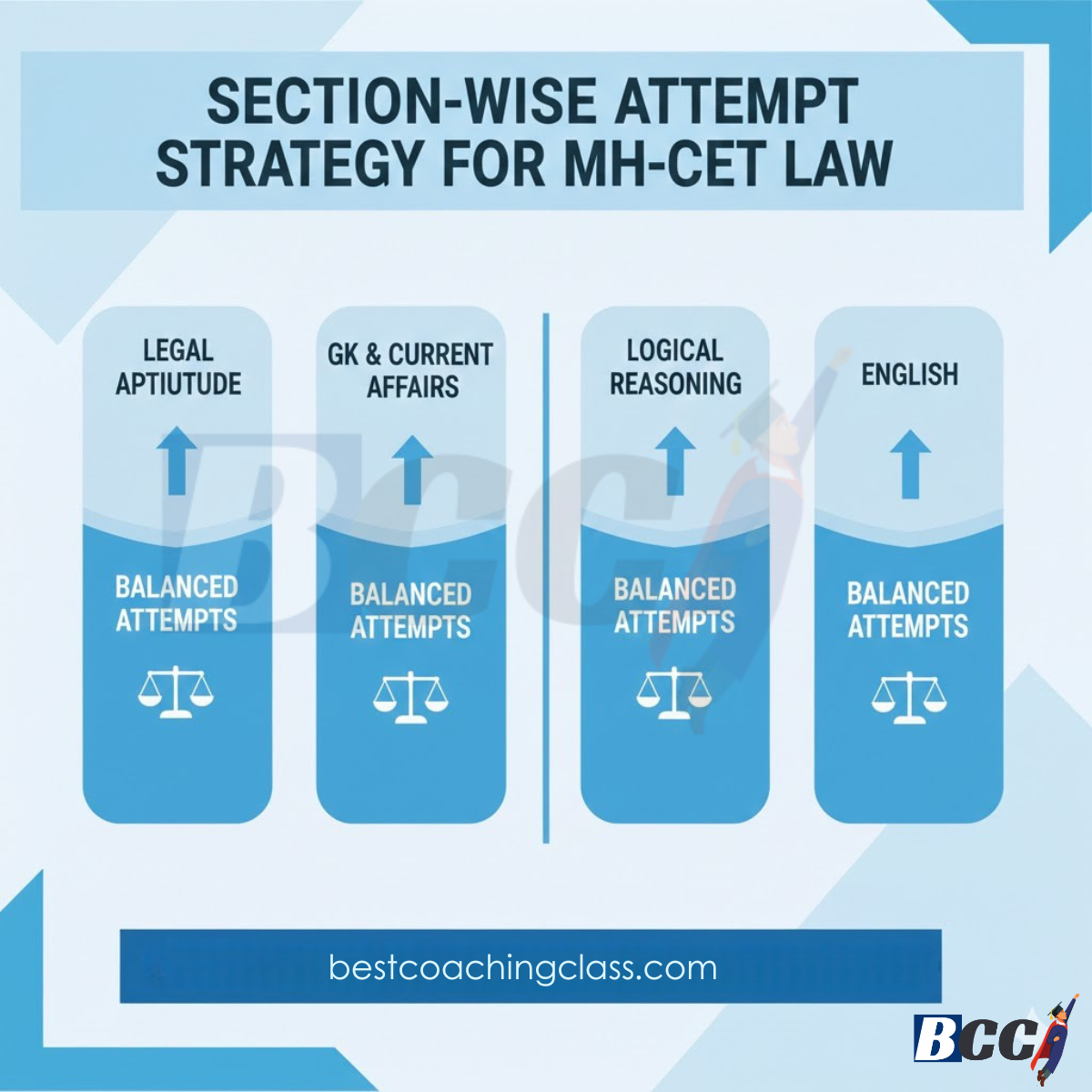
Attempt Balance: The Non-Negotiable Rule
One major mistake aspirants make is section imbalance.
For example:
- Very serious attempts in Legal
- Very low attempts in GK or LR
This imbalance damages rank badly.
Top college aspirants ensure:
- No section collapses
- No section is ignored
- Overall attempt count stays competitive
Balance does not mean equal attempts—it means no weak section.
Why Average College Aspirants Lose the Attempt Game
Most average-rank candidates fall into one of these traps:
- Overconfidence in the favourite section
- Fear of negative marking
- Excessive time on tricky questions
- Panic due to time pressure
They exit the exam thinking it went “okay,” but their attempt count tells a different story.
Mock Tests vs Real Exam: The Attempt Gap
Mock tests often mislead aspirants.
- Mock difficulty may be higher
- The competition level is lower
- The attempt strategy feels comfortable
In the real MH-CET Law exam:
- Questions feel easier
- Competition is intense
- Safe strategies fail
Top aspirants adjust their attempt strategy based on real exam conditions, not mock comfort.
Attempt Strategy for 3-Year vs 5-Year MH-CET Law
5-Year MH-CET Law
- Speed matters more
- GK basics give a quick advantage
- More serious attempts are necessary
3-Year MH-CET Law
- Competition is sharper
- Balanced accuracy + attempts matter
- GK depth plays a bigger role
In both cases, playing it safe rarely leads to top colleges.
What You Should Do Differently
To move from average colleges to top colleges:
- Track attempt count in mocks
- Identify sections you underattempt
- Practise decision-making under time pressure
- Set minimum attempt targets per section
- Learn when to move on
Your goal is not to solve everything—it is to outperform the average candidate.

Conclusion: Top Colleges Are Won on the Exam Table
MH-CET Law does not reward hesitation.
It rewards smart risk-taking, balance, and awareness of competition.
If you want top colleges:
- Do not fear attempting
- Do not ignore any section
- Do not rely only on accuracy
In MH-CET Law, the attempt strategy is the invisible line between top colleges and average colleges.
FAQs – MH-CET Law Attempt Strategy
1. How many questions should I attempt in MH-CET Law for top colleges?
There is no fixed number, but aspirants aiming for top colleges must maintain a high and balanced attempt count across all sections.
2. Is accuracy more important than attempts in MH-CET Law?
Accuracy matters, but low attempts hurt rank more in easy to moderate papers. Smart attempts with reasonable accuracy work best.
3. Which section should never be underattempted?
GK & Current Affairs. Underattempting this section causes major rank loss due to high competition.
4. Can I skip a section if I am strong in others?
No. Even one weak section can push your rank down significantly in MH-CET Law.
5. Is the attempt strategy different for the 3-Year and 5-Year MH-CET Law?
Yes. The 5-Year exam demands speed and higher attempts, while the 3-Year exam requires tighter balance and GK depth.