

How to Maximize SSC Score in the Last 60 Days: Smart Strategy for SSC CGL, CHSL & GD
The final 60 days before an SSC exam can decide your selection. At this stage, success depends not on studying more, but on studying smarter. Many aspirants waste this crucial period by overloading new topics, ignoring revision, or misusing mock tests.
To maximize your SSC score, you need a targeted revision plan, a structured mock strategy, and a smart system for improving weak areas. This article provides a complete last-60-day SSC preparation roadmap for SSC CGL, CHSL, and GD aspirants.
Why the Last 60 Days Are Crucial for SSC Exams
The final two months are important because:
- Most concepts should already be completed
- Rank improvement depends on speed, accuracy, and revision quality
- Previous year trends become clearer
- Small improvements can create big score jumps
In SSC exams, even a 10–20 mark improvement can significantly shift your rank.
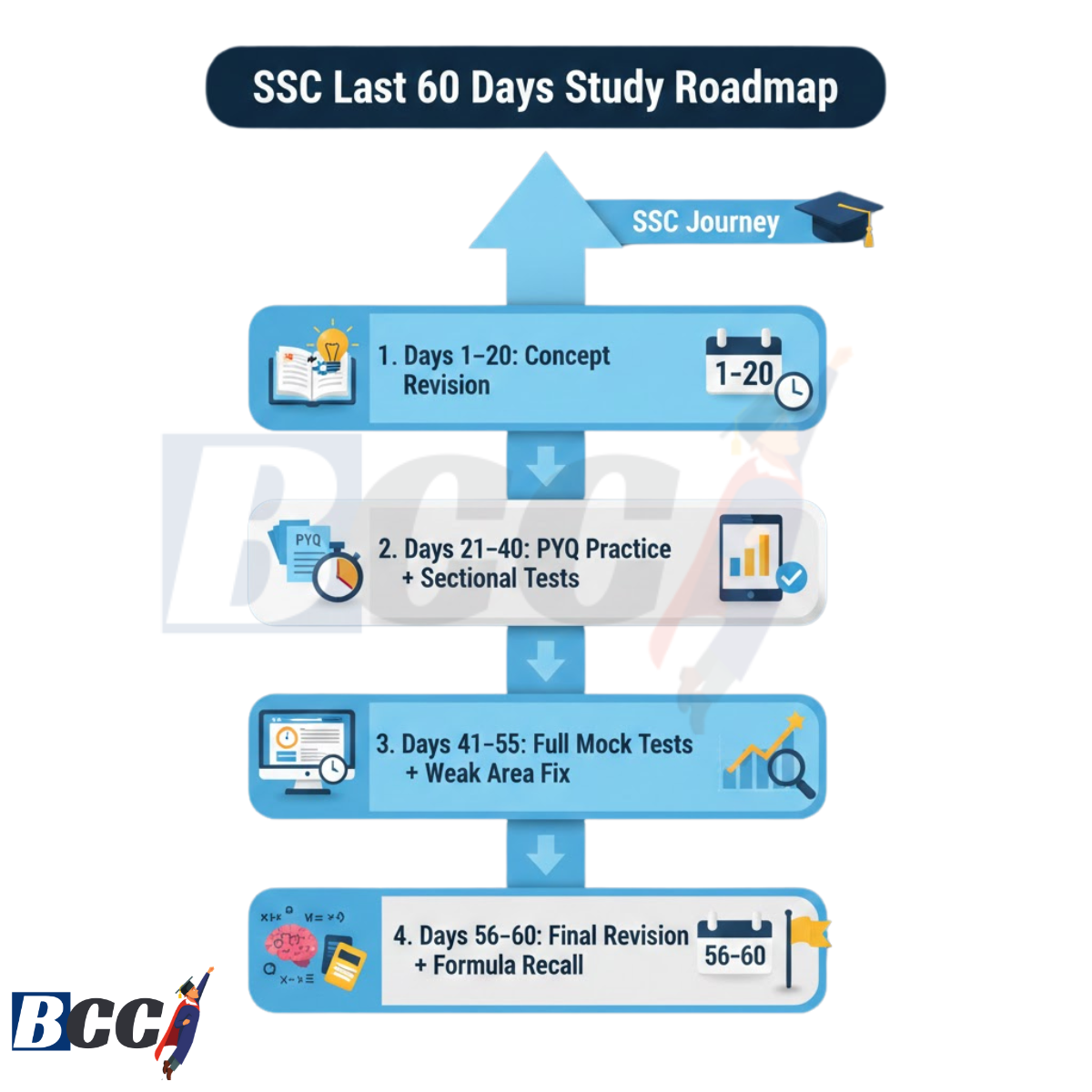
Step 1: Shift from Learning Mode to Revision Mode
In the last 60 days, your focus must move from new learning to strengthening existing knowledge.
Priority Order:
- Revise completed topics
- Practice previous year questions
- Analyze mistakes
- Improve speed and accuracy
- Avoid starting too many new topics
Smart Rule:
If a topic gives low returns, do not waste time mastering it. Focus on high-scoring and familiar areas.
Step 2: Smart Subject-Wise Strategy
Quantitative Aptitude
Focus on:
- Arithmetic (Profit & Loss, SI/CI, Time & Work, Ratio)
- Percentages and Averages
- Algebra and Number System basics
- Geometry and Mensuration formulas
- Data Interpretation speed practice
Strategy:
- Maintain a formula revision notebook
- Practice at least 25–40 quant questions daily
- Track slow questions and optimize solving time
Reasoning Ability
Focus on:
- Puzzles and Seating Arrangements
- Coding-Decoding
- Analogy and Classification
- Series and Direction Sense
- Syllogism and Logical Reasoning
Strategy:
- Practice timed reasoning sets
- Reduce overthinking
- Focus on pattern recognition
English Language
Focus on:
- Vocabulary (Synonyms, Antonyms, One-word substitution)
- Error Spotting
- Cloze Test
- Reading Comprehension
- Para Jumbles
Strategy:
- Learn 10–15 words daily
- Revise grammar rules weekly
- Practice RC with time limits
General Awareness (GA/GK)
Focus on:
- Static GK
- Current Affairs (last 6–12 months)
- Science basics
- History, Polity, Geography
- SSC-repeated topics
Strategy:
- Revise from short notes only
- Attempt daily GA quizzes
- Focus on repeated PYQ themes
Step 3: Mock Test Strategy (The Score Booster)
Mock tests are the biggest rank-improvement tool in SSC preparation.
Ideal Mock Frequency:
- Full-length mocks: 2–3 per week
- Sectional tests: 3–4 per week
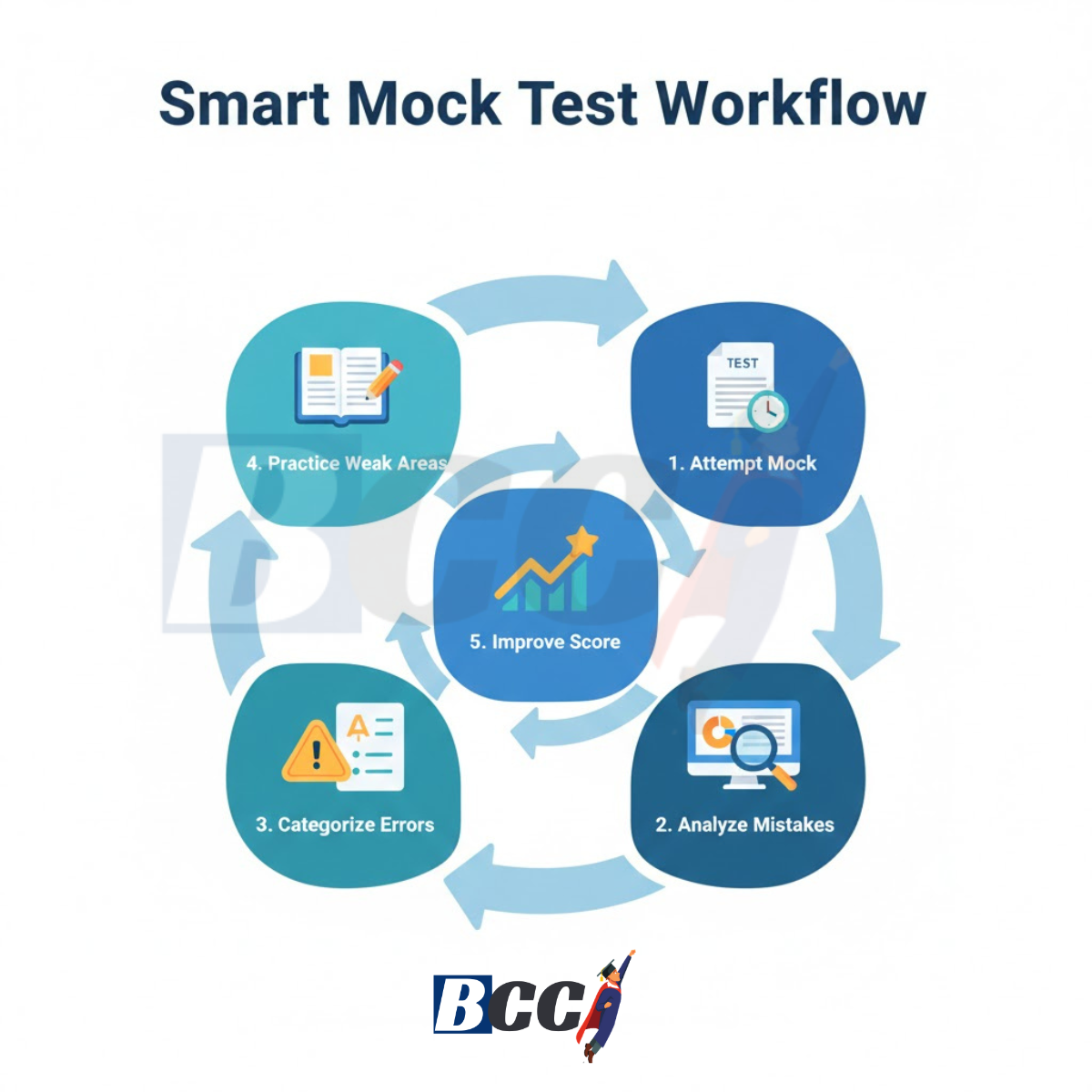
Correct Mock Test Process:
- Attempt mock like real exam
- Review every wrong answer
- Categorize mistakes:
-
- Concept error
- Calculation error
- Time management error
- Maintain a Mistake Notebook
- Revise mistakes weekly
Key Rule:
Never attempt a new mock without analyzing the previous one.
Step 4: Weak-Area Targeting Strategy
Do not ignore weak areas — fix them smartly.
How to Improve Weak Topics:
- Identify topics where accuracy < 70%
- Revise theory basics
- Practice topic-wise PYQs
- Limit improvement time to 7–10 days per topic
Smart Tip:
Do not try to make weak areas perfect — make them manageable.
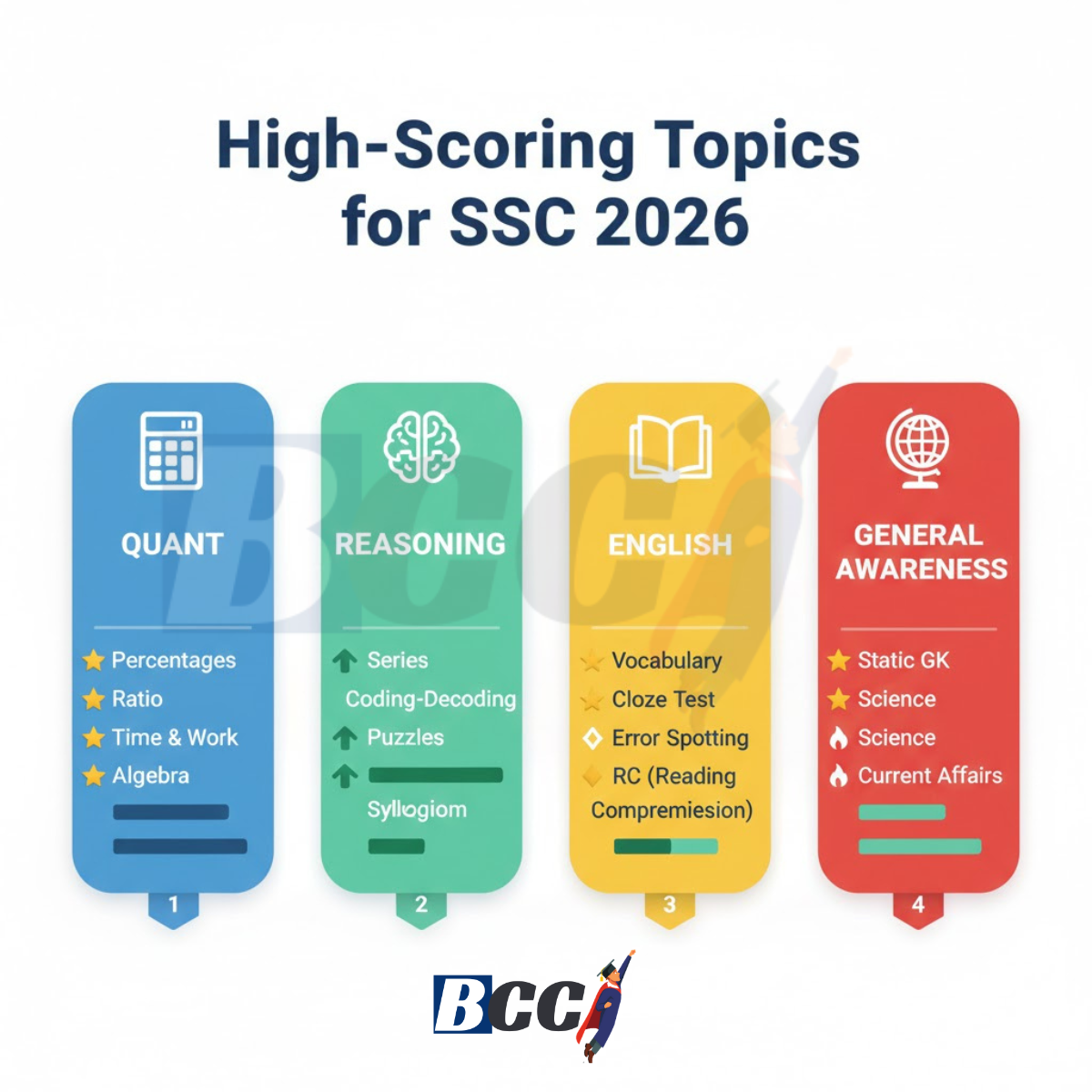
Step 5: High-Scoring Topic Priority List
Best Return Topics for SSC:
- Quant: Percentages, Ratio, Time & Work, Algebra
- Reasoning: Series, Coding, Puzzles
- English: Vocabulary, Error Spotting, Cloze Test
- GA: Static GK, Science, Current Affairs
Spend 70% of your time on high-yield topics.
Step 6: Daily 4-Hour Study Model (Last 60 Days)
Sample Routine:
- 1 hour: Quant practice
- 45 minutes: Reasoning
- 45 minutes: English
- 45 minutes: GA revision
- 30 minutes: Mock analysis
Consistency matters more than long study hours.
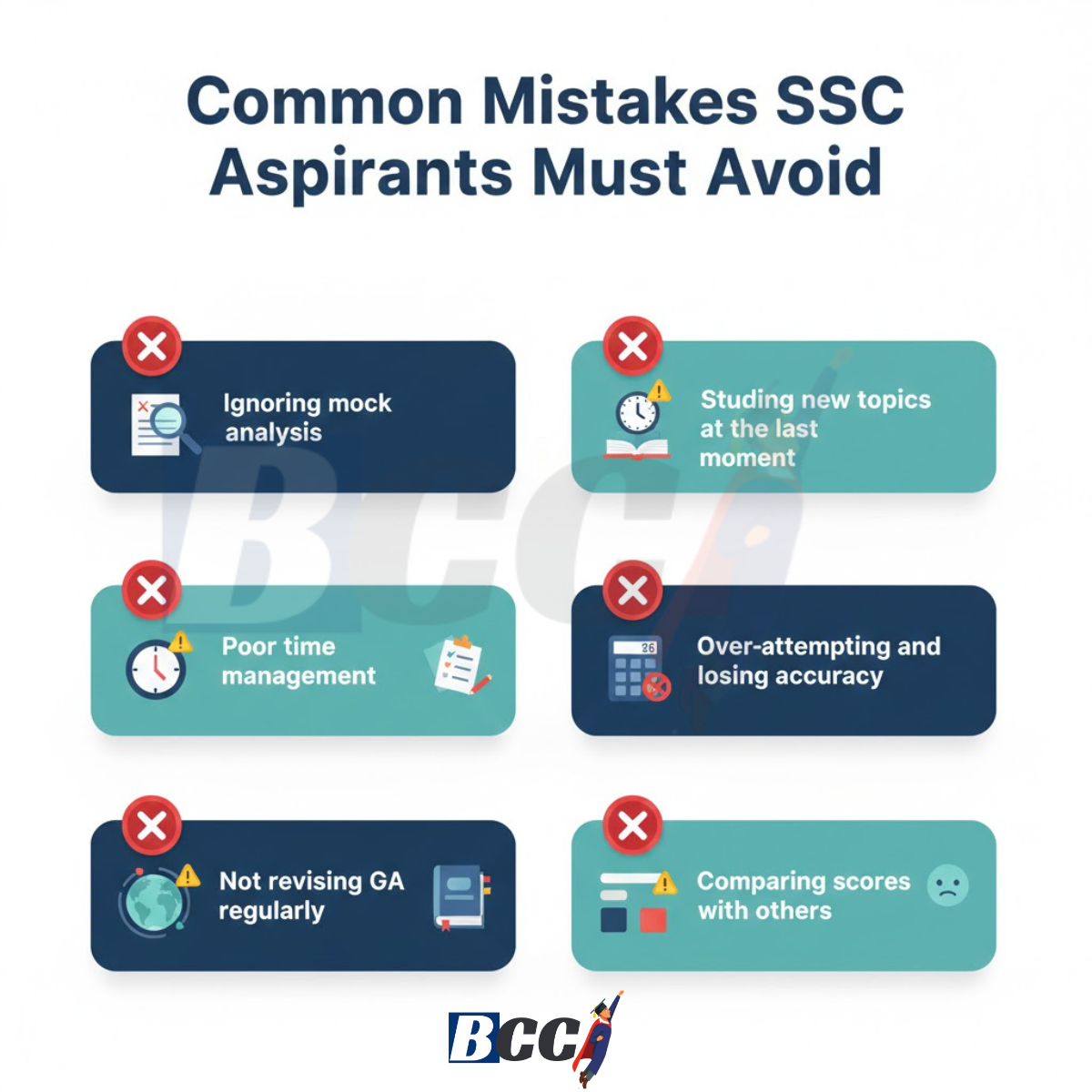
Step 7: Common Mistakes SSC Aspirants Must Avoid
- Studying new topics too late
- Ignoring mock test analysis
- Revising without practicing
- Spending too much time on weak areas
- Not revising GA daily
- Over-attempting and losing accuracy
- Comparing scores with others
Step 8: Last 30 Days Action Plan
Focus on:
- Only revision and PYQs
- Formula and vocabulary recall
- Improving accuracy above 85%
- Speed optimization
- Mock-based learning
Golden Rule:
Revise more than you study new.
Step 9: Exam-Day Strategy
- Attempt strong sections first
- Avoid spending more than 1 minute on one question
- Skip doubtful questions
- Keep calm and avoid panic
- Trust your preparation
Conclusion
Maximizing your SSC score in the last 60 days requires discipline, smart revision, mock-driven improvement, and focus on scoring topics. Success depends not on how much you study, but how strategically you revise, practice, and analyze.
A focused, consistent, and data-driven strategy can easily boost your SSC rank and bring you closer to selection.
FAQs — SSC Last 60 Days Preparation
Q1. Can I improve my SSC score in 60 days?
Yes. With smart mock practice, revision, and weak-area correction, significant score improvement is possible.
Q2. How many mock tests should I attempt weekly?
At least 2–3 full-length mocks and 3–4 sectional tests per week.
Q3. Should I start new topics in the last 2 months?
Only if they are high-scoring and easy. Otherwise, prioritize revision.
Q4. How much GA should I revise daily?
Minimum 30–45 minutes daily, focusing on short notes and PYQs.
Q5. What matters more — speed or accuracy?
Accuracy first. Speed improves naturally with practice.