

How Normalisation Changes Your Final Rank: Score Scaling, Fairness & Shift Differences
Introduction: Why Normalisation Confuses Aspirants
Many aspirants feel shocked after exam results when their expected marks do not match their final score or rank. A common reaction is:
“I did well, but my rank is still low. Why?”
In most Bank, SSC, and RRB exams conducted in multiple shifts, the answer lies in normalisation.
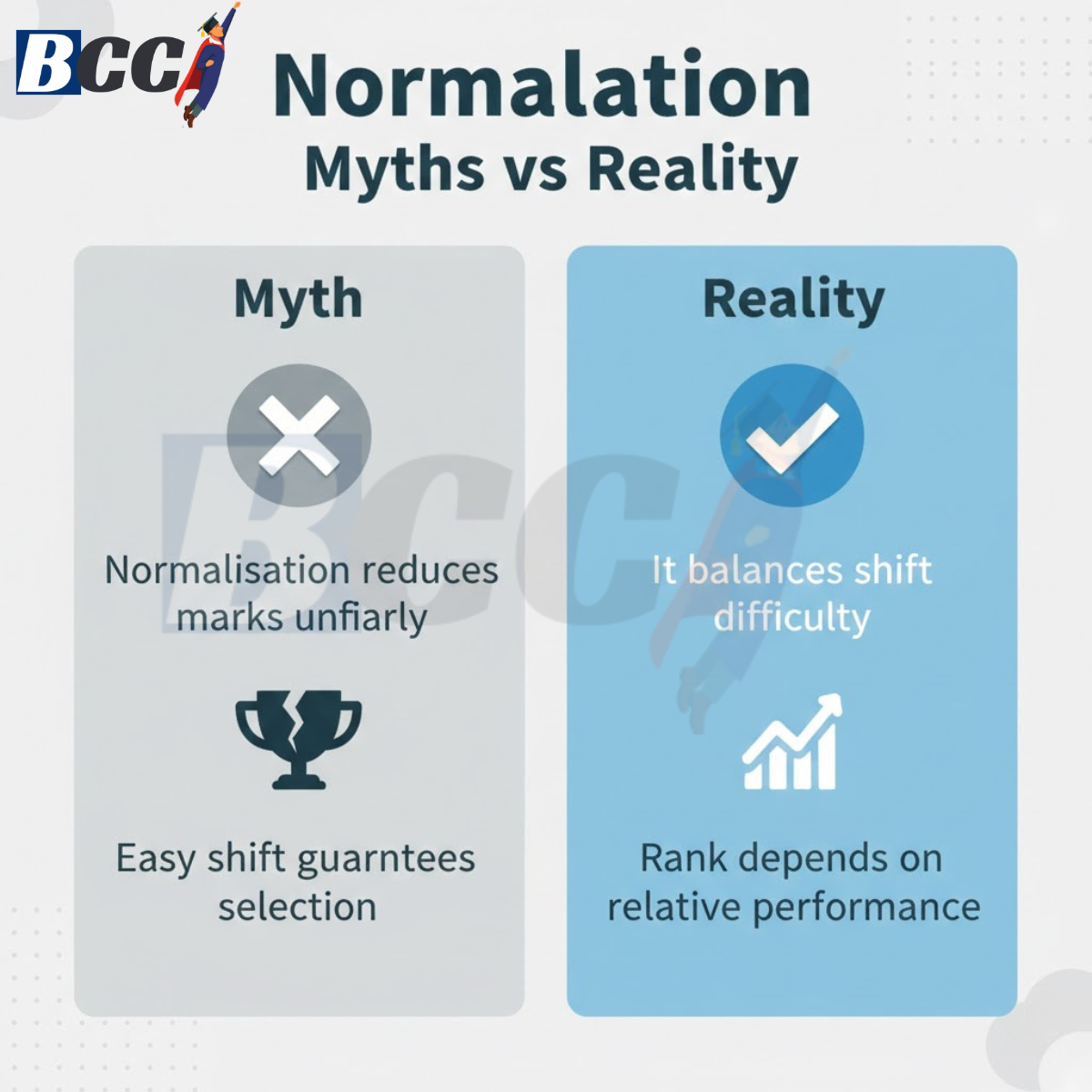
Normalisation is not about reducing marks unfairly. It is a system designed to balance score differences between easy and difficult shifts so that no candidate gets an unfair advantage or disadvantage.
This article explains how normalisation works, why it affects rank more than raw marks, and how aspirants should prepare with this reality in mind.
Why Normalisation Is Needed in Competitive Exams
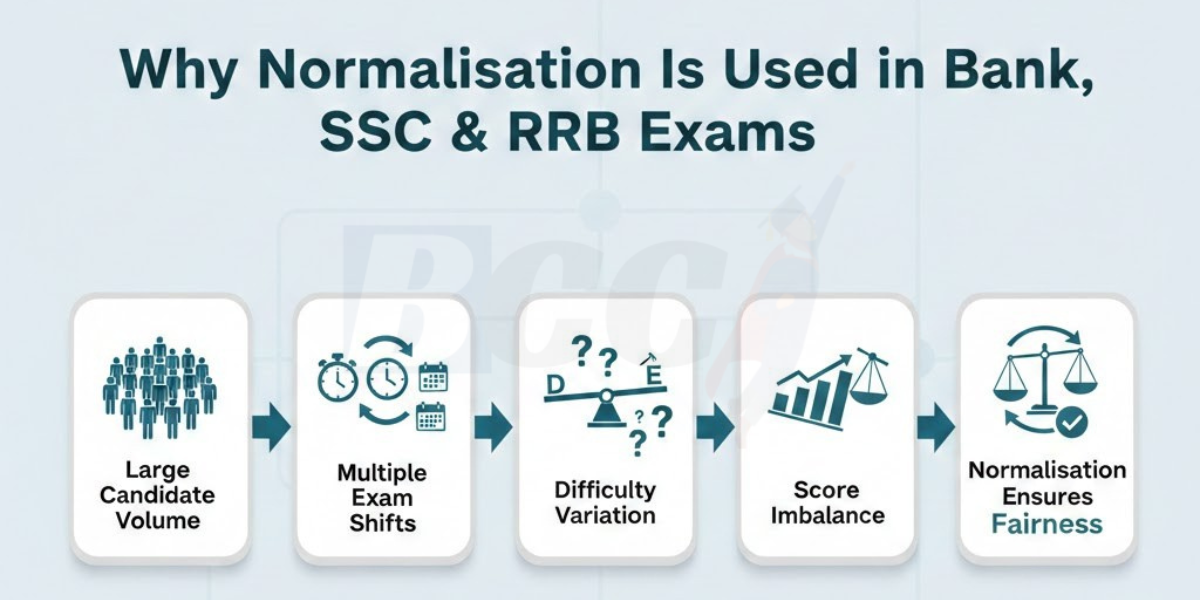
Large-scale exams like Bank, SSC, and RRB are conducted in multiple shifts due to:
- A huge number of candidates
- Limited exam centres
- Time and logistical constraints
Each shift may vary slightly in difficulty:
- One shift may be easier
- Another may be harder
- Attempt levels may differ
Without normalisation, candidates from an easier shift could score higher without being more capable.
Normalisation ensures fair competition across all shifts.
Raw Marks vs Normalised Score: The Real Difference
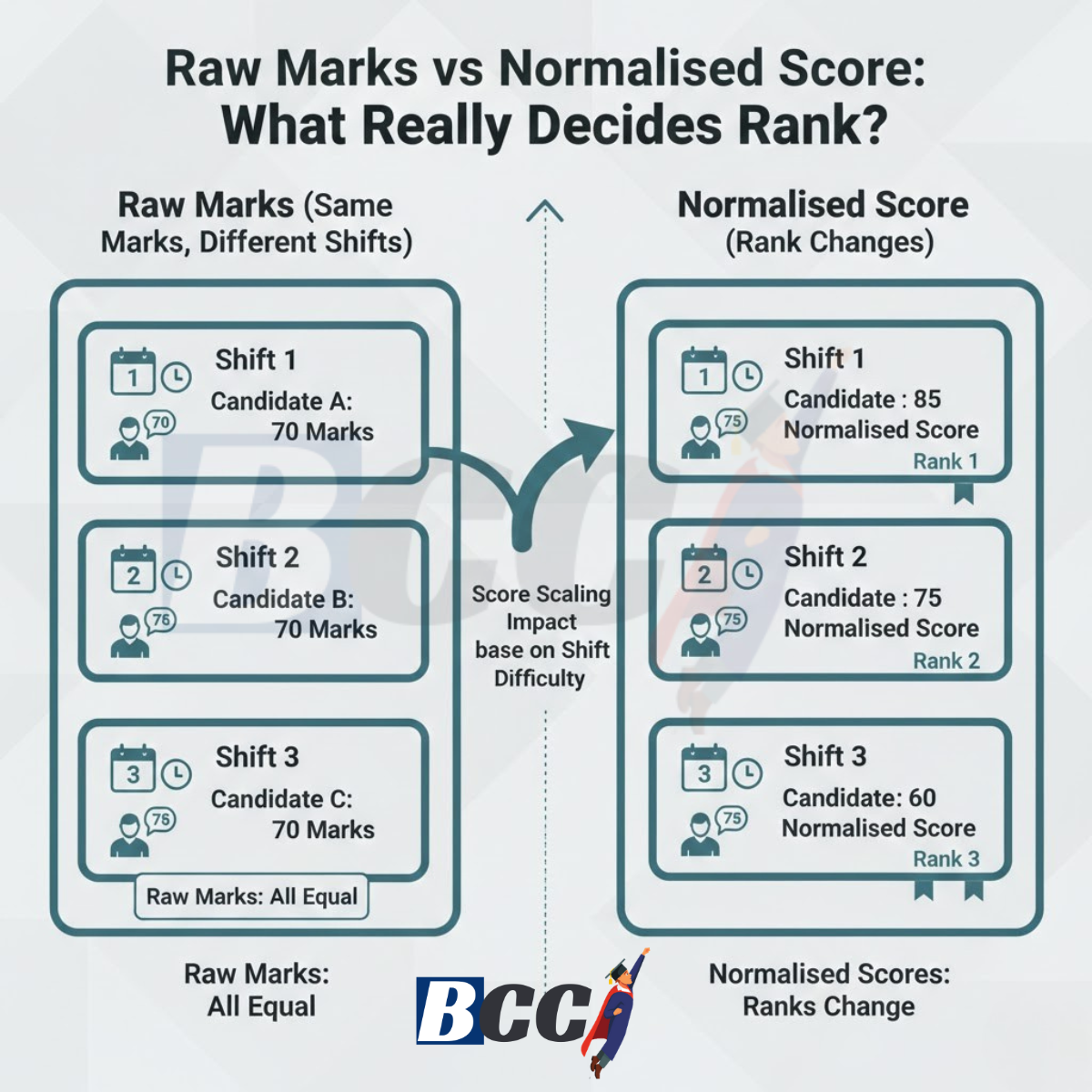
Raw Marks
- Actual marks scored in your shift
- Do not consider paper difficulty
Normalised Score
- Adjusted marks based on shift difficulty
- Reflects relative performance across all candidates
Final rank and cut-off are decided using normalised scores, not raw marks.
This is why two candidates with the same raw marks can have different final ranks.
How Normalisation Changes Your Final Rank
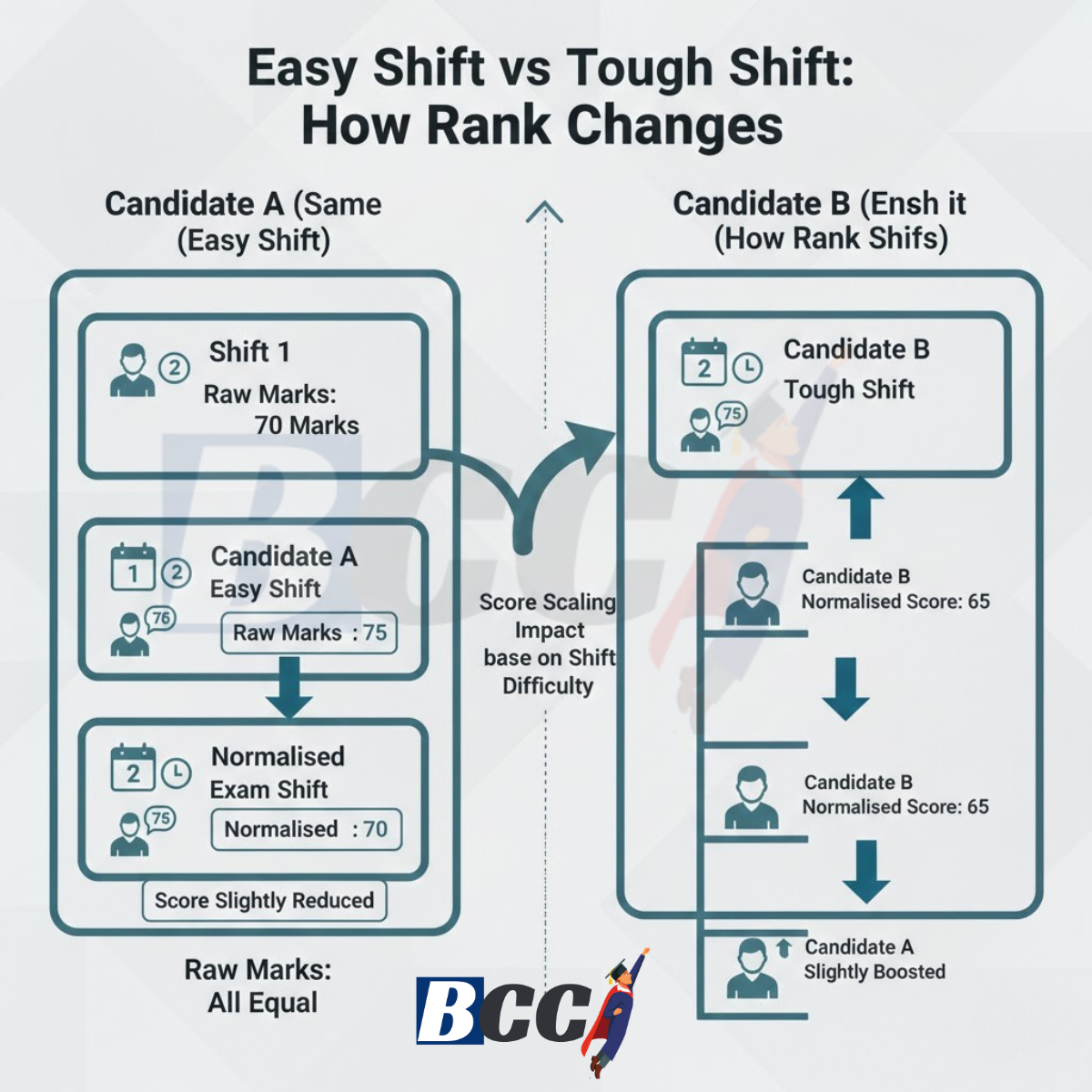
1. Easier Shift = Higher Risk of Score Reduction
If your paper was easier:
- More candidates score high
- Competition increases
- The normalised score may reduce slightly
2. Tougher Shift = Possible Score Boost
If your paper was harder:
- Average attempts are lower
- Normalisation may increase your score
- Your rank may improve
This system ensures that performance is judged relative to difficulty, not luck.
Example: How Shift Difficulty Impacts Rank
| Candidate | Shift Level | Raw Marks | Normalised Score | Rank Impact |
|---|---|---|---|---|
| A | Easy Shift | 78 | 74 | Rank drops |
| B | Tough Shift | 72 | 76 | Rank improves |
Even though Candidate A scored more raw marks, Candidate B may rank higher due to shift difficulty adjustment.
Why Normalisation Feels Unfair (But Isn’t)
Aspirants often feel:
- “My marks were reduced”
- “Others got lucky”
- “Normalisation ruined my selection”
In reality, normalisation prevents unfair advantage.
Without it:
- Easy-shift candidates would dominate rankings
- Hard-shift candidates would be unfairly pushed down
Normalisation protects overall merit and fairness.
Normalisation Matters More in High-Competition Exams
In Bank, SSC, and RRB exams:
- Cut-offs are decided by small mark differences
- Even 0.5 to 2 marks can change rank drastically
- Normalisation plays a major role near cut-off zones
This means rank is influenced more by relative performance than absolute marks.
How Aspirants Should Prepare Keeping Normalisation in Mind

1. Focus on Accuracy Over Over-Attempts
Random guessing hurts normalised score due to negative marking.
2. Do Not Panic About Shift Difficulty
Shift difficulty cannot be controlled. Your performance can.
3. Aim to Beat the Average, Not Just Attempt More
Normalisation rewards relative strength, not blind speed.
4. Strengthen Scoring Sections
Strong performance in:
- General Awareness
- Quantitative Aptitude
- Reasoning
creates safety even after normalisation.
Why Cut-Offs Rise Despite Normalisation
Even with score scaling:
- Competition continues to grow
- Average preparation levels improve
- Easy scoring questions increase
Normalisation balances shifts, but cannot reduce overall competition pressure.
This is why cut-offs keep rising even when normalisation is applied.
Common Mistakes Aspirants Make About Normalisation
- Overthinking the shift difficulty after the exam
- Blaming normalisation instead of analysing performance
- Increasing guesswork in easy shifts
- Ignoring accuracy under pressure
Smart aspirants focus on controllable factors, not shifting assumptions.
Conclusion: Normalisation Rewards Smart, Balanced Performance
Normalisation does not punish good students.
It protects fairness and ensures equal opportunity.
Final rank is determined not just by marks, but by:
- Accuracy
- Consistency
- Sectional balance
- Relative performance
Aspirants who understand normalisation prepare calmly, strategically, and without panic, giving them a better chance of final selection.
FAQs: Normalisation in Bank, SSC & RRB Exams
1. Does normalisation reduce everyone’s marks?
No. It may increase or decrease marks depending on shift difficulty.
2. Can normalisation affect the final rank significantly?
Yes. Small changes can move a rank up or down near cut-offs.
3. Should I attempt more if my shift seems easy?
No. Accuracy matters more than blind attempts.
4. Is normalisation used in all Bank, SSC & RRB exams?
Yes, in most multi-shift competitive exams.
5. Can normalisation be avoided?
No. It is necessary for fairness across shifts.
SEO Meta Details
Meta Title
How Normalisation Changes Your Final Rank in Bank, SSC & RRB Exams
Meta Description
Tags (Comma-Separated)
normalisation in bank exams, SSC score scaling, RRB rank calculation, shift difficulty impact, banking exam cut off logic, SSC exam strategy, RRB preparation tips, exam score normalisation, government exam ranking system
Infographic 1: Why Normalisation Exists
Placement: After section — “Why Normalisation Is Needed in Competitive Exams”
Title:
Why Normalisation Is Used in Bank, SSC & RRB Exams
Prompt:
A step-by-step visual flow showing:
Large candidate volume → Multiple exam shifts → Difficulty variation → Score imbalance → Normalisation ensures fairness.
Use clean icons, arrows, minimal text, professional exam theme, flat-3D hybrid style, accent color #3b576c.
Infographic 2: Raw Marks vs Normalised Score
Placement: After section — “Raw Marks vs Normalised Score”
Title:
Raw Marks vs Normalised Score: What Really Decides Rank?
Prompt:
A split comparison chart showing:
Left side: Raw Marks (same marks, different shifts)
Right side: Adjusted Normalised Scores (rank changes)
Include arrows showing score scaling impact. Minimal, data-focused, flat-3D hybrid style with #3b576c highlights.
Infographic 3: Easy Shift vs Tough Shift Rank Impact
Placement: After section — “How Normalisation Changes Your Final Rank”
Title:
Easy Shift vs Tough Shift: How Rank Changes
Prompt:
Two candidate cards:
Candidate A (Easy Shift) → Score slightly reduced
Candidate B (Tough Shift) → Score slightly boosted
Visual ranking ladder showing rank movement. Clean academic look, balanced composition, accent color #3b576c.
Infographic 4: What Aspirants Should Focus On
Placement: After section — “How Aspirants Should Prepare Keeping Normalisation in Mind”
Title:
Smart Strategy to Beat Normalisation Impact
Prompt:
A checklist-style infographic showing:
Accuracy over guesswork
Beat average, not just attempt more
Strengthen scoring sections
Stay calm regardless of shift
Modern exam-prep visual style, minimal text, flat-3D hybrid look, #3b576c highlights.
Infographic 5: Normalisation Myths vs Reality
Placement: Before Conclusion
Title:
Normalisation Myths vs Reality
Prompt:
Two-column comparison:
Myth: Normalisation reduces marks unfairly
Reality: It balances shift difficulty
Myth: Easy shift guarantees selection
Reality: Rank depends on relative performance
Use clean icons, clear contrast, exam-themed flat-3D style, accent color #3b576c.