
Beginner’s Roadmap to UPSC: How to Start IAS Preparation After 12th and During Graduation
Starting UPSC preparation right after Class 12 or in college is a smart move. You get more time to build concepts gradually, practice answer writing, and attempt the exam with a strong foundation instead of last‑minute cramming. This roadmap is designed for school pass‑outs and college students who want a clear, practical, and sustainable path to the Civil Services Examination.
Step 1: Understand UPSC Basics Early
Before jumping into books, first be clear about the exam itself.
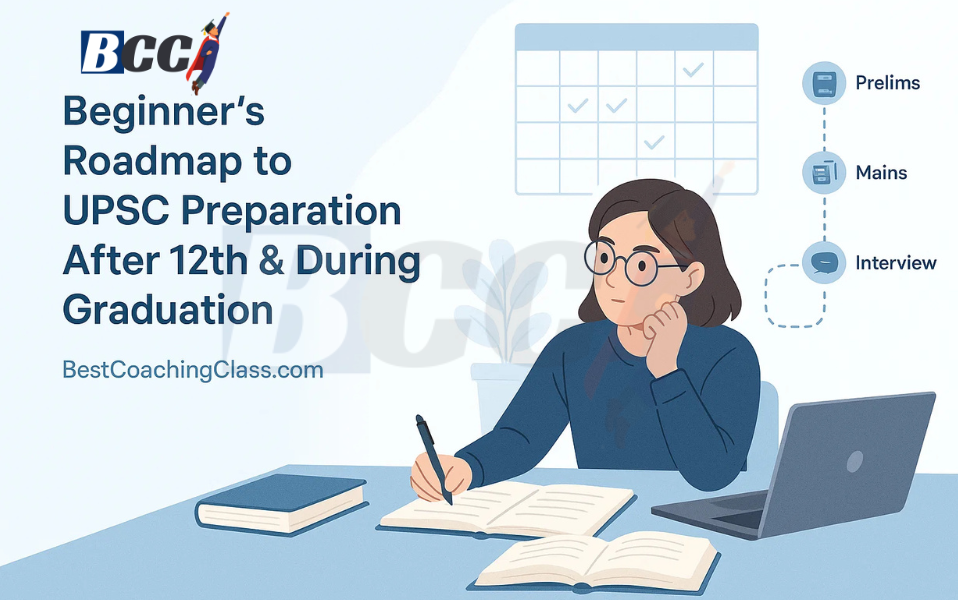
- UPSC CSE has three stages: Prelims (objective), Mains (descriptive), and Interview (Personality Test).
- You can appear only after graduation and at 21 years of age, but serious preparation can easily start in Class 12 or first year of college.
- The core subjects—History, Polity, Geography, Economy, Environment, Science, and Current Affairs—repeat across Prelims and Mains, so early work never goes waste.
Make a simple note of: exam pattern, number of papers, marks, attempts and age limit, so your mind always knows what you are working toward.
Step 2: Choose Graduation & Subjects Smartly
You do not have to take a particular stream to crack UPSC, but some choices make life easier.
- Arts/Humanities with subjects like Political Science, History, Sociology, Geography, Economics etc. overlap heavily with GS and common optionals.
- Commerce and Science students can still clear UPSC comfortably; they just need to consciously add humanities reading parallel to their degree.
- If possible, select a graduation subject that you might also keep as your optional later (e.g., Pol. Sci., Sociology, Public Administration, Geography). This gives you 3 years of natural preparation without extra load.
Wrong choice of stream never “ends” your UPSC journey, but an aligned stream gives you a headstart.
Step 3: Build a Strong Base with NCERTs
For the first 12–18 months, especially in late school and early college, your main focus should be foundation.
Priority NCERTs (Class 6–12) include:
- History: Ancient, Medieval, Modern and Themes of World History
- Geography: Physical, India, and Human Geography
- Polity: Democratic Politics, Indian Constitution at Work, Indian Polity
- Economics: Macroeconomics, Indian Economic Development
- General Science & Biology basics
How to study them:
- Read each chapter 2–3 times over a few months instead of one fast reading.
- After finishing a chapter, quickly write down 10 key points in your own words.
- At the end of each book, revise all your chapter notes in one sitting.
When NCERT concepts are strong, standard UPSC books become much easier.
Step 4: Start Current Affairs and Newspaper Habit
Current affairs are the “live” part of the syllabus and need early attention.
- Pick one good national newspaper (like The Hindu or Indian Express) and read it daily for 45–60 minutes. Focus on national, international, economy, editorials and important Supreme Court/Parliament news.
- Maintain a notebook or digital document where you write 4–5 bullet points per important issue: What happened, why, background, impact.
- Once a month, revise these notes and tag them by subject (Polity, Economy, Environment etc.) so that they directly link with static topics later.
If you build this habit during Class 12 and graduation, current affairs will never feel like a burden close to the exam.
Step 5: Adopt a Phase‑Wise Plan During Graduation
Year 1 of College (or Class 12 end)
- Finish most NCERTs calmly.
- Start reading one standard book in Polity and Modern History.
- Develop English writing skills: 2–3 short paragraphs or one 150‑word answer every week on any GS/current topic.
Year 2 of College
- Add standard books for Economy, Geography, and remaining GS areas.
- Begin light optional‑subject reading—basic textbooks or IGNOU/introductory material.
- Start solving 5–10 Prelims MCQs daily for whichever subject you are studying.
Year 3 / Final Year
- Move to a more “exam‑oriented” mode with topic‑wise and mixed GS tests.
- Increase answer‑writing frequency to 3–4 answers a week and occasional essays.
- By the time you reach final year (and age 21+), you should be ready for a serious first attempt at Prelims soon after graduation.
This slow, layered preparation removes the pressure of completing the entire UPSC syllabus in just 8–10 months.
Step 6: Learn Answer Writing from Day One
UPSC Mains is a writing race as much as a knowledge test. Begin early, even if your answers are bad initially.
- Pick one issue from the day’s news or a GS topic you are studying.
- Write a 150–200 word answer in the simple Introduction–Body–Conclusion format.
- Focus first on clarity and structure, not fancy words. Over time, add facts, examples, committees, case studies and simple diagrams.
By the time you actually sit for Mains, writing 20 answers in 3 hours should feel normal, not scary.
Step 7: Don’t Ignore CSAT and Basic Aptitude
Even as a beginner, keep some time for aptitude. It helps in CSAT and also for placement tests, other exams and general cognitive skills.
- Revise basic maths of Classes 8–10: percentages, ratios, averages, time–work, time–distance, simple algebra and geometry.
- Solve reasoning puzzles, seating arrangements, syllogisms and basic data interpretation from any CSAT or aptitude book.
- Practise comprehension passages by summarising them and answering questions without looking at options first.
One or two short sessions each week are enough during college; they will protect you from failing Prelims on CSAT later.
Step 8: Manage Time with College, Internships and Personal Life
Balancing UPSC with graduation needs realistic planning, not 10‑hour study fantasies.
- Aim for 2–4 focused study hours daily on weekdays and 4–6 hours on weekends.
- Use travel time for audio lectures, podcasts or quick revision through flashcards.
- During exams or projects, reduce UPSC load temporarily but don’t completely stop reading the newspaper.
Remember, consistency over years beats one or two random “motivation bursts”.
Step 9: When and How to Use Coaching
Coaching is a tool, not a guarantee. As a beginner, especially in college, you can use it smartly in two possible ways:
- Foundation programmes that cover NCERTs, basics of GS and CSAT in a structured timeline. This works well if you like classroom discipline and need external push.
- Focused modules later for tricky areas like Polity, Economy, CSAT or Essay once your self‑study base is ready.
Look for batches and institutes that understand college constraints and offer flexible timings, online options, and mentorship rather than just long lectures.
How The Prayas India Fits This Beginner Roadmap
When you reach the stage where you want structured guidance, a coaching ecosystem designed for long‑term aspirants can make your journey smoother. Institutes such as The Prayas India are known for:
- Foundation‑style courses that start from NCERT level and gradually build toward full GS and CSAT coverage, suitable for students starting in early college.
- Integrated planning that respects the Prelims–Mains–Interview cycle, with tests, doubt‑clearing and mentorship aligned to each phase.
- Flexible online and classroom options that allow college students to attend regular classes, revisit recorded lectures, and stay consistent even during semesters or internships.
Using such support at the right time, combined with the multi‑year strategy outlined above, can turn your first serious attempt at UPSC CSE into a confident and well‑prepared one—rather than a trial run.
Conclusion
Starting UPSC preparation after Class 12 or during graduation is a long‑term investment, not a sprint. By using your college years to build NCERT foundations, develop a strong newspaper and note‑making habit, practise answer writing, and slowly integrate test practice, you reach the eligible age with a clear edge over “last‑moment” aspirants. With the right mix of self‑study and timely guidance from a structured coaching ecosystem like The Prayas India, your first serious attempt at UPSC CSE can already be a well‑planned and competitive one.