
Banking Awareness 2026: Types of Accounts & Financial Terms Simplified
Banking Awareness is one of the most scoring sections in competitive exams like IBPS PO, IBPS Clerk, SBI PO, SBI Clerk, RBI Assistant, and even SSC CGL (especially in General Awareness and Tier-2). Unlike Quant or Reasoning, banking questions are mostly direct and concept-based. If your concepts are clear and properly revised, you can score full marks in this section.
In 2026, competition is increasing and cutoffs are rising. So, having strong clarity on types of bank accounts and important financial terms is non-negotiable.
This article simplifies everything for you in exam-friendly language.
Why Banking Awareness Is Important for Bank + SSC CGL
- In banking exams, 15–40 questions come directly from banking and financial awareness.
- In SSC CGL, questions on economic terms, RBI policies, and financial concepts are frequently asked.
- Most questions are factual and definition-based.
- It is a low-effort, high-return section if revised regularly.
Types of Bank Accounts
Understanding the basic features of bank accounts is very important. Questions are often direct: “Which account is used for business?” or “Which account earns higher interest?”
Let’s understand each clearly.
1. Savings Account
A Savings Account is meant for individuals to deposit their personal savings.
Features:
- Earns interest (usually 2.5%–4%, depending on the bank)
- Limited number of withdrawals (as per bank rules)
- Minimum balance required (varies by bank)
- ATM, cheque book, and online banking facility available
Exam Point:
Used by salaried individuals, students, and general public for saving money.
2. Current Account
A Current Account is mainly used by businesses, traders, and companies.
Features:
- No interest paid
- Unlimited transactions allowed
- Higher minimum balance requirement
- Overdraft facility available
Exam Point:
Best suited for business transactions.
3. Fixed Deposit (FD)
In a Fixed Deposit, money is deposited for a fixed period.
Features:
- Higher interest than savings account
- Money locked for a fixed tenure
- Penalty for premature withdrawal
Exam Point:
Safe investment option with fixed returns.
4. Recurring Deposit (RD)
A recurring deposit allows depositing a fixed amount monthly.
Features:
- Fixed monthly installment
- Fixed tenure
- Interest similar to FD
Exam Point:
Best for disciplined monthly savings.
5. Salary Account
A Salary Account is opened by employers for employees.
Features:
- Zero minimum balance
- Linked to employer
- Converts to savings account if salary stops
6. NRI Accounts (Basic Idea)
- NRE Account – Income earned outside India (tax-free in India)
- NRO Account – Income earned in India (taxable)
7. Pradhan Mantri Jan Dhan Account
Launched under the financial inclusion scheme.
Features:
- Zero balance account
- RuPay card provided
- Overdraft facility available
- Insurance benefits
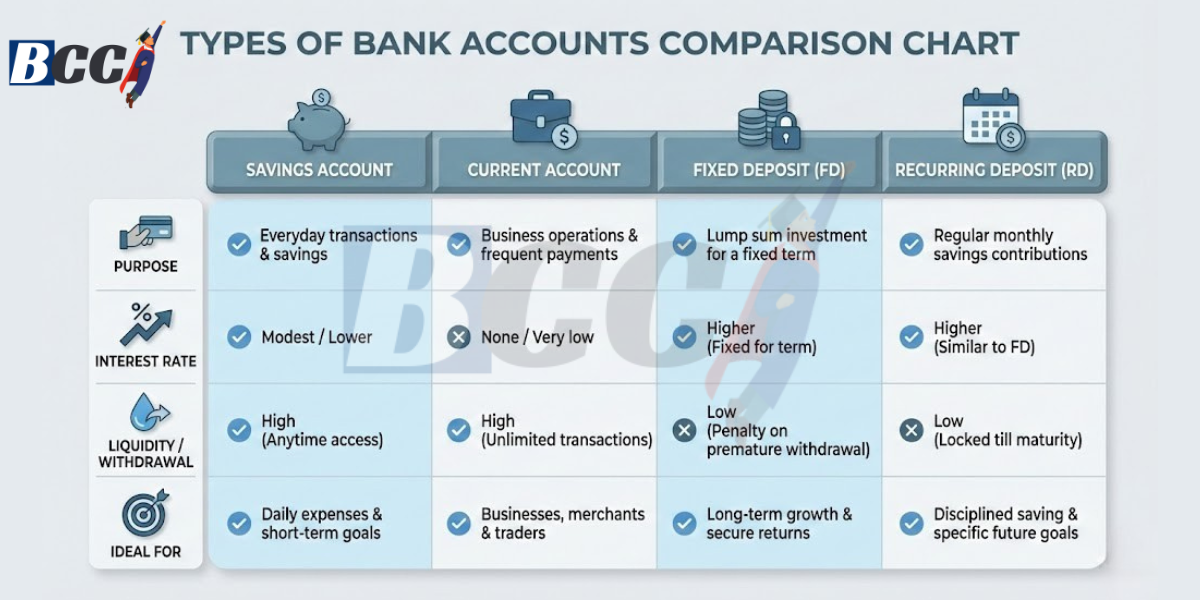
Comparison Table of Major Accounts
| Feature | Savings | Current | FD | RD |
|---|---|---|---|---|
| Interest | Yes | No | Yes (High) | Yes |
| Transactions | Limited | Unlimited | Not allowed | Monthly deposit |
| Suitable For | Individuals | Businesses | Investors | Salaried persons |
| Minimum Balance | Moderate | High | Lump sum | Monthly deposit |
Important Financial Terms
Understanding financial terms is crucial for Bank + SSC exams.
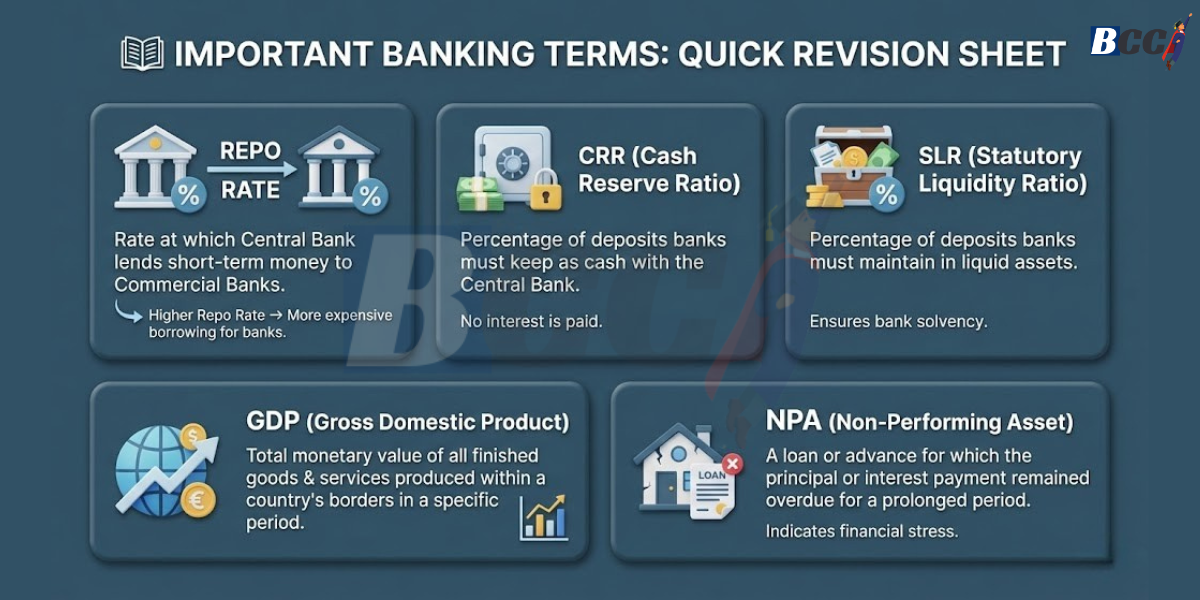
Repo Rate
Rate at which the Reserve Bank of India lends money to commercial banks.
Reverse Repo Rate
Rate at which RBI borrows money from commercial banks.
CRR (Cash Reserve Ratio)
Percentage of total deposits that banks must keep with RBI in cash.
SLR (Statutory Liquidity Ratio)
Percentage of deposits banks must maintain in liquid assets (gold, cash, government securities).
Bank Rate
Long-term rate at which RBI lends to banks without collateral.
MSF (Marginal Standing Facility)
Emergency borrowing facility for banks from the RBI.
Inflation
Increase in the general price level.
Deflation
Decrease in the general price level.
Stagflation
High inflation + high unemployment + slow growth.
GDP (Gross Domestic Product)
Total value of goods and services produced in a country.
Fiscal Deficit
When government expenditure exceeds revenue.
Capital Expenditure
Government spending on infrastructure and asset creation.
NPA (Non-Performing Asset)
Loan not repaid for 90 days.
Priority Sector Lending
Banks must lend a fixed percentage to sectors like agriculture, MSME, and education.
NEFT
National Electronic Funds Transfer – a batch-based transfer system.
RTGS
Real Time Gross Settlement – large-value instant transfer.
IMPS
Immediate Payment Service – 24×7 instant transfer.
UPI
Unified Payments Interface – a mobile-based instant payment system.
KYC
Know Your Customer – identity verification process.
Basel Norms
International banking regulations for risk management and capital adequacy.
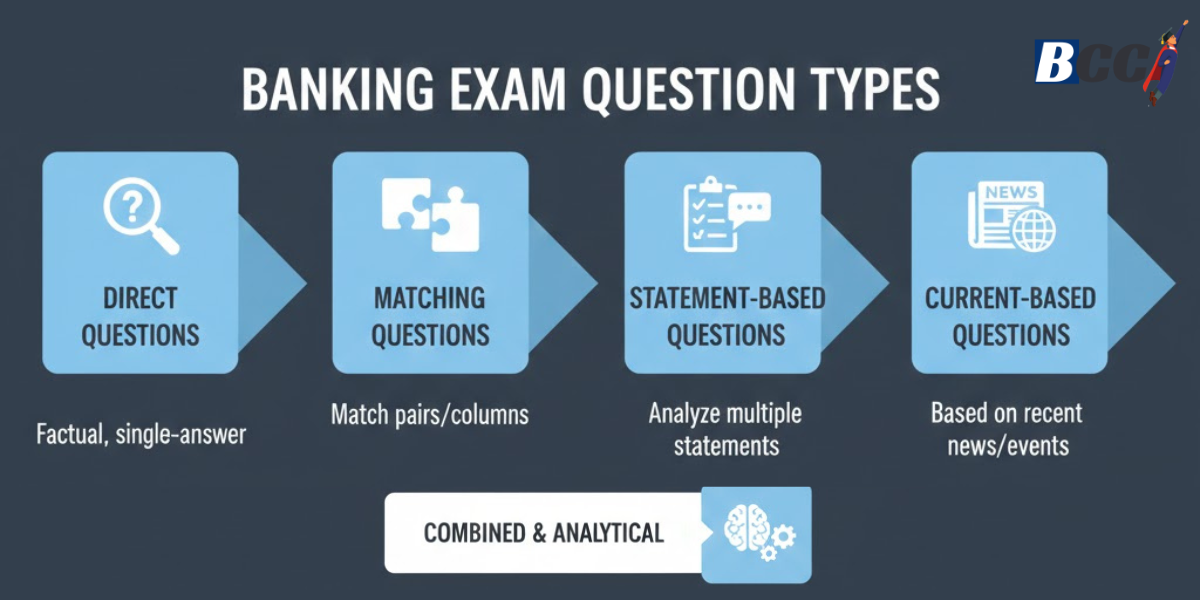
Banking Exam Question Pattern
Banking questions are usually:
- Direct definition-based
- Match the following
- Statement-based
- Current affairs linked (RBI policy changes)
Example:
- Repo rate decided by?
- Which account is suitable for a business?
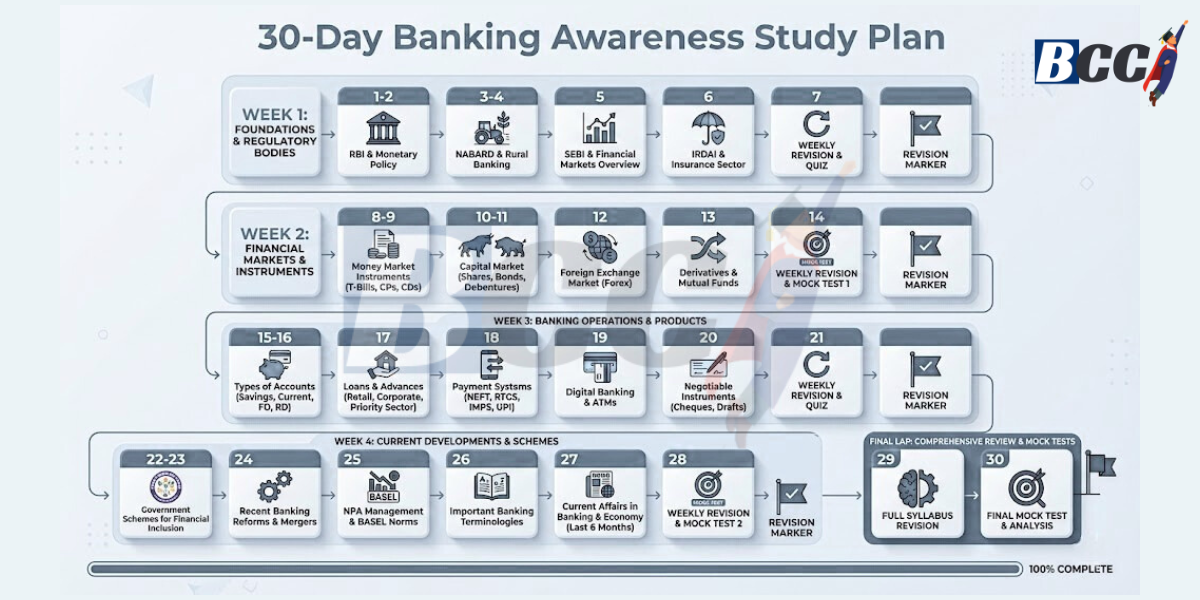
30-Day Banking Awareness Preparation Plan
Daily (30–45 Minutes)
- 15 min: Static banking terms
- 10 min: Current banking news
- 10 min: Revision
- 10 min: Practice MCQs
Weekly
- Revise all terms
- Solve one sectional mock
- Update short notes
Common Mistakes Aspirants Make
- Ignoring static terms
- Not revising regularly
- Memorising without understanding
- Ignoring RBI policy updates
- Skipping previous year questions
Last 10 Days Revision Strategy
- Revise only short notes
- Solve previous year questions
- Focus on definitions
- Avoid new sources
- Revise repo, CRR, SLR multiple times
Conclusion
Banking Awareness is one of the easiest sections to score if concepts are clear and revised properly. For Bank and SSC CGL aspirants, mastering basic account types and financial terms can significantly improve overall score. Focus on clarity, repetition, and PYQs.
Consistent 30–45 minutes daily is enough to master this section.
FAQs
1. Is Banking Awareness important for SSC CGL?
Yes, especially for economic terms and financial awareness questions.
2. How many banking questions come in IBPS PO?
Usually 15–20 in the mains exam.
3. Is current affairs enough for banking awareness?
No, static banking concepts are equally important.
4. Should I memorise definitions?
Understand first, then memorise in short form.
5. How many days are enough to prepare for Banking Awareness?
30–45 days with regular revision is sufficient.
Feature Image Prompt
Flat-3D hybrid illustration, Indian banking exam aspirant studying finance on laptop, subtle silhouette of RBI-style central bank building in background, minimal clean desk setup, financial icons floating (rupee symbol, graph, bank building), soft shadows, modern UI style, Google Discover friendly, no text, theme color #3b576c
Infographic Prompts + Placement
1. Infographic: “Types of Bank Accounts Comparison Chart”
Placement: After the Types of Bank Accounts section
Prompt: Clean flat-3D hybrid infographic, comparison table of Savings, Current, FD, RD with icons and feature highlights, theme #3b576c, minimal layout, no text clutter
2. Infographic: “Important Banking Terms Quick Revision Sheet”
Placement: After Financial Terms section
Prompt: Visual cheat sheet style infographic, repo rate, CRR, SLR, GDP, NPA with simple icon representations, structured layout, flat-3D hybrid, theme #3b576c
3. Infographic: “30-Day Banking Awareness Study Plan”
Placement: After 30-Day Plan section
Prompt: Calendar-style visual roadmap, weekly blocks, revision markers, mock test icons, clean minimal design, flat-3D hybrid, theme #3b576c
4. Infographic: “Banking Exam Question Types”
Placement: After Question Pattern section
Prompt: Flowchart-style infographic showing Direct → Match → Statement → Current-based, simple icons, flat-3D hybrid style, theme #3b576c