
SSC English 2026: Most Repeated Grammar Rules + Error Spotting Strategy (CGL, CHSL, GD Tier-1)
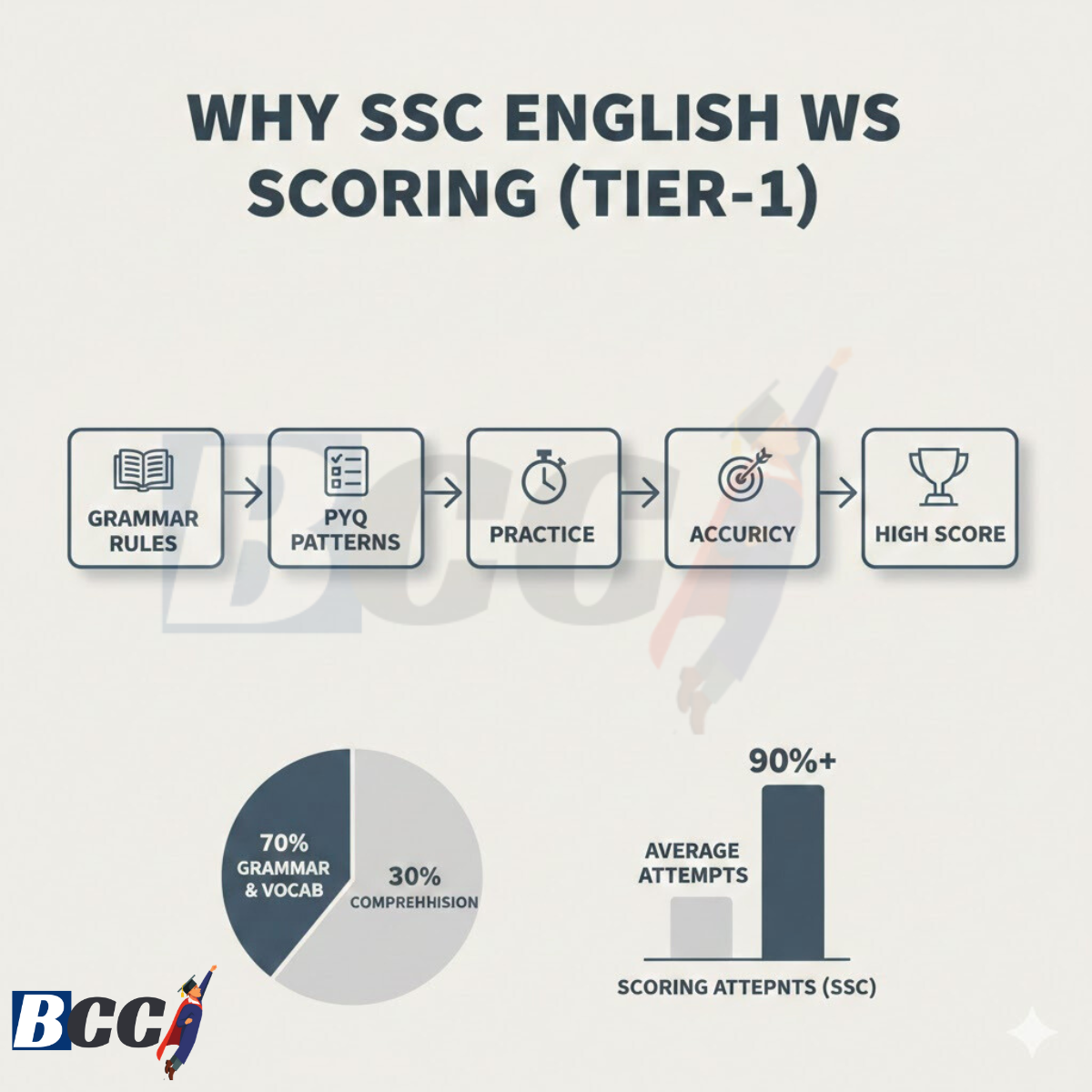
SSC English is one of the most scoring sections in SSC CGL, CHSL, and GD Tier-1 because:
- The syllabus is limited and predictable
- Grammar rules repeat across years
- The same error patterns come again and again
- With practice, accuracy becomes very high
Unlike Vocabulary (which depends on reading habits), Grammar and Error Spotting are rule-based. If you know the rules and practice PYQs, you can score consistently even with average English background.
Another major reason SSC English feels scoring is that the questions are not complex. SSC mainly tests:
- Common grammar mistakes
- Basic sentence structure
- Frequently repeated rules
- Confusing word usage
This is why aspirants who master the most repeated rules and follow a clear error-spotting strategy can easily gain 15–20 marks advantage in Tier-1.
Most Repeated Grammar Rules for SSC English (With Examples)
SSC does not ask advanced grammar. It asks the same “high-frequency rules” again and again. Below are the most repeated grammar topics for SSC 2026 with simple explanations and exam-level examples.
1) Subject–Verb Agreement (SVA)
Subject–Verb Agreement is the most repeated grammar topic in SSC exams. SSC tests whether the verb matches the subject in number and person.
Key Rules (SSC Level)
Rule 1: A singular subject takes a singular verb
- He plays cricket.
- She writes well.
Rule 2: Two subjects joined by “and” take a plural verb
- Ram and Shyam are friends.
Exception: If they refer to the same person/thing
- Bread and butter is my breakfast.
Rule 3: With “each, every, either, neither” use singular verb
- Each of the students is present.
- Neither of them has come.
Rule 4: “Along with / together with / as well as” does not change the subject
-
The teacher, along with the students, is going.
Rule 5: Collective nouns (team, committee, jury)
Usually singular in SSC:
- The team is winning.
Rule 6: “One of the + plural noun” takes singular verb
-
One of the boys is absent.
Rule 7: “A number of” vs “The number of”
-
A number of students are absent.
-
The number of students is increasing.
SSC Exam Example
Incorrect:
- Each of the players have a jersey.
Correct: - Each of the players has a jersey.
2) Tenses
SSC focuses on basic tense consistency and correct verb forms.
Most Repeated SSC Rules
Rule 1: Past event + past time marker
-
Yesterday, I went to the market. (not go)
Rule 2: Since/for with Present Perfect
- I have lived here for 5 years.
- He has worked since 2020.
Rule 3: “When” clause for past + past
-
When I reached, the train had left.
Rule 4: Universal truth in Present Simple
-
The sun rises in the east.
Rule 5: If-clauses (important for SSC)
-
If you work hard, you will succeed.
-
If I were you, I would study more.
SSC Exam Example
Incorrect:
- I have seen him yesterday.
Correct: - I saw him yesterday.
3) Articles (A, An, The)
Articles are extremely common in SSC error spotting.
Important Rules
Rule 1: Use “a” before consonant sound
-
a university (starts with “yu” sound)
Rule 2: Use “an” before vowel sound
-
an honest man (silent h)
Rule 3: “The” is used for:
- Unique things: the sun, the moon
- Superlatives: the best, the most important
- Rivers/seas: the Ganga, the Arabian Sea
- Musical instruments: the guitar
Rule 4: No article with:
- Proper names: India, Rahul
- Abstract nouns (general): honesty, courage
- Plural nouns (general): Students are hardworking.
SSC Exam Example
Incorrect:
- He is a honest man.
Correct: - He is an honest man.
4) Prepositions
SSC tests prepositions heavily because errors are common and easy to trap.
Most Repeated Preposition Rules
| Expression | Correct Preposition | Example |
|---|---|---|
| depend | on | depend on you |
| interested | in | interested in music |
| good | at | good at maths |
| angry | with (person) / at (thing) | angry with him |
| responsible | for | responsible for work |
| afraid | of | afraid of dogs |
| different | from | different from you |
SSC Exam Example
Incorrect:
- He is good in English.
Correct: - He is good at English.
5) Pronouns
Pronoun questions in SSC usually involve:
- wrong case (I/me)
- wrong reflexive (myself)
- agreement issues
Key Rules
Rule 1: Subject pronoun vs object pronoun
- He and I went there.
- The teacher called him and me.
Rule 2: Reflexive pronouns
Use when the subject and object are the same:
- He blamed himself.
Do not use unnecessarily:
Incorrect:
- He himself went to market. (often acceptable, but SSC may trap)
Better: - He went to the market himself.
Rule 3: Relative pronouns
- Person: who/whom
- Thing: which
- Possession: whose
SSC Exam Example
Incorrect:
- Me and my friend went there.
Correct: - My friend and I went there.
6) Modals (Can, Could, May, Might, Should, Must)
SSC uses modals in error spotting because many students mix tense and form.
Rules
Rule 1: Modal + base verb (V1)
-
He can speak English. (not speaks)
Rule 2: “Must” for strong obligation
-
You must follow rules.
Rule 3: “Could” for past ability
-
I could run fast when I was young.
Rule 4: “Should have” for past advice/regret
-
You should have studied.
SSC Exam Example
Incorrect:
- He can speaks English.
Correct: - He can speak English.
7) Conjunctions
SSC tests conjunction pairs and sentence joining.
Important Rules
Rule 1: Either…or / Neither…nor
Verb agrees with nearest subject:
- Either Ram or his friends are coming.
- Either his friends or Ram is coming.
Rule 2: Although/Though + yet (avoid double)
Incorrect:
- Although he is poor yet he is honest.
Correct: - Although he is poor, he is honest.
Rule 3: Because + so (avoid double)
Incorrect:
- Because it was raining so we stayed.
Correct: - Because it was raining, we stayed.
SSC Exam Example
Incorrect:
- Though he is rich but he is unhappy.
Correct: - Though he is rich, he is unhappy.
8) Active and Passive Voice
SSC Tier-1 asks voice in:
- sentence improvement
- fill blanks
- error spotting
Core Rule
Passive = Object + be verb + V3 (+ by + subject)
Active:
- He wrote a letter.
Passive:
- A letter was written by him.
Tense-wise Quick Table (SSC Level)
| Tense | Active | Passive |
|---|---|---|
| Present Simple | writes | is written |
| Past Simple | wrote | was written |
| Present Continuous | is writing | is being written |
| Past Continuous | was writing | was being written |
| Present Perfect | has written | has been written |
| Future Simple | will write | will be written |
SSC Exam Example
Incorrect:
- The work has been do.
Correct: - The work has been done.
9) Direct and Indirect Speech
SSC repeats reporting rules frequently.
Key Rules
Rule 1: Reporting verb changes tense (usually)
Direct: He said, “I am tired.”
Indirect: He said that he was tired.
Rule 2: No tense change for universal truth
Direct: He said, “The sun rises in the east.”
Indirect: He said that the sun rises in the east.
Rule 3: Pronoun changes
“I” becomes he/she based on speaker.
Rule 4: Time words change
- now → then
- today → that day
- yesterday → the previous day
- tomorrow → the next day
SSC Exam Example
Direct: She said, “I will help you.”
Indirect: She said that she would help me.
10) Adjectives and Adverbs
SSC loves testing wrong usage like:
- adjective used instead of adverb
- double comparatives
- wrong degree
Key Rules
Rule 1: Adjective modifies noun
-
He is a good boy.
Rule 2: Adverb modifies verb
-
He speaks well.
Rule 3: Comparative structures
- He is taller than me.
- This is the best book.
Avoid double:
Incorrect:
- more better
Correct: - better
Rule 4: “Very” with adjective, not with comparative
Incorrect:
- very better
Correct: - much better
SSC Exam Example
Incorrect:
- She sings very beautiful.
Correct: - She sings very beautifully.
Error Spotting Rules (SSC Tier-1)
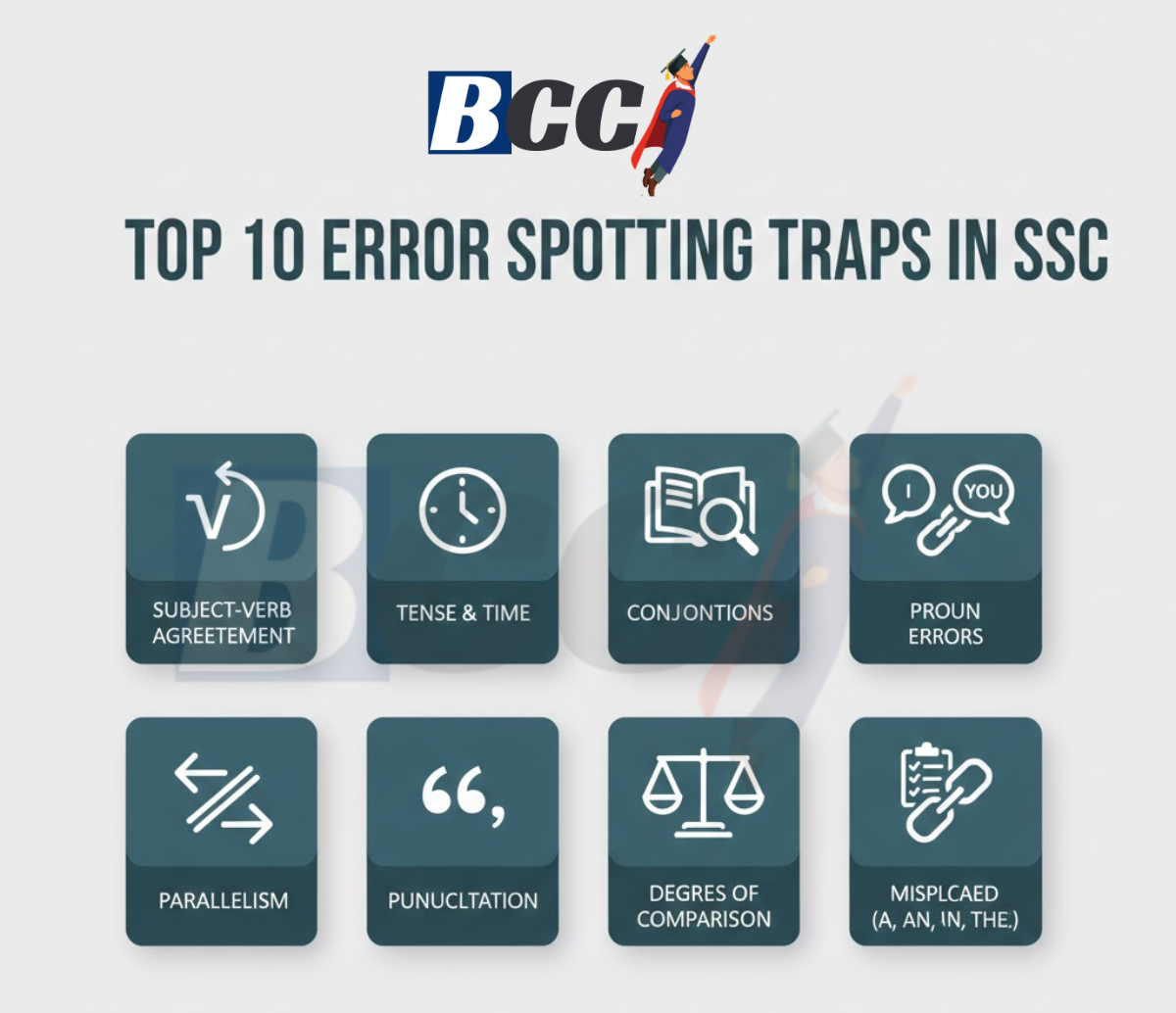
Error spotting in SSC is not about deep grammar. It is about identifying high-frequency mistakes quickly.
Most Common Error Areas
- Subject–verb mismatch
- Wrong tense
- Wrong article
- Wrong preposition
- Pronoun case error
- Wrong conjunction pair
- Wrong voice form
- Wrong narration conversion
- Degree of comparison error
- Parallelism error
Parallelism Rule (Very Important for SSC)
When items are joined by conjunctions, the structure should remain parallel.
Incorrect:
- He likes reading, to write, and singing.
Correct: - He likes reading, writing, and singing.
Error Spotting Strategy (Step-by-Step Method)
Aspirants lose marks not because they do not know grammar, but because they do not follow a fixed method.
Here is a simple and exam-effective step-by-step strategy for SSC Tier-1:
Step 1: Identify the Main Verb First
In most SSC error spotting questions, the error lies around:
- verb form
- helping verb
- subject–verb agreement
So first find:
- main verb
- helping verb
- subject
Step 2: Check Subject–Verb Agreement
Ask these quick questions:
- Is the subject singular or plural?
- Is there “each/every/either/neither”?
- Is the subject separated by “along with/as well as”?
Step 3: Check Tense Consistency
Look for time markers:
- yesterday, last year → past
- since, for → present perfect
- by the time → past perfect
Step 4: Check Articles Quickly
Look for:
- a/an usage (sound rule)
- missing “the” for unique/superlative
- unnecessary article before plural/general nouns
Step 5: Check Prepositions (Most Common SSC Trap)
If the sentence looks correct, quickly check:
- depend on
- interested in
- good at
- prefer to
- married to
Step 6: Check Pronouns
Look for:
- me/I
- him/he
- who/whom
- reflexive misuse
Step 7: Check Conjunction Pairing
Common traps:
- although + yet
- because + so
- though + but
- neither/nor agreement
Step 8: Check Comparison and Modifiers
- more better
- very better
- adjective/adverb confusion
Step 9: Do Not Overthink
SSC English is straightforward. If you overthink, you may change the correct option to wrong.
Step 10: Use Elimination
If you are unsure, eliminate based on:
- grammar structure
- common SSC patterns
SSC Pattern: What Type of Grammar Errors Are Most Common?
SSC CGL, CHSL, and GD Tier-1 English section is designed for speed + accuracy. Grammar questions are typically:
In Error Spotting / Sentence Improvement
- SVA errors
- tense errors
- preposition errors
- article errors
- pronoun case errors
- conjunction misuse
In Fill in the Blanks
- prepositions
- articles
- modals
- verb form
In Sentence Rearrangement
- conjunction placement
- tense consistency
- pronoun reference
PYQ Trend Analysis (Topic-Wise Importance)
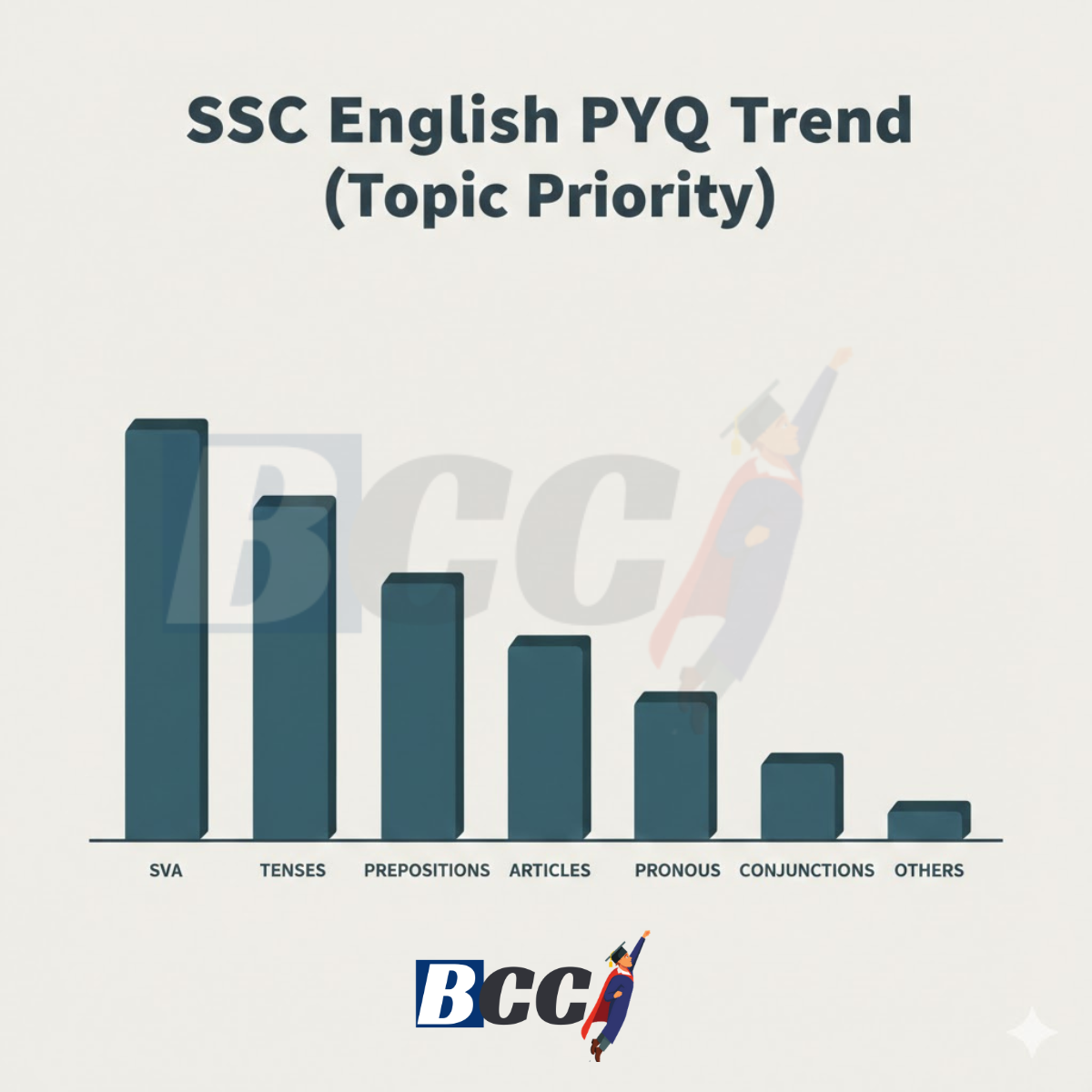
Below is a practical trend-based importance table (based on repeated SSC patterns over the years).
| Topic | Importance | Why it repeats |
|---|---|---|
| Subject–Verb Agreement | Very High | Easy to test, common mistakes |
| Tenses | Very High | time markers + verb form traps |
| Prepositions | Very High | fixed usage, confusing options |
| Articles | High | sound + omission rules |
| Pronouns | High | case confusion (I/me) |
| Conjunctions | High | double conjunction errors |
| Adjectives/Adverbs | Medium | modifier confusion |
| Active/Passive | Medium | form-based, easy conversion |
| Direct/Indirect | Medium | tense shift and pronoun shift |
| Modals | Medium | base verb rule |
| Parallelism | Medium | repeated in sentence improvement |
Exam-level conclusion:
If you master the first 6 topics, you can solve most SSC grammar questions confidently.
Common Mistakes Aspirants Make in SSC English
Even strong candidates lose marks due to avoidable mistakes.
1) Memorising Rules Without Practice
Grammar is not a theory subject. Without solving PYQs, rules remain inactive knowledge.
2) Ignoring Prepositions
Prepositions feel small but cause repeated mistakes.
3) Not Learning from Mistakes
Most students solve mock tests but do not create an error notebook.
4) Studying Too Many Books
For SSC English, limited sources + revision is better.
5) Guessing in Error Spotting
Error spotting needs logic, not random guessing.
6) Skipping Revision
Grammar is highly forgettable without revision.
7) Overthinking Simple Sentences
SSC grammar is mostly basic. Over-analysis wastes time.
30-Day Practice Plan for SSC English Grammar (Daily Routine)
This plan is designed for:
- SSC CGL Tier-1
- SSC CHSL Tier-1
- SSC GD
It focuses on maximum repetition + revision.
Daily Time Required
60 to 90 minutes per day is enough if done consistently.
30-Day Plan (Week-wise)
Week 1 (Days 1–7): Build Core Rules
Daily routine:
- 30 min: Learn rules (SVA + Tenses)
- 30 min: Solve 40 PYQs
- 10 min: Note mistakes
Targets:
- Day 1–3: Subject–Verb Agreement
- Day 4–7: Tenses
Week 2 (Days 8–14): High-Frequency Scoring Topics
Daily routine:
- 20 min: Revise Week 1 notes
- 30 min: Articles + Prepositions
- 30 min: Error spotting PYQs
Targets:
- Day 8–10: Articles
- Day 11–14: Prepositions
Week 3 (Days 15–21): Medium Topics + Speed
Daily routine:
- 20 min: Revision
- 30 min: Pronouns + Conjunctions
- 30 min: Mixed error spotting
Targets:
- Day 15–17: Pronouns
- Day 18–21: Conjunctions + Parallelism
Week 4 (Days 22–30): Full Mixed Practice + Mock Focus
Daily routine:
- 15 min: Quick rule revision
- 45 min: Mixed PYQs (all topics)
- 30 min: Mini mock (English section only)
Targets:
- Day 22–25: Active/Passive + Modals
- Day 26–27: Direct/Indirect
- Day 28–30: Full revision + speed drills
Daily Practice Structure (Best Routine)
Follow this format every day:
- 10 minutes: Revise short notes
- 30 minutes: Topic practice (PYQs)
- 20 minutes: Error spotting practice
- 10 minutes: Mistake notebook update
Best Way to Make Short Notes for Grammar (SSC-Friendly)
Short notes are extremely important because grammar needs revision again and again.
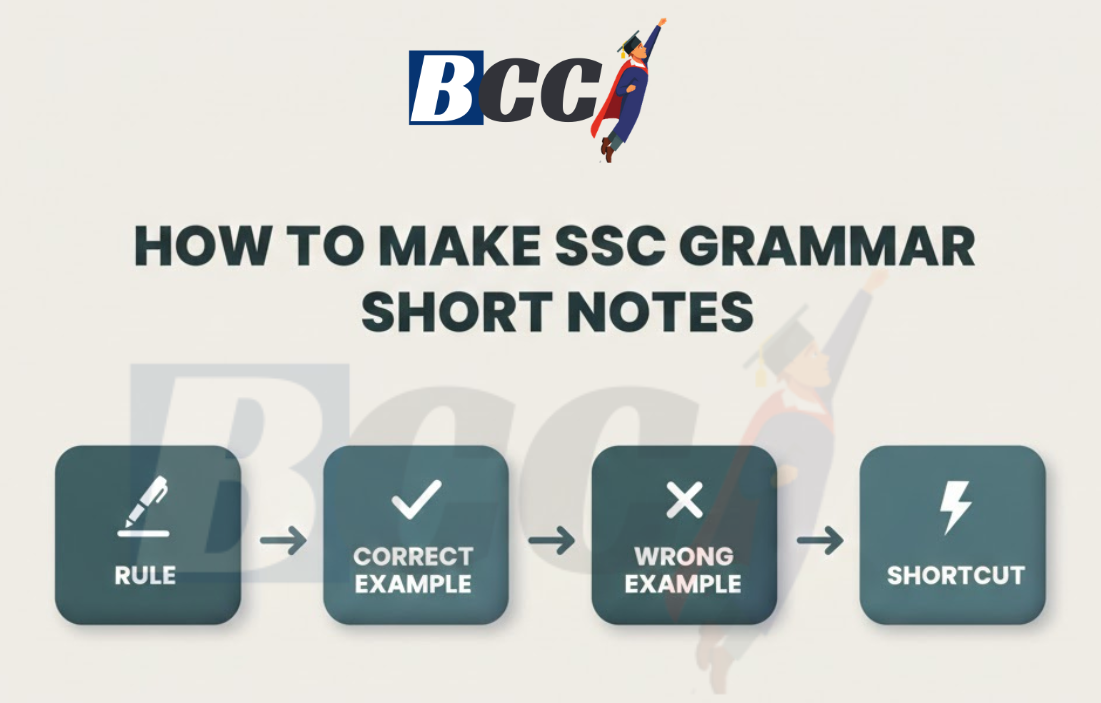
Best Format for Grammar Notes
For every rule, write:
- Rule in 1 line
- 1 correct example
- 1 common SSC wrong example
- 1 quick shortcut
Example Note (SVA)
Rule: Each/every takes singular verb
Correct: Each of the boys is present
Wrong: Each of the boys are present
Shortcut: Each = singular always
What NOT to Do in Notes
- Do not write full theory
- Do not write 10 examples for one rule
- Do not copy entire grammar book
Your notes should be revision-ready in 15 minutes.
Last-Week Revision Checklist (SSC English Tier-1)
In the final 7 days before exam, you should not learn new rules. You should revise and practice.
Checklist (7 Days)
Grammar Revision
- Subject–Verb Agreement (all rules)
- Tenses (especially perfect tenses)
- Articles (a/an/the rules)
- Prepositions (fixed usage list)
- Pronouns (I/me, who/whom)
- Conjunction pairs
- Comparison rules
- Parallelism
Practice Checklist
- 5 full English section mocks
- 300 error spotting questions
- 200 fill-in-the-blanks
- 150 sentence improvement questions
Mistake Revision
- Revise your error notebook daily
- Focus on repeated mistakes only
Speed Checklist
- Solve 25 English questions in 12–15 minutes
- Avoid spending more than 40 seconds on one question
Conclusion
SSC English 2026 can become your highest scoring section if you prepare it with the right approach. The key is not learning advanced English. The key is mastering the most repeated grammar rules and practising error spotting with a fixed method.
For SSC CGL, CHSL, and GD Tier-1, focus mainly on:
- Subject–Verb Agreement
- Tenses
- Articles
- Prepositions
- Pronouns
- Conjunctions
Once these topics are strong, your accuracy will improve naturally. Combine PYQ practice with short notes and regular revision, and you will see a clear jump in your English score within 30 days.
FAQs (SSC English 2026)
1) Which grammar topic is most important for SSC English?
Subject–Verb Agreement and Tenses are the most repeated and most scoring topics.
2) Is error spotting enough to score well in SSC English?
Error spotting is important, but you should also practise fill blanks, sentence improvement, and basic rules.
3) How many questions should I practise daily for SSC English grammar?
A target of 40–60 questions daily is enough if done consistently for 30 days.
4) Can I prepare SSC English without reading newspapers?
Yes. SSC grammar is rule-based. Newspapers help more in vocabulary and comprehension.
5) What is the best way to revise SSC grammar quickly?
Use short notes (rule + correct example + wrong example) and revise them daily in the last week.