

Daily 3-Hour RRB Study Plan for Working Aspirants – Smart Routine & Productivity Tips
Focus: Realistic Routine, Productivity Techniques
Exam Relevance: RRB NTPC, Group D, ALP, Technician
Introduction: Can Working Aspirants Really Crack RRB?
One of the biggest myths around RRB preparation is that long study hours are compulsory. In reality, many selected candidates are working professionals who studied only 3–4 hours daily, but with discipline, planning, and smart revision.
For working aspirants:
- Time is limited
- Energy is uneven
- Consistency matters more than intensity
This article presents a practical 3-hour daily study plan that fits around office hours, reduces burnout, and steadily improves performance in RRB CBT-1.

Why 3 Hours a Day Is Enough for RRB
RRB syllabus is:
- Limited
- Repetitive
- Conceptually moderate
If studied correctly:
- Maths & Reasoning need concept + practice
- General Awareness needs daily revision
- Mocks need analysis, not endless attempts
3 focused hours > 6 distracted hours
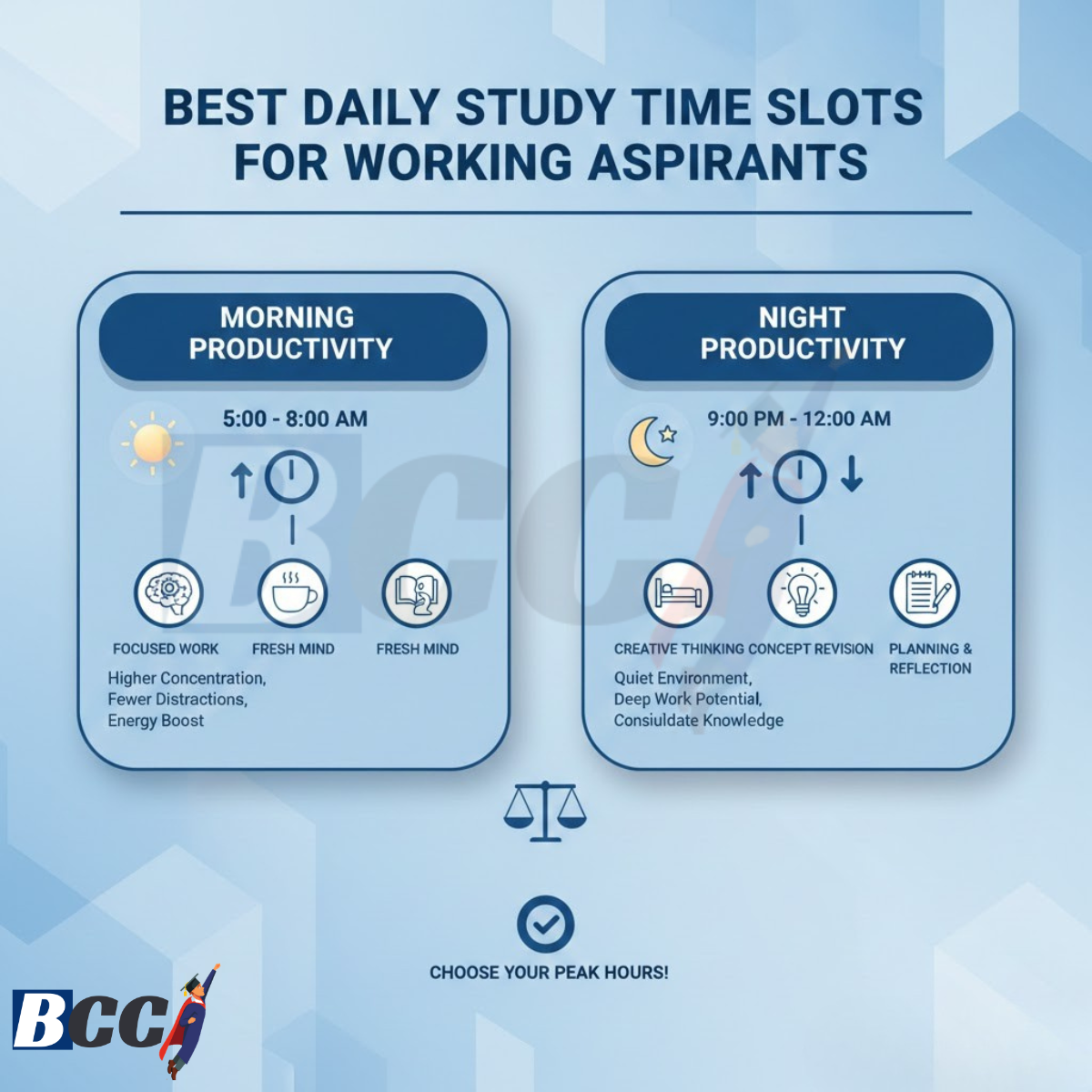
Ideal Time Slots for Working Aspirants
The day should be divided based on mental energy, not clock time.
Recommended Study Windows
- Morning (Before Office): Fresh mind → Concepts
- Night (After Office): Practice + Revision
Evening fatigue is real — the plan respects that.
The Daily 3-Hour Study Plan (Weekdays)
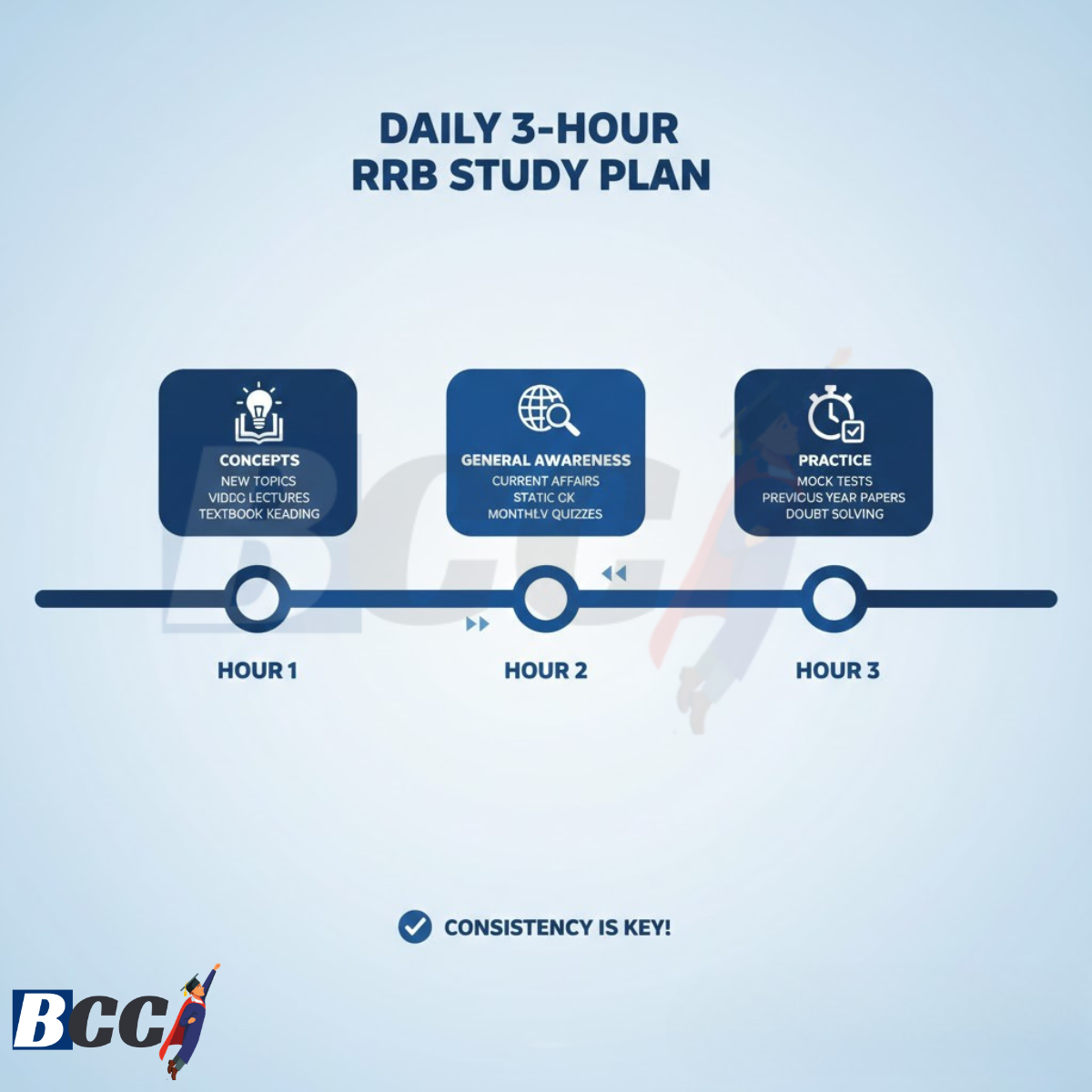
Hour 1: Core Concept Building (60 Minutes)
Best Time: Morning (5:30–6:30 AM or before office)
What to Study
- Mathematics OR Reasoning (alternate days)
- Focus on one topic only
Examples
- Maths: Percentage, Ratio, Time & Work
- Reasoning: Series, Analogy, Coding-Decoding
Rule
- No multitasking
- No phone notifications
- Concept + 10–15 practice questions
Hour 2: General Awareness + Railway GK (45 Minutes)
Best Time: Night (after dinner, light focus)
Structure
- 20 min: Static GK / Science basics
- 15 min: Current Affairs (last 6–8 months)
- 10 min: Railway GK
Use:
- Short notes
- One-liners
- Tables
Avoid deep reading.
Hour 3: Practice + Revision (45 Minutes)
What to Do
- Sectional test OR PYQs
- Revise mistakes from previous mocks
Golden Rule
Revision without testing is incomplete.
Testing without analysis is useless.
Weekly Structure for Working Aspirants
Weekday Focus
- Learning + light practice
- No overload
Weekend Focus
- Mock tests
- Deep analysis
- Full revision
Weekend Plan (Saturday–Sunday)
| Task | Time |
|---|---|
| Full-length Mock | 90 min |
| Mock Analysis | 60 min |
| Weak Topic Revision | 60 min |
| GA Weekly Revision | 30 min |
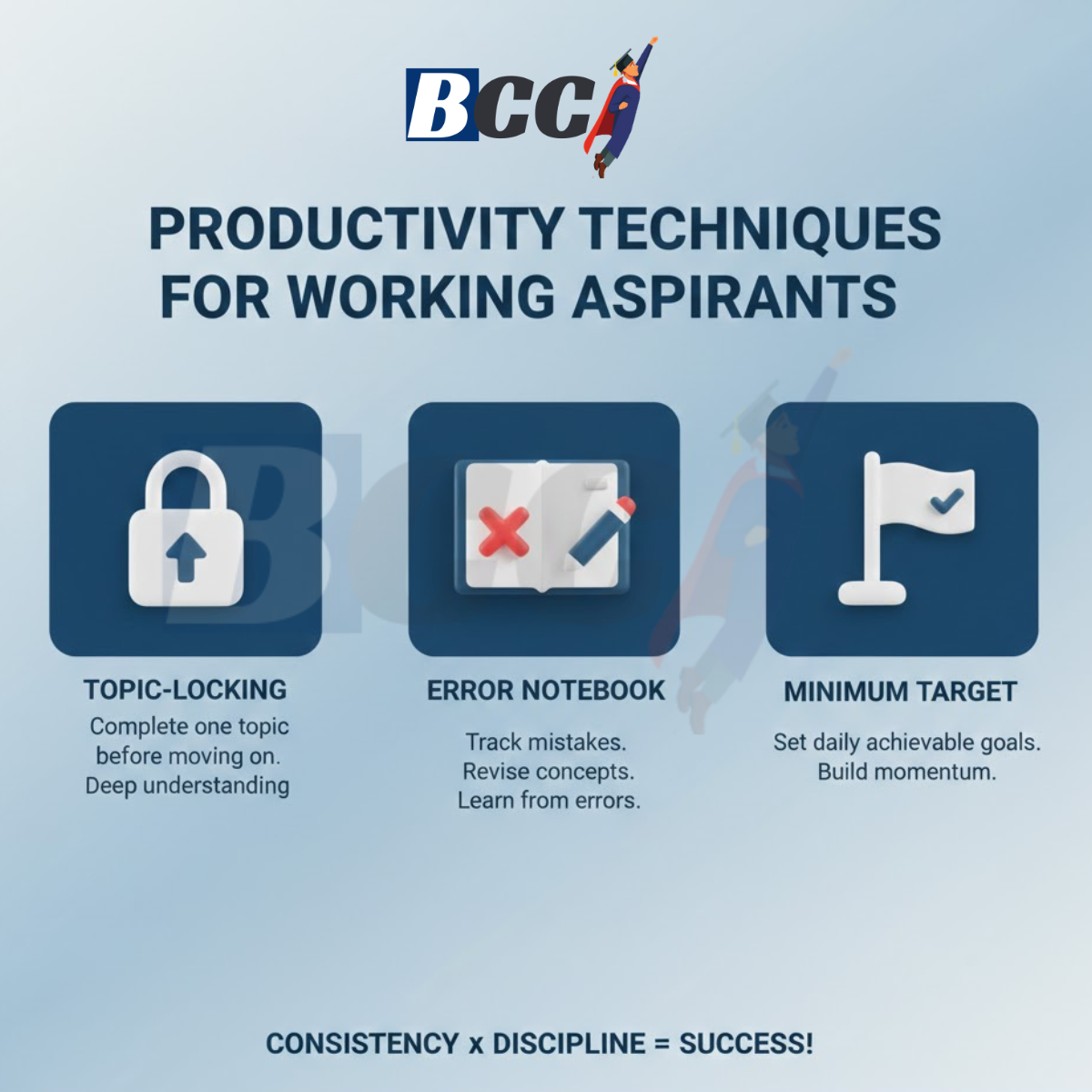
Productivity Techniques That Actually Work
1. Topic-Locking Technique
Study only one topic per session. Switching subjects wastes energy.
2. Error Notebook
Maintain a small notebook:
- Wrong formulas
- Confusing GK facts
- Repeated mistakes
Revise this daily for 10 minutes.
3. Minimum Target Rule
Even on bad days:
- Solve 20 questions OR
- Revise one GA topic
Never break continuity.
How to Manage Fatigue After Office
- Avoid heavy meals before studying
- Use short breaks (5 minutes)
- Switch to GA or revision when tired
- Do not force difficult topics at night
RRB preparation is a marathon, not a sprint.
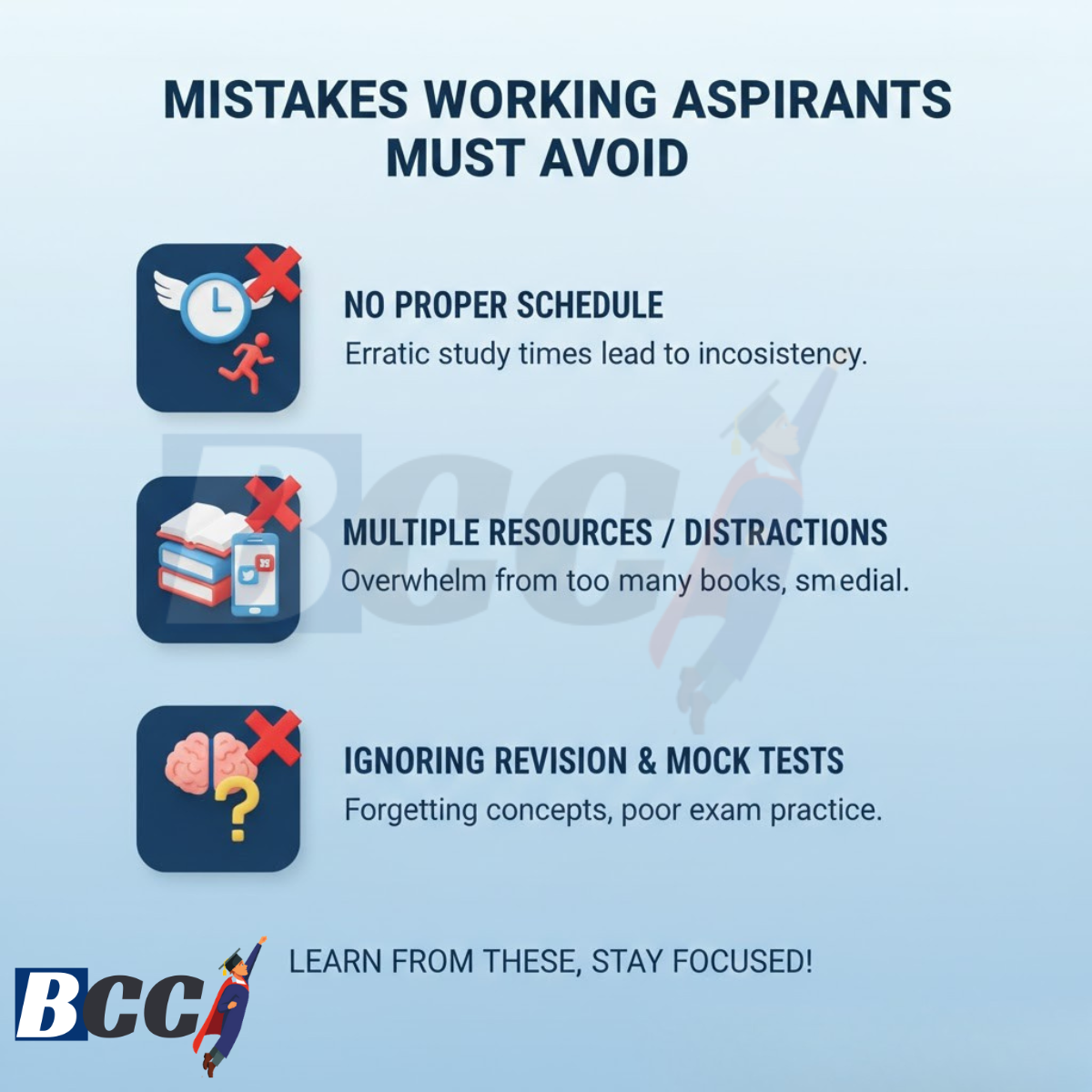
Common Mistakes Working Aspirants Make
- Studying randomly without a plan
- Skipping GA due to tiredness
- Studying only on weekends
- Ignoring mock analysis
- Comparing study hours with full-time students
30-Day Consistency Challenge (Optional)
- 3 hours daily × 30 days
- 15 sectional tests
- 6 full mocks
- 3 full GA revisions
This alone can significantly improve CBT-1 score.
Conclusion: Consistency Beats Long Hours
RRB exams reward:
- Discipline
- Smart planning
- Accuracy
If you are a working aspirant, do not aim for perfection. Aim for daily progress.
A focused 3-hour routine, followed consistently, is more than enough to clear RRB CBT-1 and move confidently towards selection.
FAQs – Daily 3-Hour RRB Study Plan
Q1. Can I really clear RRB exams by studying only 3 hours daily?
Yes. With focused study, consistent revision, and smart mock practice, 3 hours daily is sufficient for working aspirants.
Q2. How should I split 3 hours for maximum efficiency?
Divide it into:
- 1 hour: Maths/Reasoning concepts & practice
- 45 minutes: General Awareness & Railway GK
- 45 minutes: Mock test practice/revision
Q3. Should I study on weekends as well?
Yes. Use weekends for full-length mock tests, error analysis, and weak-topic revision.
Q4. How can I stay productive after office fatigue?
Focus on light revision or GA, take short breaks, avoid heavy meals before study, and use the minimum target rule (even 20 questions/day counts).
Q5. Are short notes useful in a 3-hour study plan?
Absolutely. Short notes for GA, formulas, and errors save time, especially for daily revision and last-minute preparation.