
India’s Global Diplomacy After Republic Day 2026: EU Chief Guests, Strategic Impact & Bilateral Relations
Foreign Chief Guests, Strategic Signals, and Bilateral Impact (UPSC IR Focus)
India’s Republic Day is not only a constitutional celebration but also a strategic diplomatic platform. The selection of foreign chief guests often reflects India’s current foreign policy priorities, geopolitical balancing, and long-term global ambitions. Republic Day 2026 marked a significant diplomatic moment with the invitation of European Commission President Ursula von der Leyen and European Council President António Costa as chief guests — an unprecedented dual representation from the European Union.
This article analyzes India’s global diplomacy after Republic Day 2026, the strategic meaning of the EU leadership presence, and its implications for bilateral relations, multilateral positioning, trade, technology, defense, and UPSC International Relations preparation.
Republic Day as a Diplomatic Signal
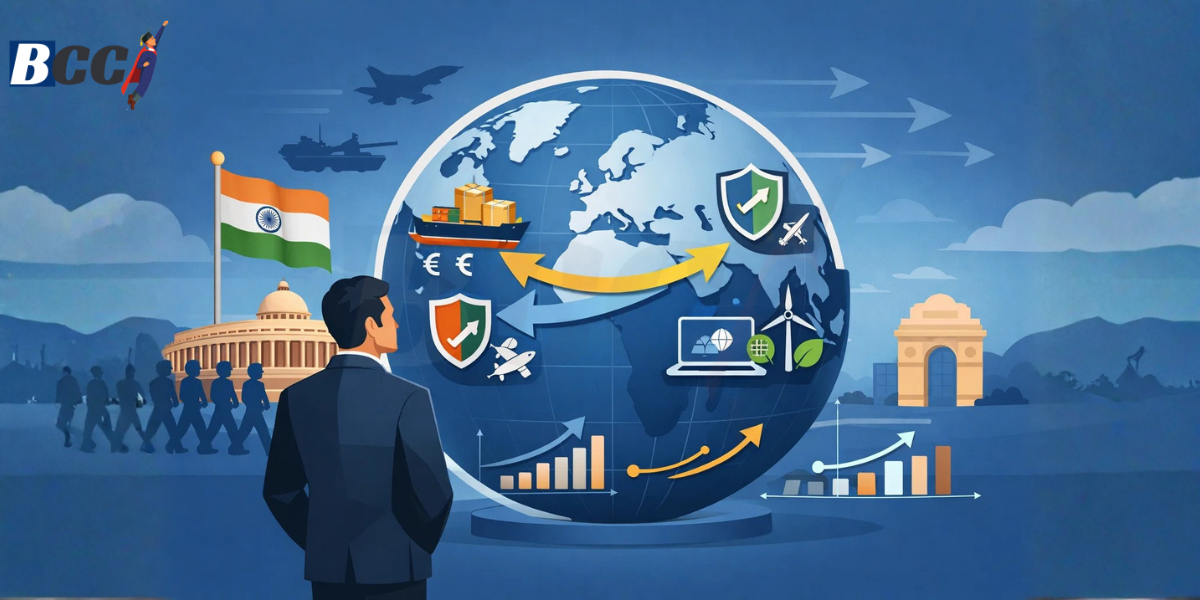
Since 1950, India has used Republic Day chief guest invitations as a soft-power and strategic signaling tool. Past invitations have aligned with India’s foreign policy priorities — from Cold War Non-Aligned Movement partners to recent outreach toward ASEAN, Africa, France, the United States, and now the European Union.
The 2026 invitation to top EU leaders signals India’s intent to deepen strategic and economic engagement with Europe, particularly amid shifting global power equations, geopolitical uncertainty, and supply chain diversification.
Why the European Union Matters to India in 2026
1. Strengthening India–EU Strategic Partnership
The presence of Ursula von der Leyen and António Costa reflects India’s commitment to elevating India–EU relations beyond trade into areas like digital governance, climate cooperation, defense production, and critical technologies. The visit aligns with ongoing discussions on a comprehensive Free Trade Agreement (FTA) and long-term economic collaboration.
2. Diversifying Global Partnerships
India continues to pursue a multi-alignment foreign policy — balancing ties with the United States, Russia, Europe, ASEAN, and Global South nations. The EU invitation reinforces India’s strategy of reducing overdependence on any single power bloc and strengthening partnerships with democratic economies.
3. Technology, Green Transition, and Digital Cooperation
The EU is a major partner in climate finance, renewable energy, artificial intelligence regulation, semiconductor supply chains, and digital public infrastructure. India aims to leverage EU collaboration for:
- Green hydrogen development
- Electric mobility
- Climate adaptation funding
- Digital governance frameworks
This supports India’s vision of becoming a global technology and sustainability leader.
Defense and Security Dimensions
Republic Day 2026 also highlighted India’s indigenous defense capabilities, including Made-in-India military equipment showcased at Kartavya Path. This reinforces India’s push for Atmanirbhar Bharat in defense while maintaining strategic partnerships with Europe and NATO-aligned nations.
India–EU defense cooperation increasingly focuses on:
- Maritime security in the Indo-Pacific
- Cybersecurity
- Joint defense manufacturing
- Counterterrorism and intelligence sharing
The diplomatic engagement strengthens India’s role as a net security provider in the Indo-Pacific region.
Global Image and Soft Power Impact
Republic Day serves as a global soft-power projection platform, showcasing India’s:
- Democratic values
- Cultural diversity
- Military modernization
- Economic rise
- Strategic autonomy
Global leaders, including the US, China, and France, extended greetings to India on its 77th Republic Day, highlighting India’s rising global stature.
This reinforces India’s identity as:
- A bridge between the Global North and the Global South
- A leader in multilateral diplomacy
- A voice for developing nations
Implications for India’s Bilateral and Multilateral Strategy
India–EU Relations
- Trade and investment expansion
- Supply chain resilience
- Digital and climate partnerships
- Strategic autonomy cooperation
India–US and Transatlantic Balance
India’s EU engagement complements — not replaces — US ties, reflecting strategic hedging and balanced diplomacy.
Global South Leadership
India continues to position itself as a leader of the Global South, advocating debt relief, climate justice, vaccine equity, and inclusive development.
Indo-Pacific Strategy
Republic Day diplomacy reinforces India’s role in:
- ASEAN engagement
- Quad framework
- Maritime security
- Freedom of navigation
UPSC International Relations Angle: Key Takeaways
High-Probability Prelims & Mains Themes
- Role of Republic Day in foreign policy signaling
- India–EU strategic partnership
- Multi-alignment vs strategic autonomy
- Soft power and cultural diplomacy
- Indo-Pacific geopolitics
- Trade diplomacy and FTAs
Potential UPSC Mains Questions
- Analyze the diplomatic significance of foreign chief guests at India’s Republic Day.
- Discuss how India–EU relations shape India’s global strategic positioning.
- Evaluate India’s multi-alignment strategy in a fragmented world order.
Challenges and Strategic Risks
Despite growing global influence, India faces diplomatic challenges:
- Managing US–China rivalry without strategic entanglement
- Energy security amid global sanctions and price volatility
- Trade protectionism and tariff pressures
- Regional instability in South Asia
- Maintaining credibility as a Global South leader
India’s diplomacy after Republic Day 2026 reflects a calibrated approach to global uncertainty, balancing realism with long-term ambition.
Conclusion: Republic Day 2026 as a Diplomatic Milestone
Republic Day 2026 marked a strategic inflection point in India’s global diplomacy, emphasizing stronger engagement with the European Union, reinforcing multi-alignment, and projecting India as a confident, autonomous, and globally responsible power.
The choice of EU leaders as chief guests signals India’s economic, technological, and geopolitical priorities for the coming decade — positioning India as a central pillar in emerging multipolar global order.
For UPSC aspirants, this event provides high-value insights into India’s foreign policy direction, international partnerships, and evolving global role.
FAQs
1. Who were the chief guests at India’s Republic Day 2026?
Ursula von der Leyen (European Commission President) and António Costa (European Council President).
2. Why is Republic Day diplomatically important for India?
It serves as a platform to signal foreign policy priorities, strengthen bilateral ties, and project soft power.
3. What does EU leadership’s presence indicate for India’s foreign policy?
It highlights India’s focus on trade, technology, climate cooperation, and strategic diversification.
4. How is this relevant for UPSC International Relations preparation?
It connects to themes of strategic autonomy, India–EU relations, Indo-Pacific policy, and global governance.
5. Can Republic Day chief guest trends influence UPSC questions?
Yes, they often reflect evolving diplomatic priorities and become relevant for Prelims and Mains.