

Why RRB Group D Cut-Offs Keep Rising | Exam Strategy Explained
Introduction: The Post-Exam Confusion
Every RRB Group D exam cycle follows a familiar pattern. After the exam, social media fills with reactions like “Paper was easy”, “Questions were basic”, and “This time cut-off will be low.” But when the official cut-off is released, most aspirants are shocked.
Despite an easy paper, the cut-off turns out to be unexpectedly high.
This confusion is especially common among first-time Railway candidates and repeat aspirants who narrowly miss the cut-off every year. Many believe that difficulty level alone decides selection. In reality, RRB Group D cut-offs are driven by competition dynamics and strategy, not just paper toughness.
This article explains the real reasons behind rising RRB Group D cut-offs and helps aspirants shift from panic-driven preparation to smarter exam-focused strategy.

Easy Paper Does NOT Mean Easy Selection
One of the biggest misconceptions among aspirants is equating easy paper with easy selection. These two are very different.
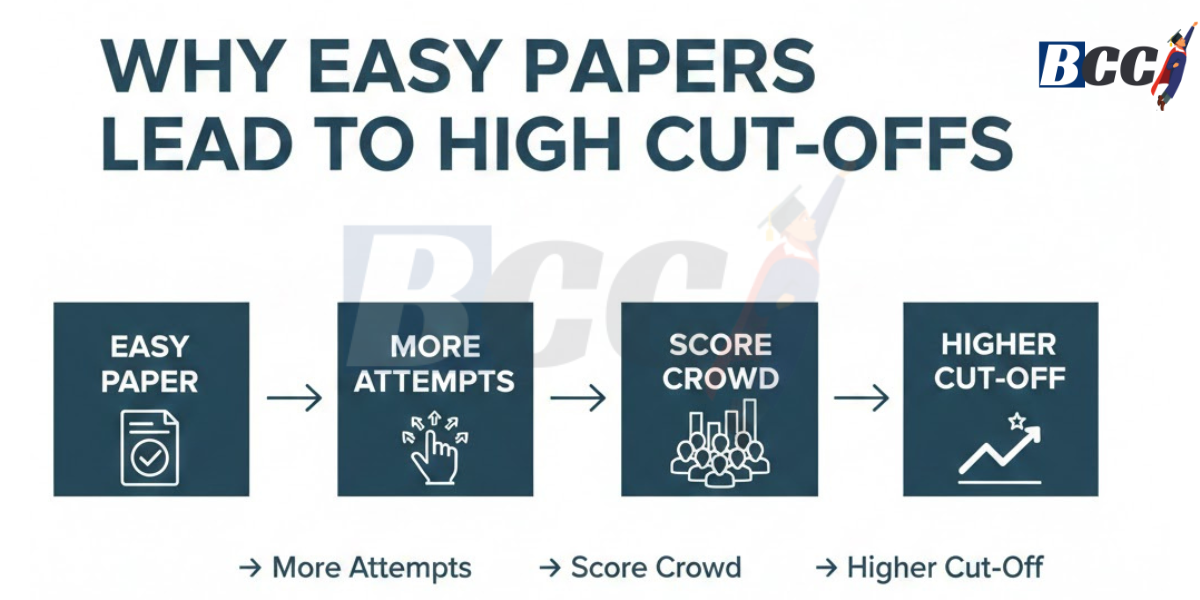
When a paper is easy:
- More candidates attempt more questions
- Average scores increase across shifts
- The score gap between candidates becomes very small
In difficult papers, fewer attempts naturally lower the average score. But in easy papers, score density increases. Thousands of candidates score within a narrow range, sometimes separated by just 1–2 marks.
So, cut-offs do not rise because the exam board wants to make things harder. They rise because more candidates perform well at the same time.
Key Idea:
Cut-offs increase due to crowding of scores, not because questions are difficult.
Why Cut-Offs Rise Even When the Paper Is Easy (Comparison Table)
Placement: Understanding the Core Reason
| Factor | Tough Paper | Easy Paper |
|---|---|---|
| Paper difficulty | High | Low |
| Average attempts | Low to moderate | Very high |
| Competition level | Spread out | Extremely dense |
| Accuracy impact | Moderate | Very high |
| Final cut-off outcome | Lower | Higher |
This table shows why easy papers almost always lead to higher cut-offs in RRB Group D.
Massive Competition in RRB Group D
RRB Group D is one of the most competitive exams in India. The scale of competition is often underestimated.
- Crores of applications for limited vacancies
- Multiple boards, zones, and categories
- Candidates from varied academic backgrounds
When lakhs of candidates attempt the same easy questions, even small mistakes become costly. One wrong question can push an aspirant below the cut-off line.
In such exams:
- Selection depends on relative performance
- Absolute marks matter less than rank
- Marginal score differences decide outcomes
This is why many repeat aspirants feel stuck near the cut-off despite decent preparation.
Role of Normalisation in Group D Exams
RRB Group D exams are conducted in multiple shifts, often spread over several days. To ensure fairness, the Railway Recruitment Boards use normalisation.
What Normalisation Actually Does
- Adjusts scores based on shift difficulty
- Compares performance relative to others in the same shift
- Does NOT arbitrarily reduce marks
What Aspirants Misunderstand
- Raw marks are not final marks
- Easy shift does not guarantee an advantage
- Average shift performance matters most
In easy papers, when most candidates score high, the normalised score advantage reduces. That’s why even 70+ raw marks may not translate into safe selection.
Attempt Strategy: The Hidden Cut-Off Factor
In RRB Group D, attempt strategy often matters more than knowledge.
Common Mistake
Many aspirants play it too safe:
- Attempt fewer questions
- Focus only on accuracy
- Avoid calculated risks
This approach works in tough exams but fails badly in easy papers.
What Top Scorers Do Differently
- Attempt a high number of questions
- Balance speed with accuracy
- Identify sure-shot questions quickly
- Avoid overthinking basic questions
In easy papers, candidates with high attempts + decent accuracy outperform those with low attempts + high accuracy.

General Science & General Awareness Impact
General Science (GS) and General Awareness (GA) often become cut-off deciding sections in RRB Group D.
Why These Sections Matter
- Questions are mostly factual
- The syllabus is limited and repetitive
- Easy marks if revised properly
Common Aspirant Errors
- Ignoring GS till the last moment
- Over-focusing on Maths or Reasoning
- Assuming GS questions are unpredictable
In reality, GS and GA questions are often direct and NCERT-based. Ignoring them means losing easy marks that most competitors secure.
Mock Test Illusion vs Real Exam Reality
Mocks are essential, but many aspirants misunderstand their purpose.
Why Mock Scores Can Mislead
- Mock competition level is lower
- The same group of students appears repeatedly
- The actual exam crowd is much larger
Correct Use of Mocks
- Analyse wrong questions
- Identify weak sections
- Improve time management
- Track attempt patterns
Marks matter less than learning patterns. Smart aspirants treat mocks as diagnostic tools, not prediction tools.
Panic Preparation vs Smart Preparation
After hearing about high cut-offs, many aspirants fall into panic mode.
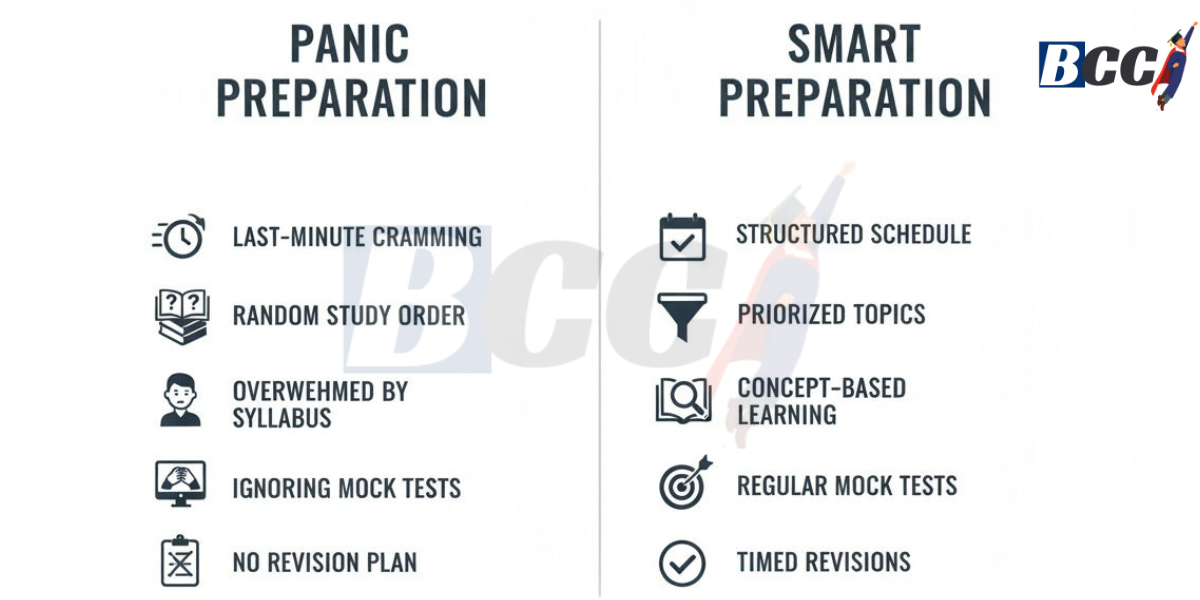
Panic Preparation Looks Like:
- Random topic hopping
- Solving unlimited questions
- Studying without revision
- Following too many sources
Smart Preparation Focuses On:
- High-frequency topics
- Regular revision cycles
- Attempt-based practice
- Mistake analysis
Structured preparation aligned with exam trends consistently beats overworked but directionless study.
What Aspirants Should Do Differently
To handle rising RRB Group D cut-offs, aspirants must shift strategy.
Actionable Steps
- Focus on scoring subjects first
- Improve attempt selection in mocks
- Revise GS and GA frequently
- Track recurring mistakes
- Practice speed without panic
Guided preparation models and structured plans often help aspirants align their effort with exam reality, especially for those stuck near the cut-off.
Conclusion: Cut-Offs Reflect Strategy, Not Just Knowledge
Rising RRB Group D cut-offs are not random or unfair. They are predictable outcomes of easy papers, massive competition, and attempt-based evaluation.
Selection depends less on how much you study and more on how you apply what you know under exam conditions.
In RRB Group D:
- Smart preparation beats hard preparation
- Strategy alignment beats syllabus completion
- Understanding trends beats assumptions
Once aspirants accept this reality, confusion reduces and preparation becomes more focused and effective.
FAQs on Why RRB Group D Cut-Offs Keep Rising
1. Why are RRB Group D cut-offs increasing every year?
Because competition is increasing and more candidates score high marks in easy papers.
2. Does an easy paper guarantee selection?
No. Easy papers increase attempts for everyone, which raises cut-offs.
3. How many questions should I attempt in RRB Group D?
There is no fixed number, but more serious attempts with controlled accuracy are essential in easy papers.
4. Does normalisation reduce my marks?
Normalisation adjusts scores fairly across shifts; it does not arbitrarily reduce marks.
5. Which subject matters most for the Group D cut-off?
General Science and General Awareness often decide the final cut-off due to their scoring nature.